Varshaphala Part 1: What Is the Hindu Progressed Horoscope? Introduction to the Tajaka System
Welcome to the first article in our comprehensive series digitizing B.V. Raman's classic work on the Tajaka system of annual astrology. This series covers every chapter, calculation, and technique from the original text.
Part 1 of 21 • Foundations • Covers: Chapter 1 — Introductory (Articles 1–7)
You know your birth chart. But what does this specific year hold for you?
Your natal horoscope reveals the broad outlines of your life — your temperament, career potential, relationships, and health tendencies. But to know what will happen this year — whether you'll get that promotion, whether your health will improve, whether a child will be born — you need something more precise.
That's where Varshaphala comes in.
Varshaphala (literally "fruit of the year") is the Hindu system of casting and interpreting a Progressed Horoscope — an annual chart erected for the exact moment the Sun returns to its natal position each year.
Known as the sidereal solar return in Western terminology, this chart reveals the events, opportunities, and challenges that await you in the coming year. The system used to interpret it is called Tajaka.
This series is a complete, modern digitization of B.V. Raman's classic exposition on Varshaphala — the first English-language presentation of the Tajaka system, originally published in 1938 and refined over 13 editions spanning five decades of practice. Every calculation, every table, every technique from the original text is covered.
The Three Pillars of Hindu Astrology
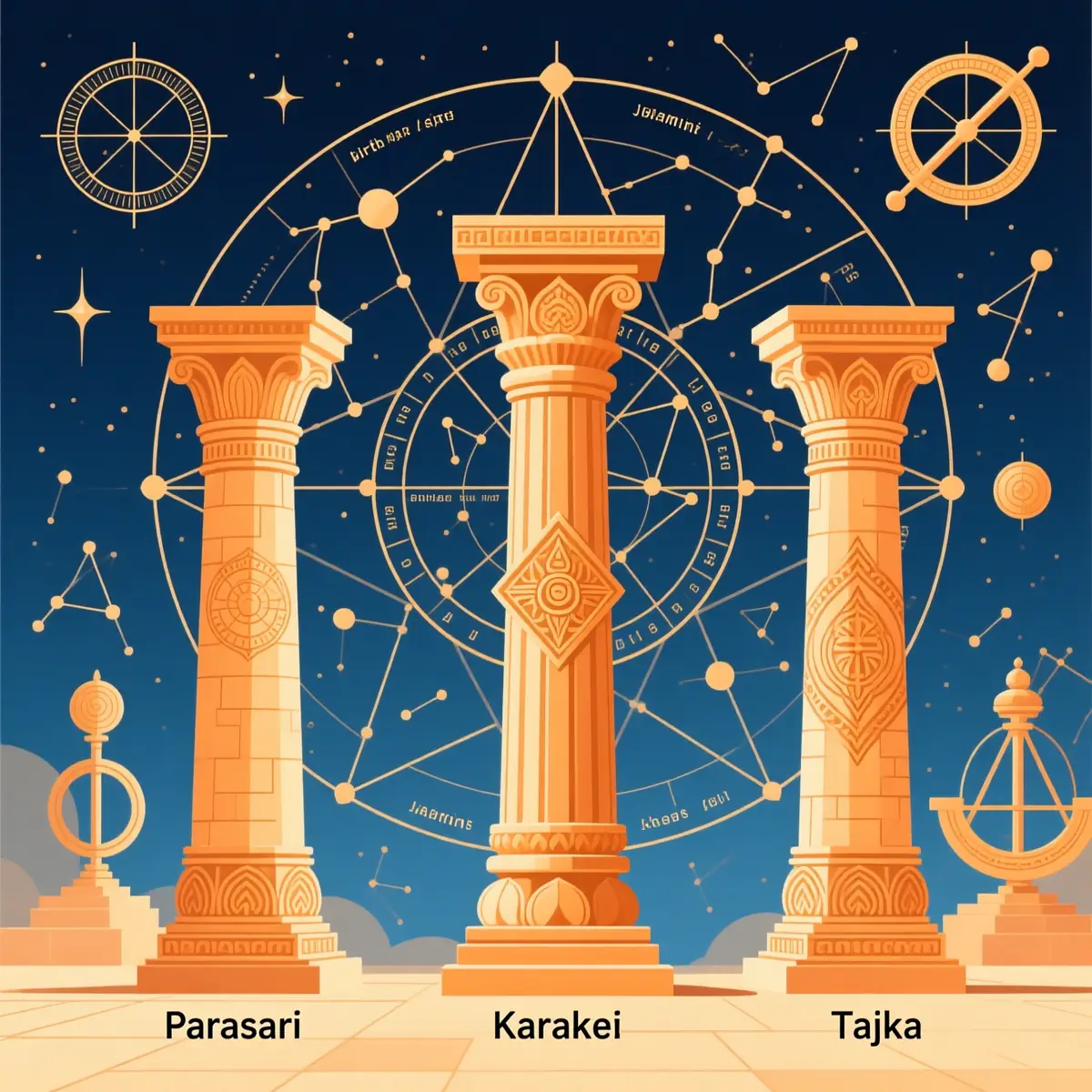
Hindu astrology, broadly speaking, rests on three distinct systems. Each has its own methods, its own masters, and its own strengths. Understanding where the Tajaka system fits within this landscape is essential before diving into its techniques.
Parasari System
The mainstream — used by the vast majority of astrologers
Almost all standard astrological works today follow the Parasari method, expounded by celebrated writers such as Varahamihira, Venkatesa, Kalyanavarma, and many others. When you read a typical Vedic astrology book or get a standard reading, you're almost certainly encountering Parasari principles. It covers natal chart interpretation, planetary periods (Vimshottari Dasa), transits, and the familiar system of planetary friendships and aspects.
Jaimini System
The alternative — different dasas, different interpretation logic
The sage Jaimini, revered as the author of profound philosophical aphorisms, also developed a distinct astrological system. It differs from Parasari in several important respects: the way dasas (planetary periods) are reckoned, how their results are interpreted, and how longevity is calculated. Despite Jaimini's high esteem in Indian intellectual tradition, his astrological system has not been as widely practiced — it's typically employed as an alternative or supplement to Parasari. An English translation of the Jaimini Sutras was made available through the efforts of the late Prof. B. Suryanarain Rao.
Tajaka System This Series
The specialist — dedicated to annual predictions
The Tajaka system is the focus of this entire series. Unlike Parasari and Jaimini, which are general-purpose systems covering all aspects of life prediction, Tajaka is specifically designed for annual readings — forecasting what will happen during a specific year. It uses its own unique methods for aspects, planetary strengths, yogas (special combinations), and timing of events. While the Hindus were aware of this method many centuries before Christ, it was systematized in its current form around 500 B.C.
| Feature | Parasari | Jaimini | Tajaka |
|---|---|---|---|
| Primary Use | Lifetime natal reading | Alternative natal reading | Annual predictions |
| Dasa System | Vimshottari (120-year cycle) | Chara, Sthira Dasas (sign-based) | Varsha Dasa (based on planet longitudes, 1-year cycle) |
| Aspects | Based on aspecting/aspected body relationship | Sign-based aspects | Based on aspect type itself (5/9 = friendly, 4/10 = inimical, etc.) |
| Planet Genders | Masculine, Feminine, Eunuch | Similar to Parasari | Only Masculine and Feminine (no eunuchs) |
| Yogas | Based on specific planet groupings | Own yoga system | Based on mutual aspects — applying, full, separating |
| Strength System | Shadbala (6 sources) | Own strength method | Panchavargeeyabala (5 sources) + Dwadasavargeeyabala (12 sources) |
| Sensitive Points | Not used | Not used | Sahams (35 sensitive points for specific events) |
| Unique Feature | Vimshottari Dasa timing | Karakamsha, Chara Karaka | Muntha (progressed ascendant), Varsheswara (Year Lord) |
| Key Authors | Varahamihira, Venkatesa, Kalyanavarma | Sage Jaimini | Nilakantha, Kesava |
What Makes Tajaka Unique?
The Tajaka system diverges from both Parasari and Jaimini in numerous ways. As you study this series, these differences will become second nature. Here's an overview of the most distinctive features:
In Parasari, planets are classified as masculine, feminine, or eunuch (neuter). Tajaka simplifies this to just two categories:
Strong during DAY
Strong during NIGHT
No eunuchs or hermaphrodites are considered in the Tajaka system.
This is perhaps the most revolutionary difference. In Parasari, whether an aspect is good or bad depends on the relationship between the aspecting and aspected planets. In Tajaka, the nature of the aspect is determined primarily by the type of aspect itself:
| Houses Apart | Aspect Nature | Result |
|---|---|---|
| 5 and 9 (Trine) | Friendly (Mitra) | Realization of desires |
| 3 and 11 (Sextile) | Friendly | Beneficial results |
| 2 and 12 | Neutral (Sama) | Success, happiness |
| 4 and 10 (Square) | Inimical (Satru) | Fear, disappointment |
| 6, 7, 8, 1 | Inimical | Generally harmful |
| Conjunction (same sign) | Destructive | Destruction, disappointment |
A unique mathematical point called Muntha (the progressed ascendant) connects the birth chart to the annual chart. It advances one sign per year from the birth ascendant, creating a direct mathematical link between your permanent natal horoscope and your yearly predictions. This point doesn't exist in the Parasari or Jaimini systems.
The Varsheswara (Year Lord) is the single planet that rules the native throughout the entire year. Determining this planet requires computing the Panchavargeeyabala (five-source strength) of five candidate planets. Most predictions are made on the basis of the Year Lord's strength, position, and aspects. This concept of a single dominant planet for the year is entirely unique to Tajaka.
While each Bhava (house) covers a broad range of life matters, a Saham is a mathematically computed sensitive point that relates to exactly one specific event — marriage, children, disease, fortune, death, foreign travel, and so on. There are up to 50 such points described by various Tajaka authors, of which about 35 are commonly used. These are computed by manipulating the longitudes of specific planets and the ascendant. This concept of event-specific sensitive points is unique to the Tajaka system.
Unlike Parasari yogas which are based on specific fixed planet groupings, the 16 Tajaka Yogas are dynamic combinations based on mutual aspects between planets — specifically, whether planets are applying (approaching each other within their orbs), full (in exact aspect), or separating (moving apart). These include Ithasala (the most important yoga, signifying fulfillment), Easarpha (its opposite, signifying disappointment), and 14 other specialized combinations.
The Masters: Nilakantha and Kesava
While many scholars have written on the Tajaka system, two authors stand above all others as the definitive authorities:
Nilakantha
Considered the most authoritative Tajaka writer
Nilakantha took a distinctive position on planetary friendships, arguing that there are no natural or temporal friendships in Tajaka — friendships arise only through mutual dispositions. His work Tajaka Neelakanthi is the primary source for B.V. Raman's exposition.
Kesava
Systematic codifier of Tajaka techniques
Kesava provides the duration of the solar year used in traditional calculations, as well as detailed planetary friendship and enmity tables. Both scholars made definitive departures from Parasari canons to establish the Tajaka system on its own foundations.
About B.V. Raman's Contribution
Bangalore Venkata Raman (1912–1998), editor of The Astrological Magazine, was the first scholar to present the Tajaka system in English for the educated public. His book, first published in 1938 at the urging of his grandfather, the late Prof. B. Suryanarain Rao, went through 13 editions over five decades. It is essentially a product of Raman's own research in the field of Tajaka, mainly based on Nilakantha with secondary reference to Kesava. This series digitizes that work completely.
Historical Origins: Indigenous or Borrowed?
One scholarly debate surrounds the origins of the Tajaka system. Some argue that it was copied from Greek and Arabian sources, pointing to the non-Indian names of certain yogas and aspects that resemble Ptolemaic configurations.
B.V. Raman takes a different view. He notes that it is equally likely that the system originally developed in India and was transmitted to the Greeks around 2,000 years ago, during the period of extensive intellectual and commercial exchanges between the two civilizations. He points out that the Greek "Lots" (derived from Sun, Moon, Ascendant, and planet positions) and "Terms" found in Greek horoscopes are nothing more than reflections of the Sahams and the Hadda Chakra of the Indian system.
The Cardinal Rule: Never Divorce Birth Chart from Annual Chart
The interpretation of an annual horoscope must always be connected with the birth horoscope. If the one is divorced from the other, the conclusions are bound to prove erroneous.
If children are not indicated in the birth chart, don't predict them from the annual chart — no matter how strong the annual indications are. If a strong constitution is shown in the birth chart, interpret "death" in the annual chart as serious illness with recovery. The birth chart is the supreme authority; the annual chart operates within its boundaries.
Raman discovered this rule through personal experimentation. In his early work, he found that whenever a Progressed Horoscope was interpreted without reference to the birth chart, the results went off the mark. He became fully convinced that the two charts must be harmoniously blended before any predictions are attempted.
Can Tajaka be applied to any age? Some pundits argued that the Tajaka system could only be applied to individuals past age 30. Raman tested this view thoroughly and was never convinced of its soundness. His grandfather, Prof. B. Suryanarain Rao, also held that Tajaka could be applied to charts of individuals of any age.
The Standard Horoscope: Our Running Example
Throughout this series, we will illustrate every technique and calculation using a single reference chart — what B.V. Raman calls the Standard Horoscope. This is the birth chart of a male native, for whom the yearly chart of the 24th year serves as the demonstration case.
| Date of Birth | 8th August 1912 A.D., Thursday |
| Time of Birth | 7:23:06 PM (Local Mean Time) = 33 gh. 52 vig. after sunrise |
| Latitude | 13° North |
| Longitude | 5h 10m 20s East |
| Annual Chart | 24th year (commencing 9 August 1935) |
As we progress through the series, we'll cast this chart (in Part 2), compute its planetary strengths (Parts 4-5), determine its Year Lord (Part 6), calculate its Dasas (Part 7), and interpret its house-by-house results (Parts 15-17). Every calculation will be worked through step by step.
Complete Series Roadmap
This 21-part series covers every chapter and technique from B.V. Raman's Varshaphala. Here's what lies ahead:
What's Next?
You now have a complete overview of the Tajaka system — what it is, how it differs from other Hindu astrological systems, its historical background, and the key concepts you'll be learning throughout this series.
The next step is learning how to actually cast the annual chart. In Part 2, we'll walk through both the traditional calculation method (based on the ancient Suryasiddhanta year duration) and the modern sidereal method that B.V. Raman himself came to prefer after decades of practice.
Two calculation methods, complete year-tables, worked examples, and the Standard Horoscope erected step by step.
Based on
Varshaphala or The Hindu Progressed Horoscope
by B.V. Raman | 13th Edition (1992) | UBS Publishers' Distributors Ltd., New Delhi