Varshaphala Part 5: Panchavargeeyabala — The Five-Fold Strength That Determines Your Year Lord
In Part 4, we learned the 12 Vargas and Dwadasavargeeyabala. Now we tackle the second strength system — the one that directly determines the ruler of your year.
Part 5 of 21 • Technical Framework • Covers: Chapter 3 — Articles 37–46 (Panchavargeeyabala)
The Panchavargeeyabala is the single most important calculation in the Tajaka system. It answers the question: which planet is strongest, and who deserves to rule the year?
While the Dwadasavargeeyabala (from Part 4) tells you whether a planet is inclined to do good or evil, the Panchavargeeyabala measures its actual power. Five specific tests are applied to each planet, and the sum determines which of the five Year Lord candidates is the strongest.
Why This Matters:
The Panchavargeeyabala is needed not only for determining the Year Lord (Part 6) but also for deciding whether any planet is strong, ordinary, or weak throughout your predictions. A planet's strength classification directly affects the results you can expect from it during the year.
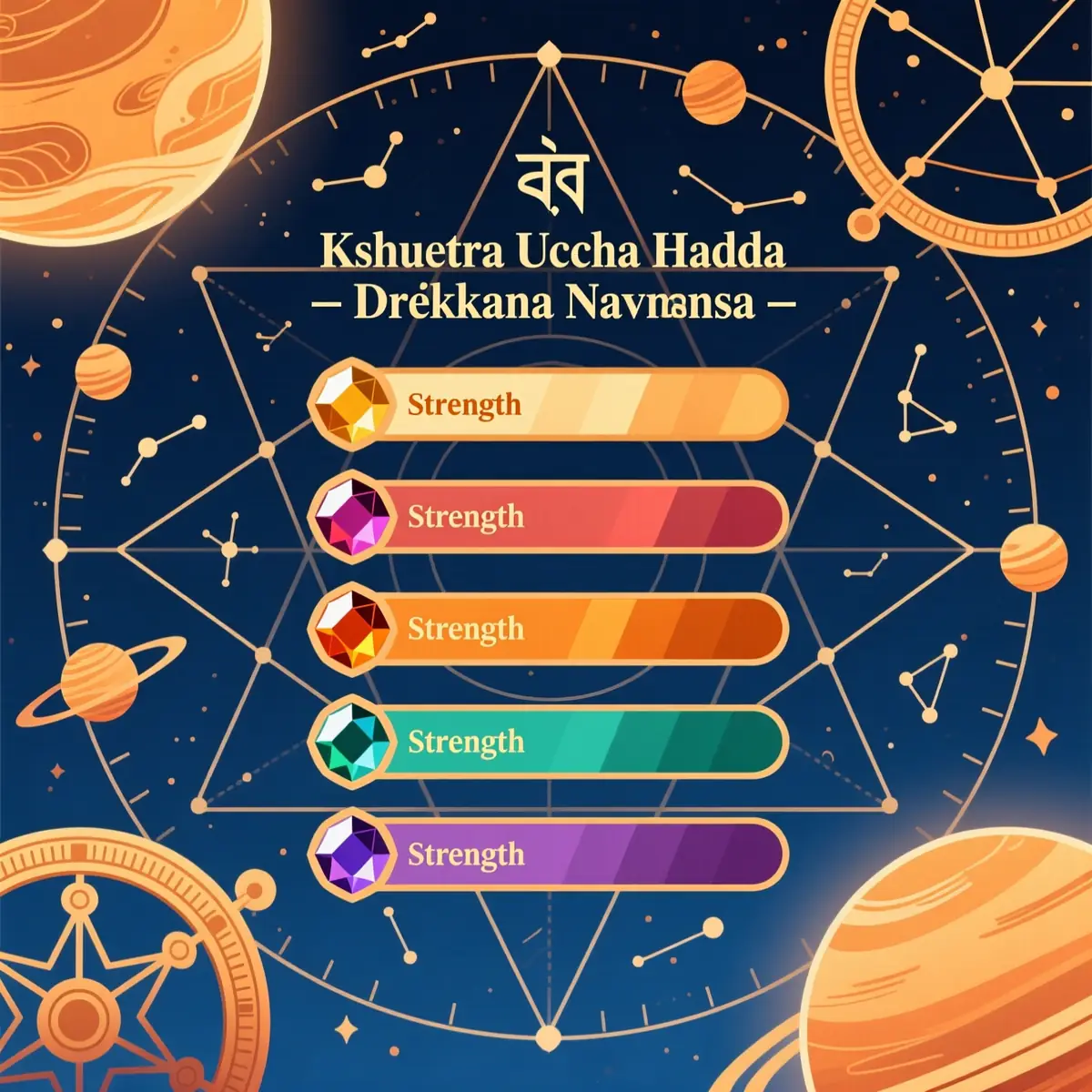
The Five Strength Components
Kshetrabala — Residential Strength
Maximum: 30 unitsThis measures the strength a planet gets from its relationship to the sign (Rasi) it occupies. A planet in its own sign is at home; in a friend's sign, it's comfortable; in an enemy's sign, it's weakened.
| Relationship to Sign | Sanskrit | Strength (Units) |
|---|---|---|
| Own Sign | Swakshetra | 30 |
| Friendly Sign | Mitra Kshetra | 15 |
| Inimical Sign | Satru Kshetra | 7.5 |
Standard Horoscope Example: Saturn is in Aquarius (own sign) = 30.0. Sun is in Cancer (Moon's sign, a friend) = 15.0. Mars is in Libra (Venus's sign, an enemy) = 7.5.
Ochchabala — Exaltation Strength
Maximum: 20 unitsA planet at its exact deep exaltation point gets the full 20 units. As it moves away from exaltation (toward debilitation, which is exactly 180° away), the strength decreases proportionally.
Formula: Ochchabala = (Distance from debilitation point ÷ 180) × 20. If the planet is closer to its debilitation point, the value will be low. At exact debilitation, it gets 0.
Exaltation Degrees of Planets
| Planet | Deep Exaltation | Debilitation (180° away) |
|---|---|---|
| Sun | Aries 10° | Libra 10° |
| Moon | Taurus 3° | Scorpio 3° |
| Mars | Capricorn 28° | Cancer 28° |
| Mercury | Virgo 15° | Pisces 15° |
| Jupiter | Cancer 5° | Capricorn 5° |
| Venus | Pisces 27° | Virgo 27° |
| Saturn | Libra 20° | Aries 20° |
Haddabala — Hadda Subdivision Strength
Maximum: 15 unitsThe Hadda is a special subdivision of each sign into unequal parts, each governed by one of five planets (Mars, Jupiter, Mercury, Venus, Saturn — the Sun and Moon are excluded as Hadda lords). A planet's Haddabala depends on its relationship to the Hadda lord it occupies.
| Relationship to Hadda Lord | Strength |
|---|---|
| Own Hadda (Swa) | 15 |
| Friendly Hadda (Mitra) | 7.5 |
| Inimical Hadda (Satru) | 3.75 |
The Hadda division table (showing the degree ranges and their lords for each sign) is provided in the Reference Guide (Part 21).
Drekkanabala — Drekkana Subdivision Strength
Maximum: 10 unitsBased on the Drekkana (10° division) the planet occupies, as calculated in Part 4. The scoring follows the same pattern as other relationship-based strengths.
| Relationship to Drekkana Lord | Strength |
|---|---|
| Own (Swa) | 10 |
| Friendly (Mitra) | 5 |
| Inimical (Satru) | 2.5 |
Navamsabala — Navamsa Subdivision Strength
Maximum: 5 unitsBased on the Navamsa (3°20' division) the planet occupies. Though this component has the lowest maximum, the Navamsa is the most important single subdivision in all of Hindu astrology.
| Relationship to Navamsa Lord | Strength |
|---|---|
| Own (Swa) | 5 |
| Friendly (Mitra) | 2.5 |
| Inimical (Satru) | 1.25 |
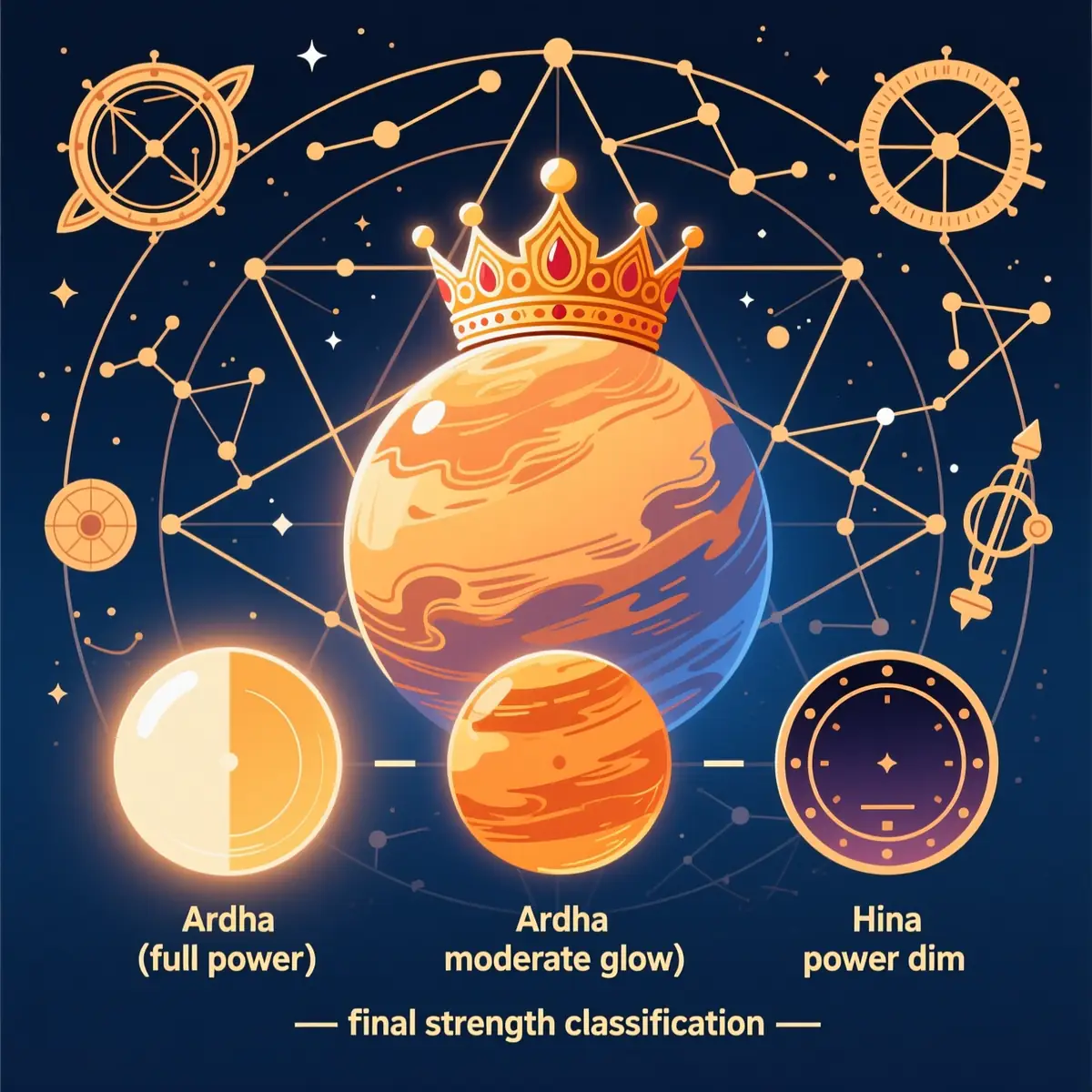
Computing Total Strength and Classification
After computing all five components for each planet, sum them to get the total Panchavargeeyabala. Then divide by 4 to get the classification value:
| PV/4 Value | Classification | Visual |
|---|---|---|
| Below 5 | Weak | |
| 5 to 10 | Ordinary | |
| 10 to 15 | Powerful | |
| 15 to 20 | Very Strong | |
| Above 20 | Extraordinary |
Worked Example: Standard Horoscope Panchavargeeyabala
Here is the complete Panchavargeeyabala computation for all seven planets in the Standard Horoscope's 24th-year chart:
| Planet | Kshtra. (max 30) |
Ochcha. (max 20) |
Hadda. (max 15) |
Drekk. (max 10) |
Navm. (max 5) |
Total PV | PV/4 | Class | Rank |
|---|---|---|---|---|---|---|---|---|---|
| 15.0 | 8.40 | 7.50 | 5.0 | 1.25 | 37.15 | 9.30 | Ordinary | II | |
| 15.0 | 1.60 | 3.75 | 5.0 | 2.50 | 27.85 | 6.97 | Ordinary | IV | |
| 7.5 | 8.51 | 7.50 | 2.5 | 1.25 | 27.26 | 6.81 | Ordinary | V | |
| 7.5 | 14.30 | 3.75 | 2.5 | 2.50 | 30.55 | 7.64 | Ordinary | III | |
| 7.5 | 7.99 | 3.75 | 2.5 | 2.50 | 24.24 | 6.06 | Ordinary | VI | |
| 7.5 | 3.01 | 3.75 | 2.5 | 1.25 | 18.01 | 4.50 | Weak | VII | |
| 30.0 | 7.05 | 3.75 | 5.0 | 1.25 | 47.05 | 11.75 | Powerful | I |
Key Results for the Standard Horoscope:
Saturn is the strongest planet (PV/4 = 11.75, classified as "Powerful"), followed by Sun (9.30), Mercury (7.64), Moon (6.97), Mars (6.81), Jupiter (6.06), and Venus (4.50, the only "Weak" planet).
Saturn's dominance comes primarily from its massive Kshetrabala — it occupies its own sign Aquarius, giving it the full 30 units out of 30 for that component alone.
What's Next?
You now know how to compute every planet's Panchavargeeyabala. Armed with this data, you're ready to determine the most important figure in the annual chart — the Varsheswara, the Lord of the Year.
The five candidates, the Thrirasi lords, the selection algorithm, and why the strongest planet doesn't always win.
Based on
Varshaphala or The Hindu Progressed Horoscope
by B.V. Raman | 13th Edition (1992) | UBS Publishers' Distributors Ltd., New Delhi