Varshaphala Part 6: Finding Your Varsheswara — How to Determine the Lord of the Year
In Part 5, we computed each planet's five-fold strength. Now we use those results to identify the single most important planet in your annual chart — the Varsheswara.
Part 6 of 21 • Technical Framework • Covers: Chapter 4 — Lord or Ruler of the Year (Articles 47–52)
The Varsheswara — the Lord of the Year — is the single planet that dominates your entire annual horoscope. Most predictions in Tajaka astrology are made on the basis of the Varsheswara's strength, position, and aspects.
Selecting the Year Lord isn't as simple as picking the planet with the highest Panchavargeeyabala. It's a multi-step algorithm that considers lordship portfolios, aspect to the ascendant, and relative strength. Let's walk through it completely.
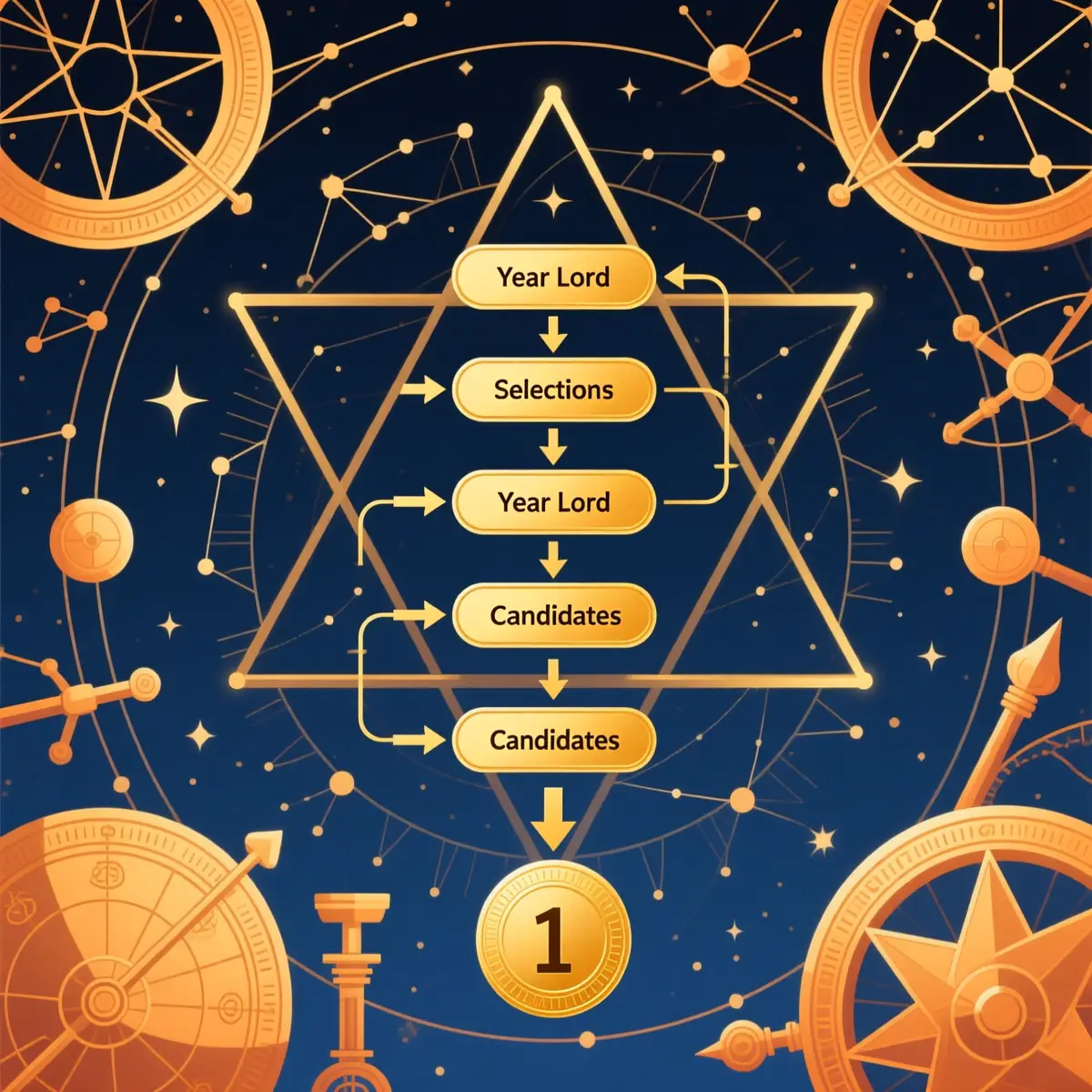
The Five Candidates for Year Lordship
Not all planets compete for the position of Year Lord. Only five specific planets are eligible — those holding one or more of these five "portfolios":
Lord of the sign occupied by the Sun or Moon
If the year commences during daytime, take the lord of the Sun's sign. If during nighttime, take the lord of the Moon's sign in the Progressed Horoscope.
Lord of the Ascendant in the Birth Horoscope
The planet ruling the rising sign at the moment of birth (from the natal/Radix chart).
Lord of the Ascendant in the Progressed Horoscope
The planet ruling the rising sign at the moment the annual chart begins (Varsharambha).
Lord of Muntha
The lord of the sign occupied by Muntha (the progressed ascendant). We'll cover Muntha calculation in Part 8.
Lord of Thrirasi (Thrirasyadhipathi)
A special Tajaka lordship determined by the ascendant of the Progressed Horoscope and whether the year starts during day or night. See the Thrirasi tables below.
The Thrirasi Lords
The Thrirasyadhipathi depends on two factors: (1) the ascending sign of the Progressed Horoscope, and (2) whether the year commences during the day or night. This gives each planet a temporary lordship in addition to its natural one.
| Asc. Sign | Thrirasi Lord |
|---|---|
| Aries, Leo, Sagittarius | Sun |
| Taurus, Virgo, Capricorn | Venus |
| Gemini, Libra, Aquarius | Saturn |
| Cancer, Scorpio, Pisces | Mars |
| Asc. Sign | Thrirasi Lord |
|---|---|
| Aries, Leo, Sagittarius | Jupiter |
| Taurus, Virgo, Capricorn | Moon |
| Gemini, Libra, Aquarius | Mercury |
| Cancer, Scorpio, Pisces | Mars |
The Year Lord Selection Algorithm
Selecting the Year Lord is a multi-criteria decision. Here is the complete algorithm as given by B.V. Raman:
Identify which of the five candidates holds the most lordships over portfolios (a) through (e). A planet that is simultaneously the birth ascendant lord, progressed ascendant lord, AND Muntha lord holds three portfolios.
Does this planet powerfully aspect the ascendant of the Progressed Horoscope? This is critical. A planet that holds many lordships but does NOT aspect the Lagna cannot be the Year Lord.
Among candidates that aspect the Lagna, the one with the highest Panchavargeeyabala wins.
If all planets are equal in lordships, strength, and Lagna aspect, declare the lord of the Sun's sign (day) or Moon's sign (night) as the Year Lord.
Even if a planet holds few lordships and is not the strongest, if it merely aspects the Lagna favorably, it invariably becomes the Year Lord. This is the most remarkable rule — a single favorable aspect to the ascendant can override all other criteria.
Aspecting the Lagna is the single most important criterion. A planet that doesn't aspect the ascendant — no matter how strong or how many lordships it holds — is disqualified. A planet that merely aspects the Lagna favorably, even without lordships or great strength, can become Year Lord.
Worked Example: Standard Horoscope Year Lord
Let's apply the algorithm step by step:
| Portfolio | Description | Planet | PV/4 Score |
|---|---|---|---|
| a | Lord of Sun's sign (daytime: Sun in Cancer) | Moon | 6.97 |
| b | Lord of birth ascendant (Aquarius) | Saturn | 11.75 |
| c | Lord of progressed ascendant (Capricorn) | Saturn | 11.75 |
| d | Lord of Muntha (Capricorn) | Saturn | 11.75 |
| e | Lord of Thrirasi (day, Capricorn rising) | Mars | 6.81 |
1. Lordship count: Saturn holds 3 portfolios (b, c, d). Moon holds 1 (a). Mars holds 1 (e). Saturn leads by a wide margin.
2. Does Saturn aspect the Lagna? Saturn is at 16°55' Aquarius. The Lagna is at 2° Capricorn. Aquarius to Capricorn = 12th house relationship. According to the Tajaka aspect table, the 12th is a neutral/benefic aspect (2/12 category). However, in practice, Saturn being in the sign just behind the ascendant does not constitute a powerful direct aspect. Saturn does NOT powerfully aspect the Lagna.
3. Check remaining candidates: Moon (in Scorpio) and Mars (in Libra) both aspect the Lagna (Capricorn). Moon's aspect (from Scorpio to Capricorn = 3/11 sextile) is favorable. Mars's aspect (from Libra to Capricorn = 4/10 square) is inimical.
4. Decision: The Moon aspects the Lagna favorably. Mars aspects it but offensively. Therefore, the Moon is the Year Lord, despite having only one portfolio and lower Panchavargeeyabala than Saturn.
Additional note from Raman: The Moon's aspect to the Lagna, though not falling strictly within the orb, can still be considered a valid aspect — Nilakantha teaches that even out-of-orb aspects have moderate influence (madhyamam drikphalam). In the Tajaka system, this moderate sextile aspect is sufficient to qualify the Moon as Year Lord.
What's Next?
You now know the Year Lord. But knowing what will happen isn't useful without knowing when. The Varsha Dasa system divides the year into planetary sub-periods, enabling precise event timing.
How the year is divided into planetary periods based on longitude, with complete calculation method and worked examples.
Based on
Varshaphala or The Hindu Progressed Horoscope
by B.V. Raman | 13th Edition (1992) | UBS Publishers' Distributors Ltd., New Delhi