Prasna Marga Chapter 6: The Five Sutras - A Modern Guide
A chapter-by-chapter modern English guide to the classical Vedic astrology text by Harihara, translated by B.V. Raman.
Chapter 6 of 32 • Stanzas 1–67 • Topics: Five Sutras, Jeeva-Roga-Mrityu Classification, Thrisphuta Analysis, Disease Timing, Planetary Dasa
Chapter 6 introduces the most important diagnostic tool in Prasna astrology: the Five Sutras . These are five different formulaic "threads" (sutra literally means "thread") that the astrologer weaves together to determine whether a situation leads to life , disease , or death .
Think of the Five Sutras as five independent diagnostic tests, each using different astrological inputs. When multiple sutras agree on the same verdict, the prediction gains strength. The chapter then expands into the powerful Thrisphuta (Triple Point) system for timing events, identifying diseases, and predicting outcomes.
"The effect of Jeeva Sutra is long life and recovery from sickness. Roga Sutra indicates prolongation of illness and attack from fresh diseases. The effect of Mrityu Sutra is death."
1. The Five Sutras Defined
Prasna Marga, Chapter VI, Stanzas 1–4
Each Sutra is determined by a specific pair of astrological reference points and is linked to one of the five elements ( Pancha Bhuta ):
| Sutra | Determined By | Element |
|---|---|---|
| Samanya (General) | Arudha Rasi + Rising Lagna | Earth (Prithvi) |
| Adhipati (Lordship) | Lords of Arudha + Lords of Lagna | Water (Jala) |
| Amsaka (Division) | Lagna Navamsa + Arudha | Fire (Agni) |
| Nakshatra (Star) | Birth Nakshatra + Query-time Nakshatra | Ether (Akasa) |
| Maha (Great) | Arudha + 10th from Arudha | Air (Vayu) |
Modern context: Think of each Sutra as a different "lens" through which the astrologer examines the same question. The Samanya uses the signs themselves, the Adhipati uses their rulers, the Amsaka uses divisional charts, the Nakshatra uses the lunar mansions, and the Maha uses house relationships. By cross-referencing five different approaches, the system reduces the chance of error.
2. The Three Verdicts: Jeeva, Roga, Mrityu
Prasna Marga, Chapter VI, Stanzas 5–14
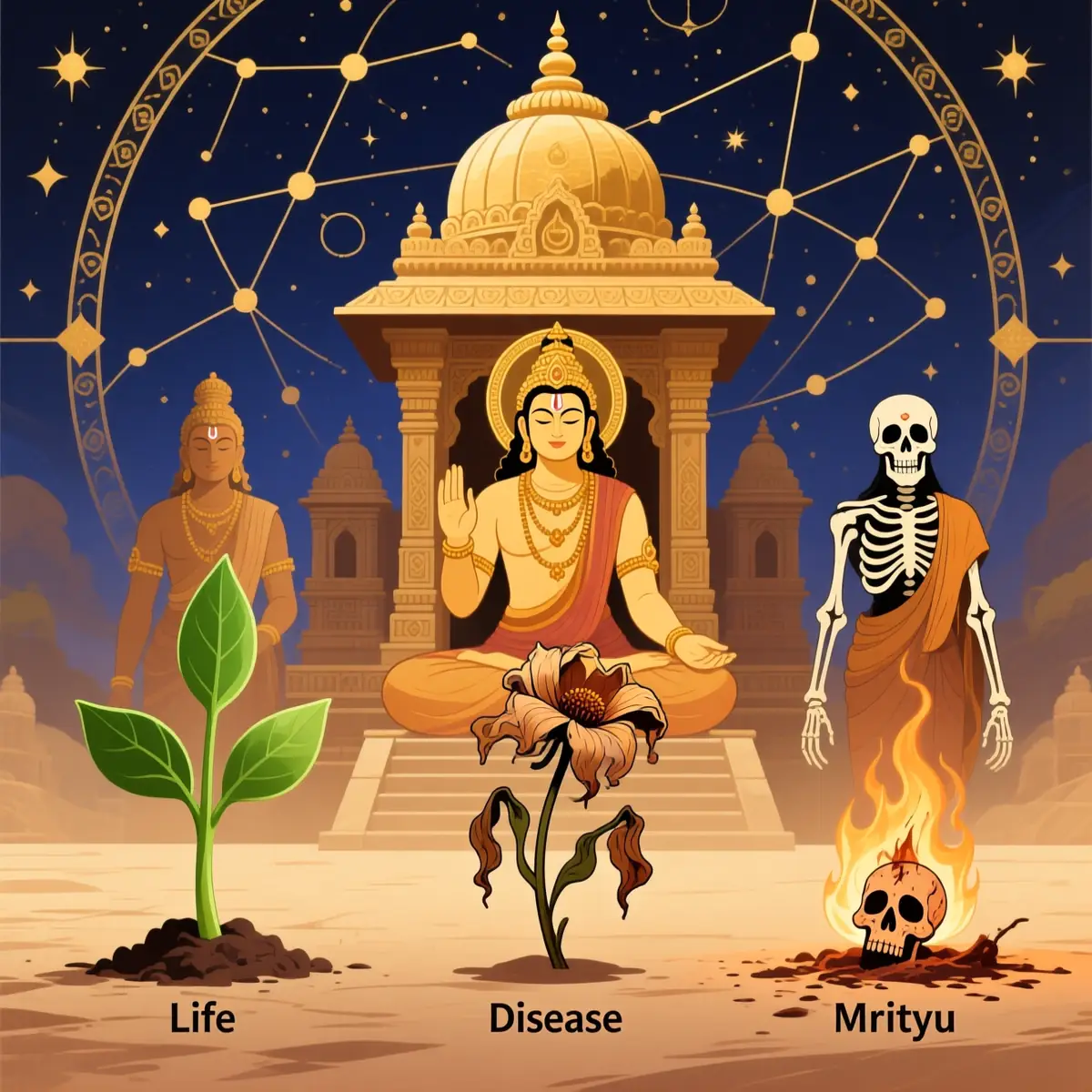
Each Sutra produces one of three possible outcomes. The method varies by Sutra type, but the result is always one of:
Jeeva
"Life"
Long life, recovery from illness, success in undertakings
Roga
"Disease"
Prolonged illness, fresh diseases, loss of money, mental worry
Mrityu
"Death"
Death, failure in undertakings, fear, mental derangement
How Each Sutra Is Classified
For Samanya Sutra (sign-based):
| Sign Combination (Arudha + Lagna) | Verdict |
|---|---|
| Both movable, OR one common + one fixed | Jeeva |
| Both common, OR one movable + one fixed | Roga |
| Both fixed, OR one movable + one common | Mrityu |
For Adhipati Sutra (lordship-based):
| Relationship Between Lords | Verdict |
|---|---|
| Same lord, or mutual friends | Jeeva |
| Neutral to each other | Roga |
| Enemies to each other | Mrityu |
For Nakshatra Sutra (star-based):
| Method | Verdict |
|---|---|
| Count from Lagna Nakshatra to Birth Nakshatra, divide by 3: remainder 1 | Jeeva |
| Remainder 2 | Roga |
| Remainder 0 | Mrityu |
For Maha Sutra (lunar/solar-based):
| Arudha + 10th from Arudha | Verdict |
|---|---|
| Both lunar signs | Jeeva |
| One lunar, one solar | Roga |
| Both solar signs | Mrityu |
3. Elements, Body Parts, and Disease Types
Prasna Marga, Chapter VI, Stanzas 15–22
When a Sutra indicates Roga (disease), the element (Bhuta) associated with that Sutra tells the astrologer what kind of disease is involved:
| Element | Body Parts Governed | Disease Type |
|---|---|---|
| Earth (Samanya) | Flesh, bones, skin, veins, hair | Structural / physical ailments |
| Water (Adhipati) | Blood, urine, sweat, saliva, seminal fluid | Fluid-related / circulatory disorders |
| Fire (Amsaka) | Hunger, thirst, sleep, bodily splendour, dullness of mind | Metabolic / digestive / mental issues |
| Air (Maha) | Movement, throbbing of limbs, shaking of body | Neurological / movement disorders |
| Ether (Nakshatra) | Affection, hatred, infatuation, fear, old age | Psychological / emotional / age-related |
Modern context: This elemental mapping of body systems is remarkably close to Ayurvedic medicine, which also classifies diseases by their elemental nature. The correlation between earth and structural tissue, water and bodily fluids, fire and metabolism, air and nervous function, and ether and mental/emotional states reflects a unified medical-astrological worldview.
4. Which Sutra Tells Past, Present, or Future?
Prasna Marga, Chapter VI, Stanzas 23–24
Each Sutra is keyed to a time dimension:
| Time | Sutras |
|---|---|
| Past | Samanya Sutra |
| Present | Nakshatra & Adhipati Sutras |
| Future | Amsaka & Maha Sutras |
Additionally, planetary positions in houses indicate timing:
- Houses 1–4: Events happening now (present)
- Houses 5–8: Events yet to come (future)
- Houses 9–12: Events already occurred (past)
This gives the astrologer a way to validate their reading — if the Past Sutra (Samanya) indicates Roga, the astrologer can tell the client about a past illness, and the client can confirm whether this is correct. This builds trust before delivering predictions about the future.
5. When Sutras Disagree — Remedies and Hope
Prasna Marga, Chapter VI, Stanzas 25–27
What happens when the five Sutras give mixed results? The text provides clear guidance:
- All Mrityu: If multiple Mrityu Sutras with additional afflictions (malefic planets, bad houses), death is certain
- All Jeeva: If Jeeva Sutras with benefic dispositions, recovery is certain even from serious illness through remedial measures
- Mixed results: Recovery is possible through remedies (prayers, rituals, medical treatment)
"If there is a combination of Jeeva and other sutras, then there will be recovery by recourse to remedial measures."
Modern context: This is an important philosophical point. Even in a system that can predict death, the text acknowledges that mixed signals leave room for intervention. Remedial measures — whether spiritual (mantras, prayers), practical (Ayurvedic medicine), or behavioral — can alter outcomes when the astrological indicators are not unanimously negative.
6. Thrisphuta — The Triple Point System
Prasna Marga, Chapter VI, Stanzas 28–35
The Thrisphuta (Lagna + Moon + Gulika, calculated in Chapter 5) now becomes a powerful analytical tool. Where it falls in the zodiac reveals the severity and timing of events.
Danger Zones
When Thrisphuta falls in the water signs , trouble intensifies:
| Thrisphuta in... | Severity | If in last Navamsa... |
|---|---|---|
| Cancer | Intense trouble | Death within 1 year |
| Scorpio | More intense | Death within 1 month |
| Pisces | Most intense | Death within 1 day |
Creative, Protective, and Destructive Areas
The zodiac is divided into three functional zones:
Creative (Srishti)
Movable signs
(Aries, Cancer, Libra, Capricorn)
Favorable — longevity
Protective (Sthiti)
Fixed signs
(Taurus, Leo, Scorpio, Aquarius)
Stable — maintenance
Destructive (Samhara)
Common signs
(Gemini, Virgo, Sagittarius, Pisces)
Unfavorable — evil only
Additional Thrisphuta Indicators
- If Thrisphuta falls in the questioner's birth Rasi → death
- If Thrisphuta falls in Aries/Leo/Sagittarius Navamsa → long life
- If Gulika or malefic planets occupy the Thrisphuta → evil omen
- If Thrisphuta shares the same Nakshatra as a family member → that person falls ill
- If benefic planets or creative signs accompany Thrisphuta → longevity
7. Planets and the Diseases They Cause
Prasna Marga, Chapter VI, Stanzas 36–37, 61–64
Each planet, when associated with the Thrisphuta or its Navamsa lord, indicates a specific type of disease:
| Planet | Disease Indicated |
|---|---|
| Sun | Fever, internal heat, headaches from heat, brain fatigue |
| Moon | Dysentery, fluid-related disorders |
| Mars | Sores, wounds, injuries |
| Mercury | Speech disorders, inability to think or talk, visual problems |
| Jupiter | Weakness of eyes, full-body pain, mental upset |
| Venus | Mental illness, body pains, swelling |
| Saturn | Disorders of hands and legs, disability |
| Rahu | Falls from elevated places |
| Ketu | Wounds (similar to Mars) |
8. Prana, Deha, and Mrityu — Life, Body, Death
Prasna Marga, Chapter VI, Stanzas 44–49
The chapter revisits the Prana-Deha-Mrityu system from Chapter 5 with refined interpretation rules:
"If Pranasphuta and Dehasphuta mutually aspect or combine, and they are free from the aspect or association of Mrityusphuta, then predict long life. If Dehasphuta is afflicted by Mrityusphuta, predict long sickness."
Navamsa Sign Type Interpretation
| Navamsa Sign Type | Prediction |
|---|---|
| Movable | Sound health |
| Fixed | Sickness |
| Common | Death |
Sukshma (Refined) Calculations
The Sukshma method recalculates these Sphutas with different multipliers:
- Prana Sphuta: (Lagna × 5) + Gulika
- Deha Sphuta: (Moon × 8) + Gulika
- Mrityu Sphuta: (Gulika × 7) + Sun
If the Mrityu Sphuta is the strongest of the three, or falls in specific "death Nakshatras" (Aslesha, Jyeshta, or Revati — the last star of each Nakshatra group), death is indicated.
Who Is Affected?
The planet associated with the Sukshma Thrisphuta indicates who in the family is affected:
| Planet | Family Member Affected |
|---|---|
| Sun | Father |
| Moon | Mother |
| Mercury | Uncle / maternal relative |
| Mars | Brothers |
| Jupiter | Son / children |
| Venus | Wife (or husband in a woman's chart) |
| Saturn | Servants / employees |
| Rahu + Gulika | The questioner themselves |
| Gulika alone | The astrologer |
| Ketu | The person who placed the gold coin |
9. Nakshatra Events — Signs That Confirm Death
Prasna Marga, Chapter VI, Stanzas 56–60
The text provides a remarkable system of confirmatory signs . If a certain event occurs on the specific Nakshatra day predicted by the Thrisphuta, it confirms the death prediction. The 27 Nakshatras are grouped into 9 sets of 3:
| Nakshatra Group | Confirmatory Event |
|---|---|
| Aswini, Makha, Moola | Quarrel within 3 days |
| Bharani, Pubba, Poorvashadha | A poor Brahmin arrives |
| Krittika, Uttara, Uttarashadha | Fire or conflagration |
| Rohini, Hasta, Sravana | Loss of vessels or cloth |
| Mrigasira, Chitra, Dhanishta | Sickness or wounds |
| Aridra, Swati, Satabhisha | A serpent is seen |
| Punarvasu, Visakha, Poorvabhadra | A noble Brahmin visits |
| Pushyami, Anuradha, Uttarabhadra | A four-legged animal dies or a servant falls |
| Aslesha, Jyeshta, Revati | A light is extinguished or news of death arrives |
If the predicted event occurs on the correct Nakshatra day, it serves as an external confirmation that the death prediction is accurate.
10. Thrisphuta Dasa — The One-Year Timeline
Prasna Marga, Chapter VI, Stanzas 65–67
The chapter concludes with a timing system. Unlike the standard 120-year Vimshottari Dasa used in birth astrology, Prasna uses a compressed one-year cycle (360 days) calculated from the Thrisphuta Nakshatra:
| Planet | Dasa Period |
|---|---|
| Sun | 18 days |
| Moon | 30 days |
| Mars | 21 days |
| Rahu | 54 days |
| Jupiter | 48 days |
| Saturn | 57 days |
| Mercury | 51 days |
| Ketu | 21 days |
| Venus | 60 days |
| Total | 360 days |
The sequence follows the same Vimshottari order (Sun → Moon → Mars → Rahu → Jupiter → Saturn → Mercury → Ketu → Venus). During the Dasa of a malefic planet that is lord of the 6th, 8th, or 12th from Arudha, or is debilitated or combust, unfavorable events are predicted.
For monthly predictions , the annual Dasa is divided by 4.
Key Takeaways from Chapter 6
- The Five Sutras are five independent diagnostic tests that each produce a verdict of Jeeva (life), Roga (disease), or Mrityu (death).
- Each Sutra is linked to an element that identifies the type of disease: Earth (structural), Water (fluid), Fire (metabolic), Air (neurological), Ether (emotional).
- The Sutras have time signatures : Samanya = past, Nakshatra/Adhipati = present, Amsaka/Maha = future.
- Mixed results leave room for remedies. Only when all Sutras unanimously indicate Mrityu with additional afflictions is the prediction considered certain.
- The Thrisphuta in water signs (Cancer, Scorpio, Pisces) indicates danger, with Pisces being the most severe.
- Each planet indicates a specific disease and a specific family member who may be affected.
- Confirmatory events on specific Nakshatra days validate or invalidate death predictions.
- The Prasna Dasa compresses the standard 120-year cycle into 360 days for short-term timing.
Try Prasna Marga Calculations
Experience the Five Sutras and Thrisphuta system with our free Horary Astrology tool, which applies these ancient diagnostic methods automatically.
If there is a combination of Jeeva and other sutras, there will be recovery