Prasna Marga Chapter 5: Mathematical Foundations - A Modern Guide
A chapter-by-chapter modern English guide to the classical Vedic astrology text by Harihara, translated by B.V. Raman.
Chapter 5 of 32 • Stanzas 1–32 • Topics: Lagna Calculation, Moon's Position, Gulika, Sphuta Combinations, Mrityu Chakra, Arudha
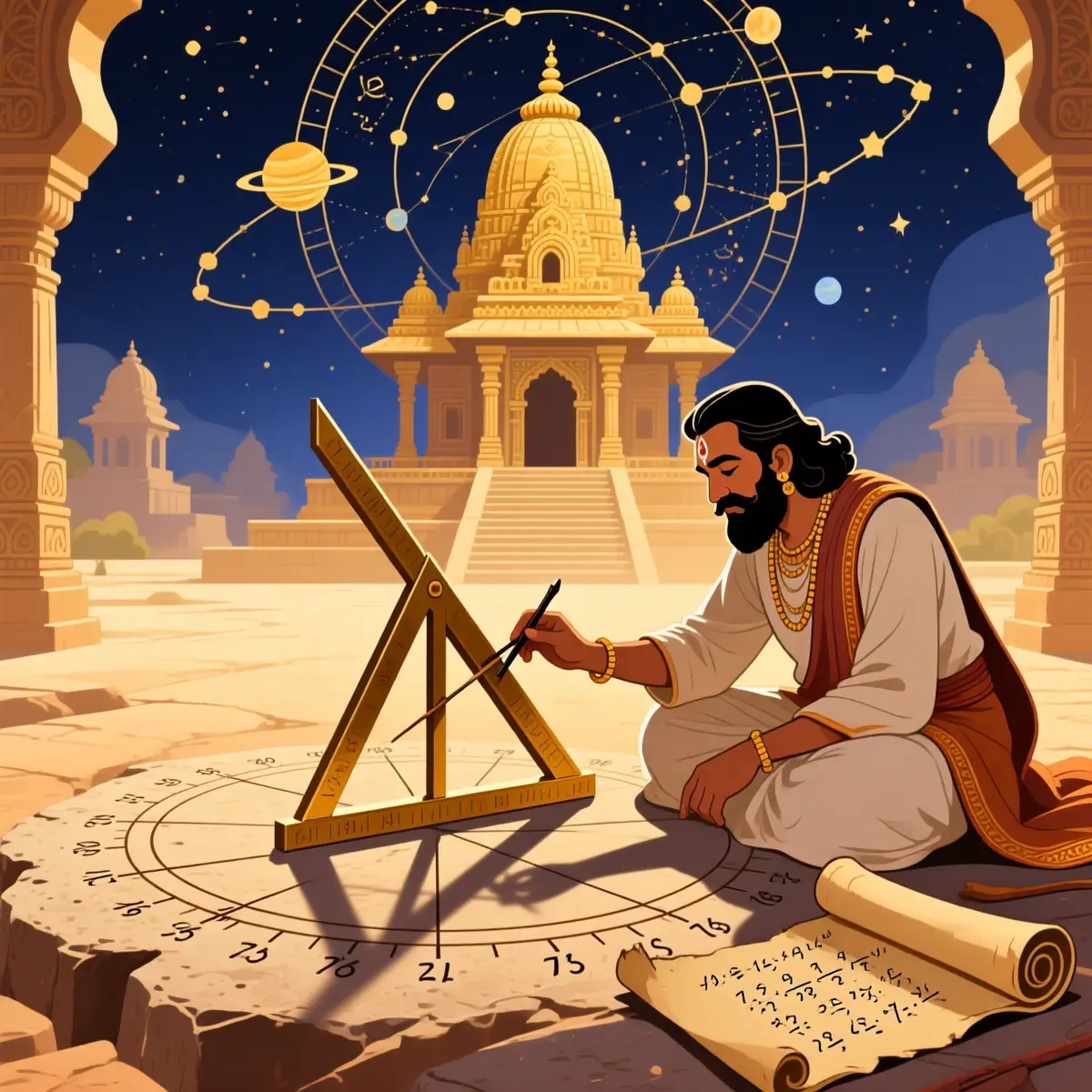
Chapter 5 is the mathematical engine room of Prasna Marga. After the ceremonial preparation (Chapters 1–4), the astrologer now needs precise astronomical data to begin interpretation. This chapter explains how to calculate the key reference points: the Ascendant (Lagna), the Moon's position, the malefic sub-planet Gulika, and several composite longitude values called Sphutas .
Many of the original calculation methods (using shadow lengths, gnomon rods, and ancient vakya formulas) are now obsolete — B.V. Raman himself notes this repeatedly in his commentary. Modern ephemerides and software provide far greater accuracy. However, the concepts behind these calculations remain essential to understanding Prasna astrology.
"Without knowing correctly the exact rising sign at the time of a question, no prediction is possible."
1. Why Accurate Lagna Is Everything
Prasna Marga, Chapter V, Stanzas 1–2
The chapter opens with a bold declaration: without knowing the exact rising sign (Lagna) at the time of the question, no prediction is possible . This has been "repeatedly explained" in earlier treatises and the author stresses it again here.
"The astrologer's statement can never be fruitless if he has studied well the astronomical and astrological treatises and if he has correctly calculated the Lagna."
Modern context: This principle is the foundation of all Prasna (horary) astrology. The Lagna is like the "timestamp" of the question — it freezes the sky at the exact moment of inquiry. Everything else (house positions, planetary aspects, Dasa periods) depends on getting this right. Today, accurate Lagna calculation is trivially easy with software, but in the author's time it required complex observational methods.
2. Calculating Lagna from the Sun's Shadow
Prasna Marga, Chapter V, Stanzas 3–7
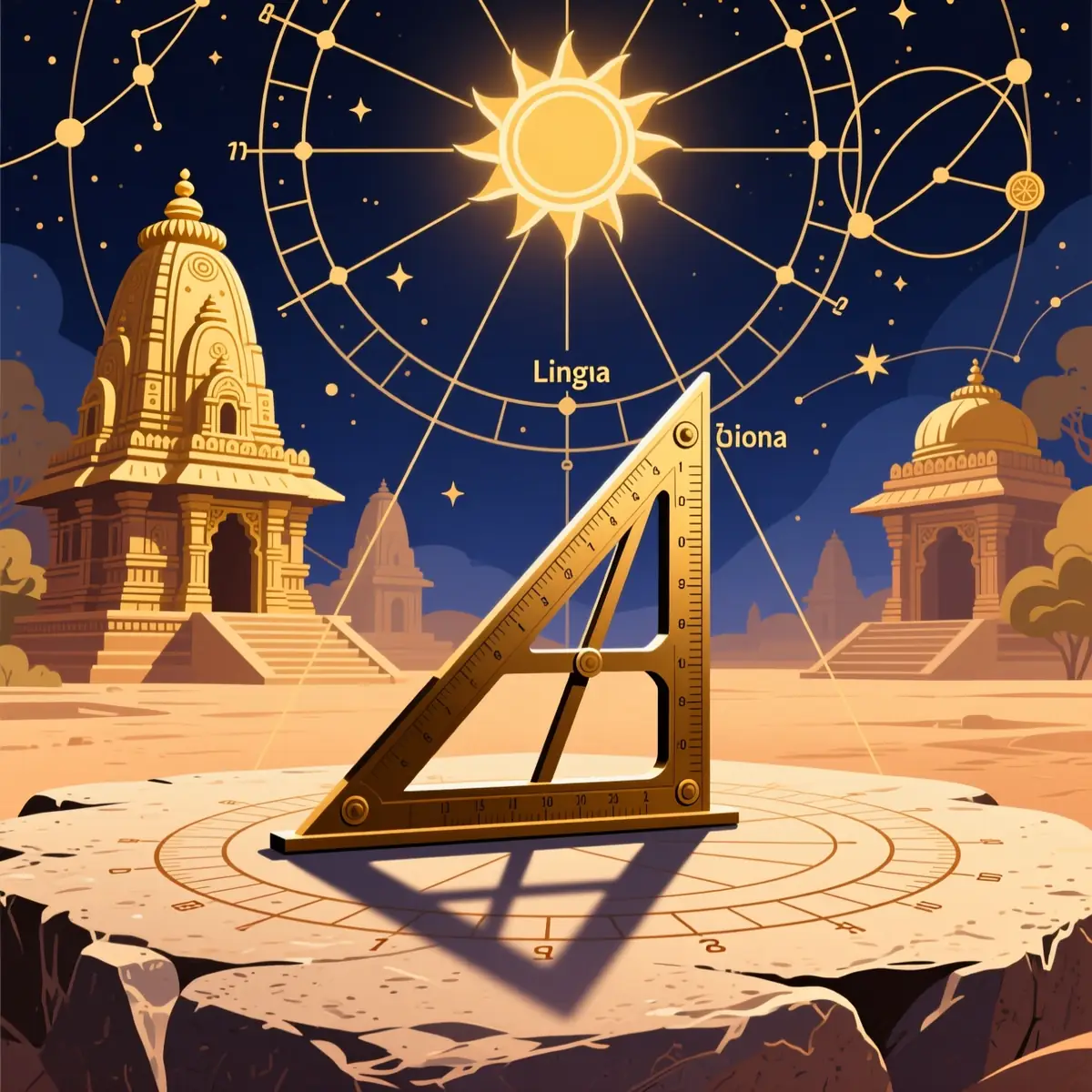
The ancient method for determining the Ascendant used a gnomon (a vertical rod of 12 digits placed at the center of a circle drawn on level ground). The astrologer would:
- Note the length of the gnomon's shadow at the time of the query
- Use vakyas (astronomical formulas in terse Sanskrit sutras) to convert the shadow length to elapsed time
- Calculate the Sun's position and find the balance of the current sign
- Work through subsequent signs until the exact Lagna degree is determined
Vakyas were astronomical formulas compressed into memorable Sanskrit phrases. For example, there are 248 lunar vakyas that give the Moon's anomalies, enabling the calculation of the Moon's geocentric longitude at sunrise on any day. These were still in use in parts of Kerala when B.V. Raman translated the text.
3. Verifying Lagna with the Kunda Method
Prasna Marga, Chapter V, Stanzas 8–9
Once the Lagna is calculated, the text provides a clever verification method using the questioner's birth constellation (Nakshatra):
- Multiply the Lagna longitude (in minutes of arc) by 81 (this is the Kunda)
- Remove all multiples of 12
- From the remainder, find the corresponding Nakshatra
- If this Nakshatra matches the questioner's birth Nakshatra (or its trines), the Lagna is correct
- If not, adjust by 10 minutes of arc per Nakshatra difference
Example
- Lagna = 11°34' = 694 minutes
- 694 × 81 = 56,214
- 56,214 ÷ 12 = remainder 6 → Aridra Nakshatra
- Birth star is Mrigasira (one star away from Aridra)
- Correction: subtract 10 minutes → Lagna = 11°24'
The principle: In Prasna astrology, there is a deep belief that the moment of the question is karmically linked to the questioner. Therefore, the Lagna at the time of the question should mathematically "resonate" with the questioner's birth data. This Kunda method is a built-in cross-check.
4. Calculating the Moon's Position
Prasna Marga, Chapter V, Stanzas 10–13
The Moon's exact longitude is critical in Prasna because it determines the Nakshatra, Tithi, and several Sphuta calculations. The text describes how to convert the Moon's position from the Parahita system (an older Kerala-based calculation method) to the more accurate Drigganita (observational) system.
The correction involves:
- Adding 24 minutes to the Parahita Moon
- Applying a variable correction (1, 3, 4, 5, 6, 5, 4, 3, 1) based on the Sun's position in 10-day intervals
- The correction is negative for certain zodiac ranges and positive for others
Modern context: The Parahita system was a Kerala-specific astronomical tradition. The correction factors described here were essentially trying to bridge the gap between two different calculation paradigms — similar to how modern astronomers apply corrections between different reference frames (geocentric vs heliocentric, tropical vs sidereal). Today, accurate Moon positions are available from any ephemeris to arc-second precision.
5. Gulika and Mandi — Saturn's Shadow Points
Prasna Marga, Chapter V, Stanzas 14–16
Gulika and Mandi are not physical planets but mathematically derived points, both considered "sons of Saturn" and carrying malefic influence. There is scholarly debate about whether they are the same point or different ones — the author of Prasna Marga treats them as identical.
How Mandi Is Calculated
The day (sunrise to sunset) is divided into 8 equal parts. Each part is ruled by a planet, starting from the weekday lord. Mandi's position corresponds to the Ascendant rising at the end of Saturn's portion .
| Weekday | Daytime: Mandi at end of... | Nighttime: Mandi at end of... |
|---|---|---|
| Sunday | 26 ghatikas after sunrise | 10 ghatikas after sunset |
| Monday | 22 ghatikas | 6 ghatikas |
| Tuesday | 18 ghatikas | 2 ghatikas |
| Wednesday | 14 ghatikas | 26 ghatikas |
| Thursday | 10 ghatikas | 22 ghatikas |
| Friday | 6 ghatikas | 18 ghatikas |
| Saturday | 2 ghatikas | 14 ghatikas |
These values assume a standard day of 30 ghatikas (12 hours). If the actual day is longer or shorter, the values must be proportionally adjusted.
How Gulika Differs
While Mandi uses fixed time offsets, Gulika is found by dividing the day into 8 equal muhurthas and identifying which one belongs to Saturn. The Ascendant at the end of Saturn's muhurtha gives Gulika's longitude.
Why it matters: Gulika plays a crucial role in Prasna. It appears in Sphuta calculations, the Mrityu Chakra (Death Circle), and is used as a timing indicator throughout later chapters. A planet conjunct Gulika is weakened; a house occupied by Gulika suffers.
6. The Five Sphuta Combinations
Prasna Marga, Chapter V, Stanzas 17–18
A Sphuta is a "refined" or "exact" longitude. The text builds up a series of composite Sphutas by progressively adding planetary longitudes together. Think of these as combined energy points that synthesize multiple astrological factors into single reference values.
Lagna + Moon + Gulika
Thrisphuta + Sun
Chatusphuta + Rahu
Worked Example
Given: Sun = 301°12', Moon = 18°29', Lagna = 43°9', Gulika = 64°26', Rahu = 6°9'
- Thrisphuta: 43°9' + 18°29' + 64°26' = 126°4'
- Chatusphuta: 126°4' + 301°12' = 427°16' − 360° = 67°16'
- Panchasphuta: 67°16' + 6°9' = 73°25'
Always expunge multiples of 360°.
These Sphutas are used in later chapters to assess the overall condition of the questioner and the likely outcome of the query.
7. Prana, Deha, and Mrityu Sphutas
Prasna Marga, Chapter V, Stanzas 19–23
Three special Sphutas represent the vital dimensions of life:
Prana Sphuta
"Life Breath"
(Lagna × 5) + Gulika
Deha Sphuta
"Body"
(Moon × 8) + Gulika
Mrityu Sphuta
"Death"
(Gulika × 7) + Sun
An alternative method for Prana Sphuta uses the time of the question itself:
- Multiply Prasna ghatis by 120
- Divide by the duration of the day
- Add the Sun's longitude
-
Adjust based on the Sun's sign type:
- Fixed sign: subtract 4 signs (120°)
- Common sign: add 4 signs (120°)
- Movable sign: no adjustment
Mrityu and Kala Sphutas from Time
Additional death-related Sphutas are calculated using the query time and weekday:
| Weekday | Add to Y for Mrityu Sphuta |
|---|---|
| Sunday | 1 sign (30°) |
| Monday | 10 signs (300°) |
| Tuesday | 2 signs 15° (75°) |
| Wednesday | 5 signs 5° (155°) |
| Thursday | 4 signs (120°) |
| Friday | 7 signs (210°) |
| Saturday | 8 signs 15° (255°) |
Where Y = (Prasna ghatis × 35) ÷ duration of day. For Kala Sphuta, subtract instead of adding the same values.
8. The Sun-Moon-Rahu Chakra
Prasna Marga, Chapter V, Stanzas 24–26
This is a special chart that tracks the assumed (not actual) positions of the Sun, Moon, and Rahu through the zodiac during the course of a day:
- Sun: Assumed to move retrograde starting from Sagittarius, spending 2½ ghatikas (1 hour) in each sign
- Moon: Always placed in the 7th house from the Sun's assumed position
- Rahu: Follows a specific irregular sequence through 12 signs (Capricorn → Leo → Cancer → Aries → Scorpio → Libra → Cancer → Aquarius → Capricorn → Libra → Taurus → Aries)
Positions at Sunrise
- Sun: Sagittarius
- Moon: Gemini (7th from Sagittarius)
- Rahu: Capricorn (first in the sequence)
The detailed use of this Chakra is explained in Chapter 8.
9. The Mrityu Chakra (Death Circle)
Prasna Marga, Chapter V, Stanzas 27–28
The Mrityu Chakra is a specialized chart used to assess the danger of death. It projects the Sun, Moon, and Gulika into a separate framework where their interactions indicate mortal risk.
How to Calculate
-
Find the Mrityu Rasi (Death Sign):
Convert the query time from
ghatikas into vighatikas, divide by 15. The result gives the longitude
of the death sign.
-
Find the Navamsa position
of the Sun, Moon, and Gulika
-
Combine:
Add the Mrityu Rasi to the Navamsa position of the Sun and Moon;
subtract
the Mrityu Rasi from Gulika's Navamsa position
Interpretation Rules
Certain Death
Mrityu Gulika conjunct Mrityu Sun in the same Rasi
Great Fear
Mrityu Gulika conjunct Mrityu Moon in the same Rasi
Improvement
Mrityu Gulika stands alone (no conjunction)
Certain Death
Mrityu Gulika conjunct Mrityu Sun in the same Rasi
Great Fear
Mrityu Gulika conjunct Mrityu Moon in the same Rasi
Improvement
Mrityu Gulika stands alone (no conjunction)
Modern context: The Mrityu Chakra is still used by traditional horary astrologers, particularly in Kerala, when the question relates to the health or survival of a seriously ill person. B.V. Raman notes that research-minded students can also study its implications in birth horoscopes.
10. Planetary Accuracy and the Arudha Position
Prasna Marga, Chapter V, Stanzas 29–32
The chapter concludes with two important points:
Demand for Accuracy
"Planetary movements and conjunctions, the solar and lunar eclipses, the setting and rising of planets, retrogression, etc., should be ascertained according to Drigganita or observational methods and worked out thrice to ensure accuracy."
"Planetary movements and conjunctions, the solar and lunar eclipses, the setting and rising of planets, retrogression, etc., should be ascertained according to Drigganita or observational methods and worked out thrice to ensure accuracy."
The author emphasizes that all calculations should be verified three times using observational (Drik) methods rather than purely theoretical ones. B.V. Raman notes that today, accurate ephemerides make this straightforward.
Arudha Sphuta
The final calculation is simple but essential: the Arudha Sphuta (exact longitude of the Arudha) is found by adding the Lagna's degrees (without the sign) to the Arudha Rasi determined during the ceremony.
Example
- Lagna = Aquarius 12°25'
- Arudha Rasi = Virgo (determined by gold piece placement in Chapter 4)
- Arudha Sphuta = Virgo 12°25'
Key Takeaways from Chapter 5
- Accurate Lagna is absolutely essential — without it, "no prediction is possible." The ancient shadow method is obsolete, but the principle remains paramount.
- The Kunda method (multiplying Lagna by 81) provides a built-in verification that the query time resonates with the questioner's birth Nakshatra.
- Gulika/Mandi are Saturn-derived mathematical points calculated from the weekday and time. They play a critical role in assessing malefic influences.
- The five Sphutas (Thri, Chatus, Pancha) combine Lagna, Moon, Sun, Gulika, and Rahu into composite reference points used in later chapters.
- Prana, Deha, and Mrityu Sphutas represent life breath, body, and death — the three fundamental dimensions of a health query.
- The Mrityu Chakra (Death Circle) is a specialized chart: Gulika conjunct the Sun means death; conjunct the Moon means great danger; standing alone means improvement.
- The author favors Drigganita (observational) over theoretical calculations and insists on triple verification .
- The Arudha Sphuta connects the ceremonial (gold piece placement) to the mathematical (Lagna degrees), bridging ritual and computation.
Try Prasna Marga Calculations
Experience the Prasna Marga system in action with our free Horary Astrology tool, which calculates Lagna, Gulika, Sphutas, and more automatically.
Without knowing the exact rising sign, no prediction is possible