Prasna Marga Chapter 4: Conducting the Prasna Ceremony - A Modern Guide
A chapter-by-chapter modern English guide to the classical Vedic astrology text by Harihara, translated by B.V. Raman.
Chapter 4 of 32 • Stanzas 1–59 • Topics: Ritual Preparation, Lamp Reading, Chakra Diagram, Body Language, Gold Piece Ceremony, Ashtamangala Number
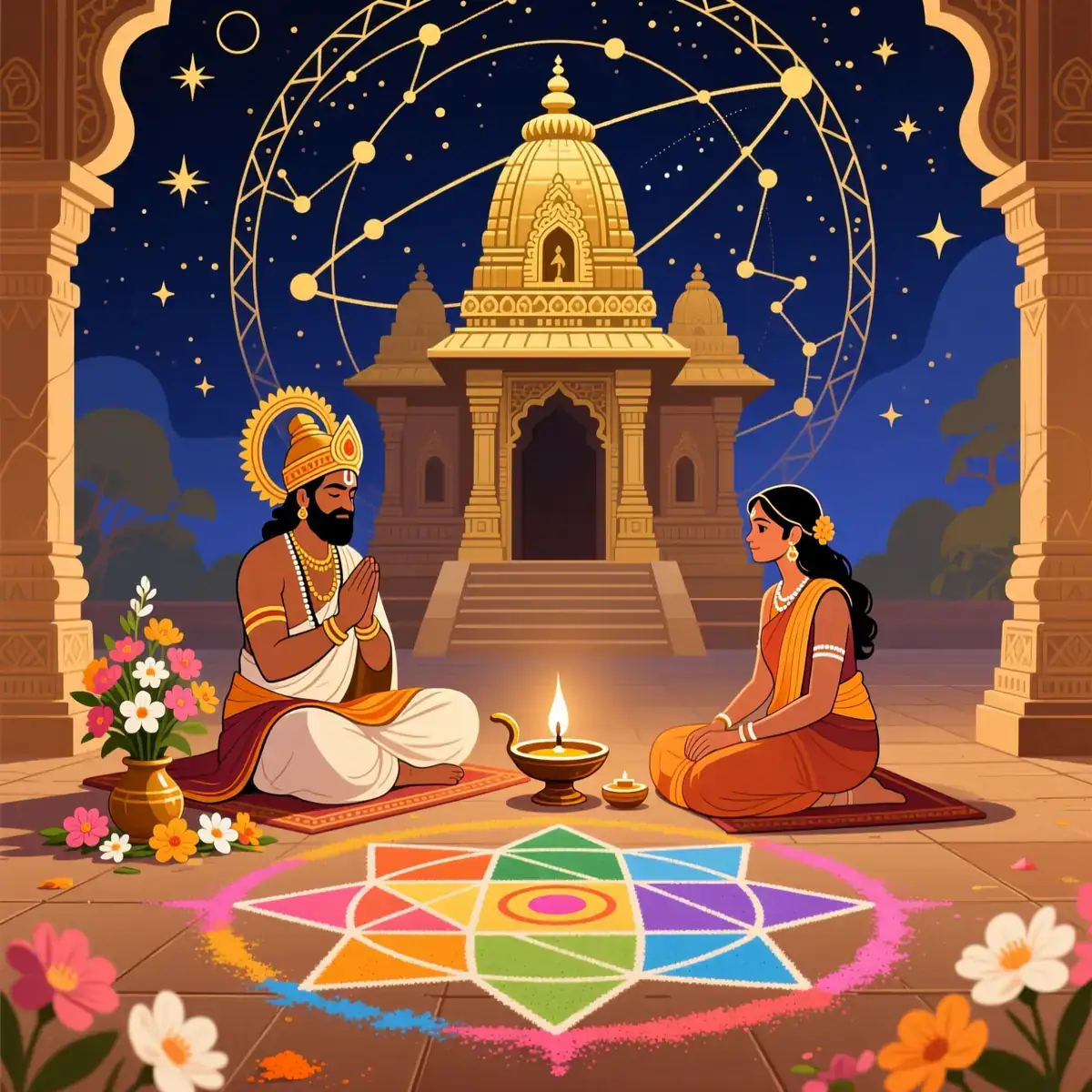
Chapter 4 is the ceremonial heart of Prasna Marga. While the previous chapters dealt with who the astrologer should be and what omens to observe, this chapter lays out exactly how the actual Prasna (horary query) ceremony is performed from start to finish.
The Ashtamangala Prasna is an elaborate ritual involving a sacred lamp, a zodiacal diagram drawn on the ground, 108 cowrie shells, a gold piece, planetary worship, and a child who acts as an innocent intermediary. Every element — the lamp's flame, the lines of the diagram, the priest's unconscious gestures — carries divinatory meaning.
"Light is the basis of all divinity in the Universe. It is said to foretell clearly the present and the future events of man."
1. Preparing for the Ceremony
Prasna Marga, Chapter IV, Stanzas 1–4
Before anything else, the astrologer must prepare both body and mind:
- Bathe and dress in clean, neat robes
- Apply sacred ashes (vibhuti)
- Face east while seated comfortably
- Open the ceremony with devotion to God and Guru
- Observe all surroundings carefully, noting any omens
Timing: The ceremony should not be performed too early in the morning or too late in the day. The ideal time is when the Sun is "bright and pleasing" — mid-morning is best.
First object brought matters: If sacred ashes are the first item brought inadvertently to the ceremony room, it forebodes evil. But if a lighted lamp is brought first, it indicates general welfare and God's blessing.
Modern context: This preparation ritual ensures the astrologer is in a focused, centered state — clean, alert, and attentive. The emphasis on timing and environmental awareness mirrors modern concepts of "setting" in psychological practice: the environment and mental state in which work is performed significantly affect outcomes.
2. Reading the Lamp (Deepa Lakshana)
Prasna Marga, Chapter IV, Stanzas 5–9
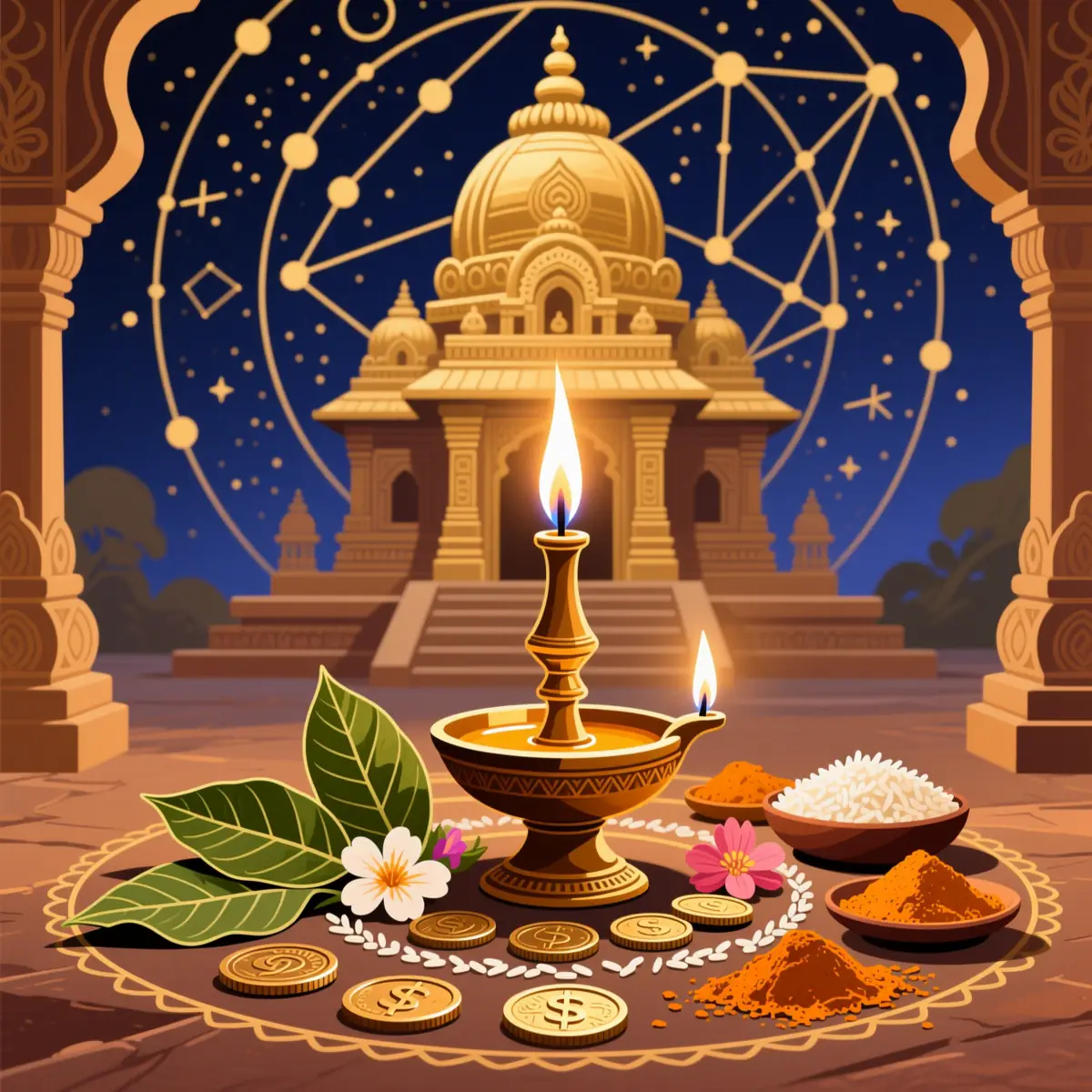
The lamp is considered a "prominent messenger of the future" in all Prasna ceremonies. The astrologer must study every aspect of the flame with great care.
Bad Signs in the Flame
Evil Indicators
-
Flame moves
anti-clockwise
-
Flame is
not bright
or too dim
-
Flame
frequently emits sparks
-
Flame is
too small
in shape
-
Flame
suddenly goes out
despite good oil and wick
-
Flame
cannot be relit
after repeated attempts
-
Flame appears
split in two halves
-
Lamp makes
cracking sounds
-
Flame
shakes without wind
Good Signs in the Flame
Prosperity Indicators
-
Flame is
dense and long
-
Flame moves only
clockwise
-
Flame is
steady and bright
-
Flame produces
no sound
-
Flame is
beautiful to look at
-
Flame has a
golden or jewel-like hue
-
Flame
burns straight
without bending
The Lamp as a Symbolic Map
Evil Indicators
- Flame moves anti-clockwise
- Flame is not bright or too dim
- Flame frequently emits sparks
- Flame is too small in shape
- Flame suddenly goes out despite good oil and wick
- Flame cannot be relit after repeated attempts
- Flame appears split in two halves
- Lamp makes cracking sounds
- Flame shakes without wind
Prosperity Indicators
- Flame is dense and long
- Flame moves only clockwise
- Flame is steady and bright
- Flame produces no sound
- Flame is beautiful to look at
- Flame has a golden or jewel-like hue
- Flame burns straight without bending
The Lamp as a Symbolic Map
The text provides a remarkable symbolic mapping where every part of the lamp corresponds to an aspect of the person's life :
| Lamp Element | Represents | How to Read It |
|---|---|---|
| Oil | Physical body | Low quantity = weak blood; high temperature = fever or mental worry; floating particles = worms |
| Wick | Soul / intellect | Dirty wick = dull intellect; two wicks intertwined = imbalanced vital energies (prana/apana) |
| Flame | Longevity / life force | Bright = happy; dim = afflicted; size indicates lifespan |
| Lamp container | The house | Size and shape indicate the home; moving the lamp = person will change house |
| Wind affecting flame | Relatives and friends | Gentle breeze = supportive friends; strong adverse wind = many enemies |
"The oil in the lamp represents the physical body; the wick, soul; the flame, longevity; its brightness and dimness, happiness and misery; the can, its size and shape, the house; and the wind, relatives and friends."
Flame Direction Meanings
The direction in which the flame leans also carries specific meaning:
| Direction | Prediction |
|---|---|
| East | Prosperity |
| South-East | Fear from fire |
| South | Death |
| South-West | Epilepsy, apoplexy, or sudden fits |
| West | Improvement and peace |
| North-West | Poverty and decline |
| North | Just overcome great danger |
| North-East | General good health |
| Vertical (straight up) | Success and gains |
Modern note: B.V. Raman himself observed that oil lamps have been replaced by electric lights in modern times, making this specific technique less directly applicable. However, the principle — that environmental conditions at the time of consultation carry meaning — remains central to Prasna methodology.
3. Article Placement and Gulika
Prasna Marga, Chapter IV, Stanza 10
When the client brings offerings (flowers, betel leaves, sandalwood, etc.), the direction in which they place these items is significant. If the articles are placed in the direction occupied by Gulika (a malefic sub-planet), or in the direction corresponding to the 8th sign from the Arudha or from the client's birth sign, it indicates early death for the questioner — unless Jupiter aspects that sign.
The directional mapping of zodiac signs is:
| Direction | Zodiac Signs |
|---|---|
| East | Aries, Taurus |
| South-East | Gemini |
| South | Cancer, Leo |
| South-West | Virgo |
| West | Libra, Scorpio |
| North-West | Sagittarius |
| North | Capricorn, Aquarius |
| North-East | Pisces |
Jupiter's protective role: Throughout Vedic astrology, Jupiter (Guru) is the great benefic. Even a potentially fatal indication can be averted if Jupiter aspects the relevant sign.
4. Drawing the Sacred Chakra
Prasna Marga, Chapter IV, Stanzas 11–15
The Chakra (zodiacal diagram) is drawn on a clean, even spot that has been purified and covered with a layer of raw rice, then adorned with a lamp, flowers, and ornaments.
Measurements
-
The Chakra is a square measuring
24 angulas
(approximately 18 inches / 45 cm) on each side
-
It is divided into
16 equal parts
of 6 angulas each
-
The
central four squares
form a lotus (
Padma
) with four petals
-
The
remaining 12 outer squares
represent the 12 zodiac signs beginning with Aries
The Rasi Chakra Layout
+----------+----------+----------+----------+
|  Pisces  |  Aries   | Taurus   | Gemini   |
+----------+----------+----------+----------+
| Aquarius |                     | Cancer   |
+----------+    PADMA (LOTUS)    +----------+
| Capricorn|                     |   Leo    |
+----------+----------+----------+----------+
|Sagittarius| Scorpio |  Libra   |  Virgo   |
+----------+----------+----------+----------+
How the Lines Are Read
Line Quality
Meaning
Bold, clear lines
Prosperity
Indistinct lines
Misery and affliction
Broken lines
Obstacles ahead for both happiness and work
The Rasi Chakra Layout
+----------+----------+----------+----------+ | Pisces | Aries | Taurus | Gemini | +----------+----------+----------+----------+ | Aquarius | | Cancer | +----------+ PADMA (LOTUS) +----------+ | Capricorn| | Leo | +----------+----------+----------+----------+ |Sagittarius| Scorpio | Libra | Virgo | +----------+----------+----------+----------+
| Line Quality | Meaning |
|---|---|
| Bold, clear lines | Prosperity |
| Indistinct lines | Misery and affliction |
| Broken lines | Obstacles ahead for both happiness and work |
The Chakra must be drawn clockwise . If it is drawn anti-clockwise and then corrected, it indicates many obstacles lie ahead.
5. Which Line the Priest Draws First
Prasna Marga, Chapter IV, Stanzas 16–19
Generally, the Chakra is drawn by the temple priest, not the astrologer. The astrologer interprets how the priest draws. Which line is drawn first carries a prediction:
Northern Line First
Monetary gains for the questioner
Western Line First
Diseases will increase
Eastern Line First
Birth of children
Southern Line First
Death can be foretold
The Chakra as a Property Map
The astrologer should also interpret the physical Chakra as a map of the questioner's house and compound :
"The astrologer must interpret the Rasi Chakra as the house and compound of the questioner."
| Found in Chakra | Indicates in Compound |
|---|---|
| Raised portions | Elevated spots in the compound |
| Depressions | Deep pits |
| Scattered grass | Trees on that side |
| Wet areas | Ponds and wells |
| Pieces of stone | Rocky spots |
| Sand particles | Elevated ground or coconut trees |
| Wet mud with ants | Ant-hills in the compound |
6. Reading the Messenger's Body Language
Prasna Marga, Chapter IV, Stanzas 20–29
This is one of the most fascinating sections. The person who draws the Chakra (or the messenger who comes on behalf of the client) unconsciously reveals information about the client's property through involuntary gestures . The text calls this "Lekhaka Sparsa Lakshanam" — signs from the touch and posture of the person drawing.
Hand Gestures → Property Information
Gesture
Indicates
Giving something away
Property will be sold
Receiving something
New property will be gained
Raising hands up
Trees on the land
Touching rings or necklace
Creepers on the trees
Folded fingers with raised palms
Trees without branches
Clenched fist
Tree stumps
Touching facial hair
Thorny trees
Touching nostrils or ear holes
Rat-holes and snake-holes
Body Parts → Land Features
Body Part Touched
Indicates
Hair on head, moustache
Kusa grass and similar vegetation
Nose
Ant-holes
Stomach, eyes, mouth, chest
Plenty of water in gardens
Perspiring parts of the body
Very fertile lands with flowing water
Armpit or lower body
Bad water quality
Arms raised high
Very tall trees
Hands lowered
Stunted trees
Teeth or nails
Mineral wealth (ore deposits)
Kneecap or bony spots
Stones and bones in the compound
Navel or depressed limbs
Pits and ponds
Ridge of the back
Rivers or small streamlets
Accompanying Persons
| Gesture | Indicates |
|---|---|
| Giving something away | Property will be sold |
| Receiving something | New property will be gained |
| Raising hands up | Trees on the land |
| Touching rings or necklace | Creepers on the trees |
| Folded fingers with raised palms | Trees without branches |
| Clenched fist | Tree stumps |
| Touching facial hair | Thorny trees |
| Touching nostrils or ear holes | Rat-holes and snake-holes |
| Body Part Touched | Indicates |
|---|---|
| Hair on head, moustache | Kusa grass and similar vegetation |
| Nose | Ant-holes |
| Stomach, eyes, mouth, chest | Plenty of water in gardens |
| Perspiring parts of the body | Very fertile lands with flowing water |
| Armpit or lower body | Bad water quality |
| Arms raised high | Very tall trees |
| Hands lowered | Stunted trees |
| Teeth or nails | Mineral wealth (ore deposits) |
| Kneecap or bony spots | Stones and bones in the compound |
| Navel or depressed limbs | Pits and ponds |
| Ridge of the back | Rivers or small streamlets |
Accompanying Persons
People who accompany the messenger also reveal what exists near the client's home:
- A bowman → Temple of God Sasta nearby
- A woman → Temple of Goddess Lakshmi or Durga
- Dirty boys → Evil spirits residing near
- A Brahmin → Brahma Rakshasa in that direction
- A wicked man → Thieves and robbers nearby
Modern context: While the specific interpretations belong to the ancient world, the principle of reading unconscious body language is well-established in modern psychology. People do reveal information through involuntary gestures, posture, and micro-expressions — the ancients simply built a systematic framework for interpreting them.
7. Worship and Invocation
Prasna Marga, Chapter IV, Stanzas 30–44
Once the Chakra is drawn, a sequence of sacred rituals begins:
Step-by-Step Worship Sequence
Step 1:
Wash feet, sanctify body with Vedic mantras, worship the Atman (Self) and Lord Ganesa
Step 2:
Worship Lord Maheswara (Siva) with the
Panchakshari Mantra
in the lotus at the center of the Chakra
Step 3:
Invoke the Lord through meditation — visualizing Him on a grand throne at Mount Kailasa, attended by gods, holding a deer, axe, and symbol of knowledge, teaching Supreme Knowledge to sages
Step 4:
Worship the zodiac signs, the planets in their positions, and Gulika as subordinate deities
Step 5:
Adore Saraswati (goddess of knowledge) and Guru in auspicious objects near the Chakra; worship Lakshmi (goddess of prosperity) in the lamp
The Gold Piece
A piece of gold is washed and placed in a basin or plantain leaf, covered with sandal paste, flowers, and colored rice. The astrologer holds it in the left hand, covers with the right, and repeats the Panchakshari Mantra 108 times.
The Cowrie Shells
108 cowrie shells are placed on a wooden plank north of the Chakra, sprinkled with holy water, covered with sandal paste and flowers, and consecrated with worship of Siva.
Navagraha Puja (Planetary Worship)
The nine planets are invoked in their assigned directions:
| Direction | Planet |
|---|---|
| East | Sun |
| South-East | Mars |
| South | Jupiter |
| South-West | Mercury |
| West | Venus |
| North-West | Saturn |
| North | Moon |
| North-East | Rahu |
The mantra is repeated 108 times during the invocation.
The Sankalpa (Intention)
The ceremony's purpose is stated aloud as a formal intention:
"May it occur to me through your grace to find out the real truth, good and bad, regarding the person born in such and such a nakshatra and bearing such and such a name, and happenings about him in the past, present and the future in respect of money, children and house affairs."
8. The Ashtamangala Ceremony
Prasna Marga, Chapter IV, Stanzas 45–57
This is the climax of the ceremony. A child — pure, well-dressed, and ignorant of astrology (so they cannot consciously influence the result) — is called to act as an innocent intermediary between the divine and the human.
The Gold Piece Placement
-
The child worships the lamp, Ganesha, and the planets with flowers
-
The astrologer places the gold piece with flowers in the child's right hand
-
The child
walks around the Chakra
(circumambulation)
-
The child stands near the Chakra
facing east
-
Meanwhile, the questioner meditates on God
-
The astrologer reflects on the question, touches the cowries three times while repeating mantras
-
The astrologer asks the child to
place the gold piece in any zodiac sign
-
The sign where the gold piece lands becomes the
Arudha Rasi
— the foundation for the entire reading
Dividing the Cowrie Shells
After the gold piece is placed, the astrologer divides the 108 cowrie shells into three groups :
Left Side
Represents the hundreds digit
In Front
Represents the tens digit
Right Side
Represents the ones digit
Calculating the Ashtamangala Number
For each group, the cowries are counted. All multiples of 8 are removed , and only the remainder (0–7) is kept. The three remainders form a three-digit number — the Ashtamangala Number .
Example Calculation
- Left group: 37 cowries → 37 ÷ 8 = 4 remainder 5
- Front group: 42 cowries → 42 ÷ 8 = 5 remainder 2
- Right group: 29 cowries → 29 ÷ 8 = 3 remainder 5
- Ashtamangala Number = 525
Additional Observations to Record
The astrologer must also note at this time:
- All omens observed and the nature of the breath
- The Sun's shadow measured in feet
- The position of the gold piece among the flowers
- Lamp signs (Deepa Lakshana)
- Number of betel leaves brought
- The year, month, date, and weekday
- The questioner's name, house name, and birth nakshatra
- The sankalpa (stated purpose of the query)
9. Summary of the Complete Ceremony
Prasna Marga, Chapter IV, Stanzas 58–59
The author recaps the entire procedure:
- Draw the Chakra on purified ground and scatter colored rice over it
- Perform puja with devotion to Lord Siva, the planets, and subsidiary deities
- Worship the cowries for the Ashtamangala calculation
- Have the gold piece placed in one of the zodiac signs by an innocent child
- Calculate the Ashtamangala Number from the three groups of cowries
- Use white flowers only (especially tumbe ) for all puja purposes
Modern context: The Ashtamangala Prasna is still performed in Kerala today, particularly for questions about property, family welfare, and health. While the full traditional ceremony is less common in other parts of India, the mathematical framework (the Ashtamangala Number and Arudha Rasi) continues to be used by horary astrologers worldwide. The principles laid out in this chapter form the foundation for all subsequent chapters that interpret the results.
Key Takeaways from Chapter 4
- The Ashtamangala Prasna is a complete ceremonial system combining ritual worship, symbolic observation, and sacred mathematics.
- The lamp is a "messenger of the future" — every aspect of the flame (direction, brightness, stability, color) carries meaning. The lamp's parts symbolically map to body, soul, life force, home, and social connections.
- The Rasi Chakra is a 24-angula square divided into 16 parts, with a lotus center and 12 zodiac signs. Its physical features (raised spots, moisture, scattered grass) map to the client's actual property.
- The messenger's body language unconsciously reveals details about the client's land, trees, water sources, and mineral wealth.
- A child ignorant of astrology places the gold piece to determine the Arudha Rasi, ensuring the result is divinely guided rather than consciously manipulated.
- The Ashtamangala Number is calculated by dividing 108 cowries into three groups, counting each, and keeping the remainder after dividing by 8.
- Jupiter's aspect can neutralize even the most negative indications, including potential death predictions from Gulika placement.
Try Prasna Marga Calculations
Experience the Prasna Marga system in action with our free Horary Astrology tool, which applies these ancient principles automatically.
Light is the basis of all divinity in the Universe