The Wounded Oyster — Suffering, Saturn, and the Making of Pearl
Article 7 showed that some karma is iron and some is clay. Now: what happens when the iron karma hurts? Is there meaning in the pain — or just pain?
Article 8 of 12 • Suffering & Growth • Topics: Saturn, Sun Dasa, Nacre, the Banyan Tree, Soul Evolution
"Our strength grows out of our weakness."
"Birth after birth as the individual advanced in his soul evolution, even without his being aware of it, he was gradually, but surely, being directed towards the Ultimate Goal of Sanatana Dharma — Moksha."
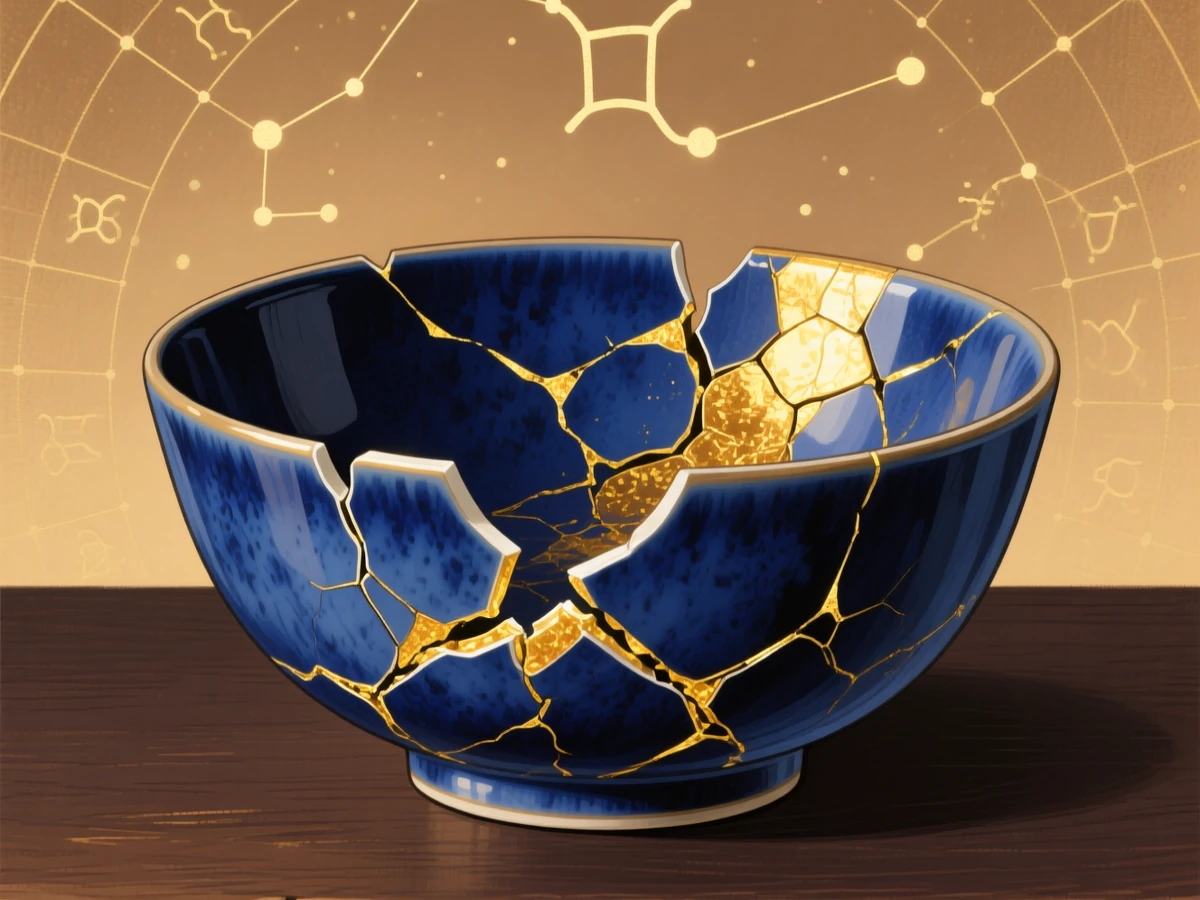
Eleven words. Emerson needed eleven words to capture an entire philosophy of suffering:
"Like the wounded oyster, he mends his shell with pearl."
— Emerson, Compensation
Think about what actually happens inside that shell. A grain of sand gets in — uninvited, unwelcome, painful. The oyster can't remove it. So it does the only thing it can: it coats the intruder with nacre, layer by slow layer, using the same luminous substance that lines its own body. Over months, over years, the wound becomes a jewel. The invader becomes the most valuable thing the creature will ever produce.
No wound, no pearl. It's that simple. And that devastating.
The Curriculum of Pain
Emerson builds an entire education theory around this image:
"A great man is always willing to be little. Whilst he sits on the cushion of advantages, he goes to sleep. When he is punished, tormented, defeated, he has a chance to learn something; he has been put on his wits, on his manhood; he has gained facts; learns his ignorance; is cured of the insanity of conceit; has got moderation and real skill."
Facts
Sees reality clearly
Ignorance
Knows what he doesn't know
Moderation
Cured of conceit
Real Skill
Earned, not inherited
Notice: not a single one of these comes from success. Every one arrives through getting knocked down.
"The wise man throws himself on the side of his assailants. It is more his interest than it is theirs to find his weak point."
"Blame is safer than praise. I hate to be defended in a newspaper. As long as all that is said is said against me, I feel a certain assurance of success. But as soon as honeyed words of praise are spoken for me, I feel as one that lies unprotected before his enemies."
This isn't masochism. It's strategy. Praise puts you to sleep. Blame keeps you awake. The cushion of advantages is the most dangerous seat in the house.
"As the Sandwich Islander believes that the strength and valor of the enemy he kills passes into himself, so we gain the strength of the temptation we resist."
Saturn — The Slowest Teacher
In Vedic astrology, there's a planet that does exactly what Emerson describes. It moves slower than any other visible planet. It takes nearly thirty years to complete a single orbit. It is relentless, patient, and utterly uninterested in your comfort.
Saturn.
Its Dasa can last years. During those years: delays, obstacles, loneliness, loss, and forced confrontation with everything you've been avoiding. It strips your life to the studs. It takes away the things you thought you needed. And then it waits — with what feels like cruel patience — to see what you build from what's left.
Raman knew Saturn from the inside. His own family went through what he called "a phase of poverty the memory of which even at this distance of time I have not been able to shake off completely." His childhood was spent studying by kerosene light, walking miles to collect the post, memorizing Sanskrit verses until midnight. He watched his father lose his sight and his grandfather's finances collapse.
And he became the most influential Vedic astrologer of the twentieth century. Not despite the hardship. Through it.
"The Saturn-Moon syndrome suggests the tendency of the mind towards gloom, caution, acquisitiveness, restlessness and misgivings… One with such a combination meets with persecution, slander, difficulties and sorrows through parents and property and even sorrow through death of mother."
But look at the next line: "The mental condition could improve with age making him more contemplative, thoughtful and capable of concentration on serious subjects."
With age. Saturn's gifts don't arrive by express mail. They arrive after decades of grinding. The pearl doesn't form overnight.
The Sun's Redirection — Pain with a Direction
But the most remarkable convergence between Emerson and Raman on the subject of suffering isn't about Saturn. It's about the Sun.
Raman describes what happens when the Sun's Dasa activates in a chart where it afflicts the houses governing love and domestic life:
"The pain and trauma of the marital disaster give a feeling of revulsion for the grosser things of life and the native, for the first time, may be, in this life, begins to get the feeling that life is more than external relationships and mundane pursuits."
"With the Sun, the pain, the disappointment, the disillusionment and anger following the marital disaster are very much there; but the direction of the reaction is ennobling and uplifting of the soul."
"As Atmakaraka, the Sun's primary concern is not rehabilitation of the native's shattered mundane activities and pursuits but re-orientation of the soul, caught in the dualities of life towards a freedom that is possible only when one steps beyond these dualities."
— B.V. Raman, The Art of Matching Charts
Emerson, writing about the same experience with nothing but language and honesty — from a man who lost his first wife at twenty and his son at five:
"The death of a dear friend, wife, brother, lover, which seemed nothing but privation, somewhat later assumes the aspect of a guide or genius; for it commonly operates revolutions in our way of life, terminates an epoch of infancy or of youth which was waiting to be closed, breaks up a wonted occupation, or a household, or style of living, and allows the formation of new ones more friendly to the growth of character."
The loss that looked like destruction turns out to be a door. The friend who died, the marriage that ended, the career that collapsed — "somewhat later" (and sometimes it's years later) you realize it was the ending of a chapter that had already gone on too long.
The Garden Flower and the Banyan
And then the most beautiful image in all of Emerson — the one that earns everything that came before it:
"The man or woman who would have remained a sunny garden flower, with no room for its roots and too much sunshine for its head, by the falling of the walls and the neglect of the gardener, is made the banyan of the forest, yielding shade and fruit to wide neighborhoods of men."
— Emerson, Compensation
The garden wall falls. The protection that felt like love turns out to be a cage. And the flower, unshielded for the first time, discovers it was never a flower at all. It was a banyan — a tree whose roots can span acres, whose branches can shelter hundreds — waiting inside a pot that was always too small.
Raman sees this same arc playing out across lifetimes:
"Birth after birth as the individual advanced in his soul evolution, even without his being aware of it, he was gradually, but surely, being directed towards the Ultimate Goal of Sanatana Dharma — Moksha."
"In this exercise and endeavour to abide by the spirit of the union, the couple, more often than not, grows in patience, forbearance, compassion and also self-denial. It was for the fostering of these qualities that marriage was originally intended."
Even when you don't know you're growing, you're growing. Even when the Saturn period feels like punishment, the nacre is building.
The Shell That Must Be Outgrown
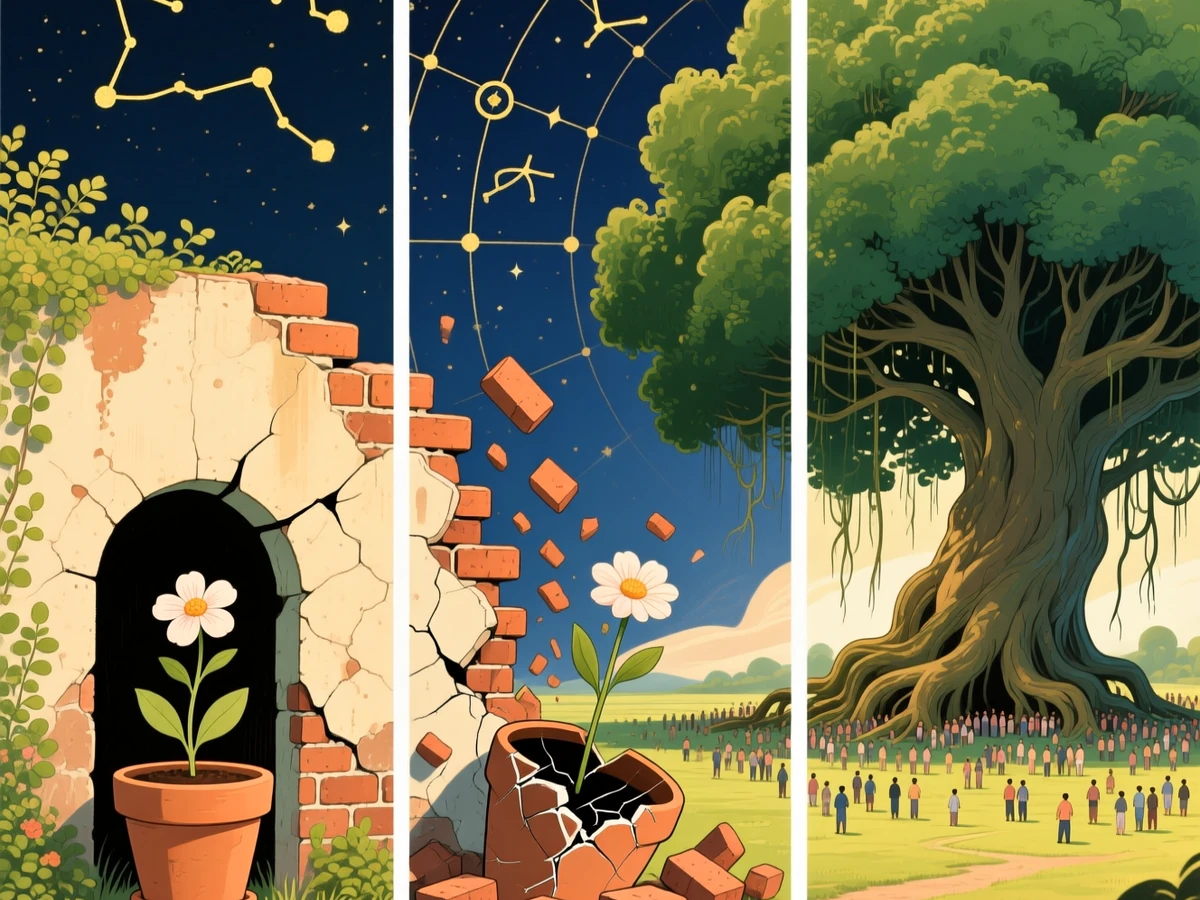
"Every soul is by this intrinsic necessity quitting its whole system of things, its friends, and home, and laws, and faith, as the shellfish crawls out of its beautiful but stony case, because it no longer admits of its growth, and slowly forms a new house."
The shellfish must leave its shell. Not because the shell is bad, but because the creature has outgrown it. The beautiful, familiar, stony case — the marriage, the career, the belief system, the identity — was perfect for who you were. It's a prison for who you're becoming.
"We cannot part with our friends. We cannot let our angels go. We do not see that they only go out, that archangels may come in."
The friends leave so the archangels can arrive. The walls fall so the banyan can spread. The shell cracks so the creature can grow. The wound forms so the pearl can begin.
Saturn is not your enemy. The Sun's Dasa is not a punishment. The crack in everything God has made is not a mistake.
The wound is where the pearl begins. It always was.
"We do not see that they only go out, that archangels may come in."
— Emerson, Compensation
When the people guarding a tradition become its biggest threat. Emerson's dead preacher and Raman's formula-driven astrologer have the same disease.
The Invisible Ledger: Where Emerson Meets Jyotish
A 12-article series bridging Transcendentalism and Vedic Astrology
Based on the essays of Ralph Waldo Emerson and the astrological works of Dr. B.V. Raman