Fixed and Flexible — Dridha Karma, Adridha Karma, and the Great Paradox of Free Will
The first six articles showed how Emerson and Raman agree on what the universe is like. Now the hardest question: if the dice are loaded and the chart is drawn, are we free?
Article 7 of 12 • Freedom & Destiny • Topics: Dridha/Adridha Karma, Pariharas, the Riverbed Metaphor
"I suppose no man can violate his nature. All the sallies of his will are rounded in by the law of his being, as the inequalities of Andes and Himmaleh are insignificant in the curve of the sphere."
"Dridha Karma is due to conscious activity — mental, verbal or physical. Adridha Karma is caused by unintentional activity."
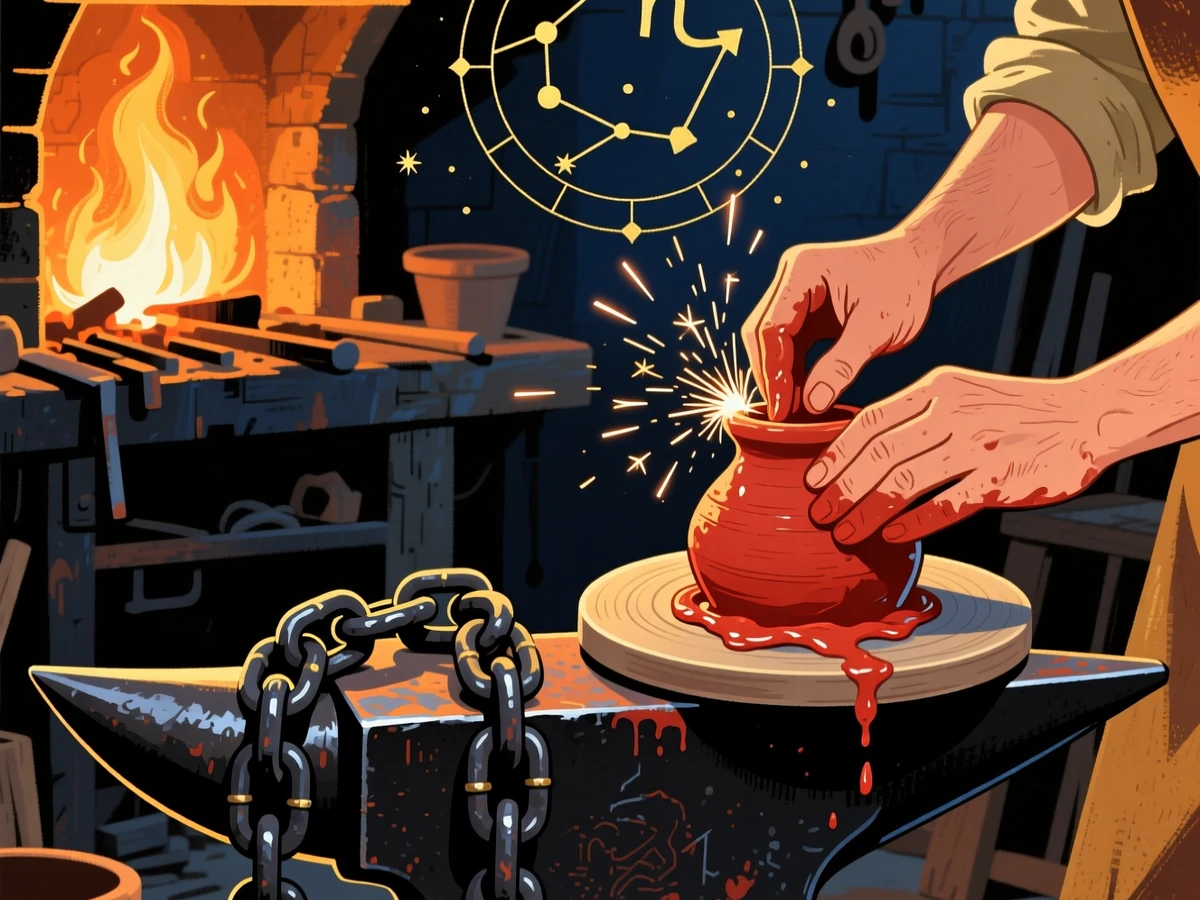
Philosophy has been stuck on the free will question for about twenty-five centuries. It's embarrassing, really. Two camps. One says everything's determined — you're a puppet, your choices are illusions, the script was written before you drew your first breath. The other says you're radically free — blank slate, open road, write whatever story you want.
Both camps have brilliant arguments. Neither has won. The pendulum swings. Tenure gets awarded. Nothing changes.
Now here's what's interesting about Emerson: he doesn't pick a side. He rides the pendulum. And he sounds completely convincing at both extremes, sometimes in the same essay, sometimes in the same paragraph.
The Paradox of One Man
"I suppose no man can violate his nature."
"A character is like an acrostic — read it forward, backward, or across, it still spells the same thing."
"The dice of God are always loaded."
"Nothing can bring you peace but yourself."
"Trust thyself: every heart vibrates to that iron string."
"What I must do is all that concerns me, not what the people think."
So which is it? Are we coded messages or free agents?
A Spectrum Instead of a Switch
This is where Vedic astrology offers something Western philosophy never managed: a spectrum instead of a binary.
The Prasna Marga introduces two categories that dissolve the whole debate:
"The good and bad effects are the resultant of two kinds of Karma — Dridha and Adridha. These can again be subdivided into three types of action, viz., mental, verbal and physical."
| Dridha Karma (Iron) | Adridha Karma (Clay) | |
|---|---|---|
| Origin | Deliberate, conscious, fully intended action | Accidental, unintentional, ignorant action |
| Consequences | Locked in. Will manifest regardless. | Real but flexible. Can be reshaped. |
| Remedies | No prayer or ritual will undo them. | Can be softened through Pariharas, conscious engagement, spiritual practice. |
| Chart Indicator | Indicator in the Moon's sign or hora | Indicator in the Sun's sign or hora |
| Emerson Equivalent | "No man can violate his nature" | "Nothing can bring you peace but yourself" |
"Whether Dridha or Adridha — Karma may be due to speech, thought, and bodily actions. The gamut of Karma is all-comprehensive and it cannot be restricted to any particular sphere of thinking or activity."
Some of your destiny is iron. Some is clay. The horoscope shows both. The wise person — and the wise astrologer — learns to tell the difference.
The Riverbed and the Current
Apply this to Emerson and the pendulum stops.
"No man can violate his nature" — that's your Dridha Karma talking. The deep pattern. The character. The riverbed. You brought it with you. You can't undo it. It's the curve of the sphere.
"Nothing can bring you peace but yourself" — that's the Adridha space. The zone of flexibility within the fixed structure. The current within the riverbed. You can't redirect the river. But you can choose how to swim.
The Riverbed Metaphor
The Riverbed
Dridha Karma. The deep structure. Your character, your fundamental pattern. Given. Unchangeable. The curve of the sphere.
The Current
Adridha Karma. The flexible space within. How you swim, which tributaries you explore, how consciously you navigate. Yours to shape.
This isn't a contradiction. It's a description. Some things about your life are iron. Some are clay. You are free within your destiny, not free from it. And wisdom begins the moment you stop confusing the two.
"Life invests itself with inevitable conditions, which the unwise seek to dodge, which one and another brags that he does not know; that they do not touch him; — but the brag is on his lips, the conditions are in his soul."
The conditions are Dridha. The brag is Adridha. You cannot escape the conditions. But you can stop bragging and start engaging.
Pariharas — Tools for the Clay
The Vedic tradition goes further: it provides tools for working with the clay. These are the Pariharas — remedial measures. Specific charities, mantras, rituals, lifestyle adjustments tailored to the planetary afflictions in your chart.
But here's the thing most people miss: the remedies aren't escape hatches. They're collaborations.
When the tradition prescribes charity for a Saturn affliction, it's not saying "trick Saturn into leaving you alone." Saturn demands discipline, patience, service. Doing those things voluntarily is Saturn's lesson — done on your own terms instead of having it forced on you. The remedy works with the grain of the karma. Not against it.
"Grandfather had often stressed the preventive and curative aspects of the remedial measures prescribed in mantrasastra for tackling afflictions in a horoscope. The planets could be 'appeased' by mantras and dana — mantrenanena danena grahanee santimrichchati."
And the Prasna Marga spells out the deeper logic:
"Unfavourable planets, however afflicted they may be, will do good — if Devas and Brahmanas shall be adorned, elderly persons should be obeyed, Vedas and Puranas should be listened to, Homas should be performed and witnessed, the mind should be kept pure, Vedic chants should be listened to and gifts offered, as ordained."
Keep the mind pure. Listen. Give. These aren't magical loopholes. They're the practices of someone who has understood the lesson the planet is trying to teach — and started doing the homework voluntarily instead of waiting for the cosmic detention.
Emerson, who knew nothing about Pariharas, described the same approach in his own language:
"A wise man will extend this lesson to all parts of life, and know that it is the part of prudence to face every claimant, and pay every just demand on your time, your talents, or your heart. Always pay; for, first or last, you must pay your entire debt."
Always pay. Don't dodge. Don't defer. The debt is real. The only question is whether you pay it willingly — with consciousness and grace — or have it extracted from you by force.

Raman, in the Prasna Marga commentary, adds one more detail that earns its place here. The tradition acknowledges a force that transcends even the Dridha/Adridha distinction:
"While the horoscope reveals destiny, spiritual knowledge (Atma-Jnana) and remedial measures can mitigate certain adverse karmic effects."
Atma-Jnana — self-knowledge — is the one thing that can bend even iron. Not by cheating the system. By outgrowing it. But that's a story for Article 11.
For now, the takeaway:
The riverbed is given. The swimming is yours. Some karma is iron. Some is clay. And the greatest freedom is the freedom to stop demanding that the universe be simpler than it actually is.
"A foolish consistency is the hobgoblin of little minds, adored by little statesmen and philosophers and divines."
Maybe the greatest freedom is the freedom to hold the paradox — to be both the acrostic that reads the same from every direction and the swimmer who chooses which current to ride.
"Always pay; for, first or last, you must pay your entire debt."
— Emerson, Compensation
What Emerson, Saturn, and a shellfish know about turning damage into something precious. Why comfort is the enemy and the wound is where the pearl begins.
The Invisible Ledger: Where Emerson Meets Jyotish
A 12-article series bridging Transcendentalism and Vedic Astrology
Based on the essays of Ralph Waldo Emerson and the astrological works of Dr. B.V. Raman