Trust Thyself — Self-Reliance, the Sun as Atmakaraka, and the Light That Cannot Be Borrowed
In Article 1, the universe kept score. In Article 2, the score was always 337. Now: what is the thing that's being scored? What is the soul — and where does it live in the chart?
Article 3 of 12 • The Soul & Individuality • Topics: Atmakaraka, Satwa Guna, Sun's Dasa, Conformity vs. Genius
"Trust thyself: every heart vibrates to that iron string."
"The Sun represents: Soul, father, personal magnetism, patrimony, self-reliance, psychic development, political power, Satwa guna, Godliness, nobility."
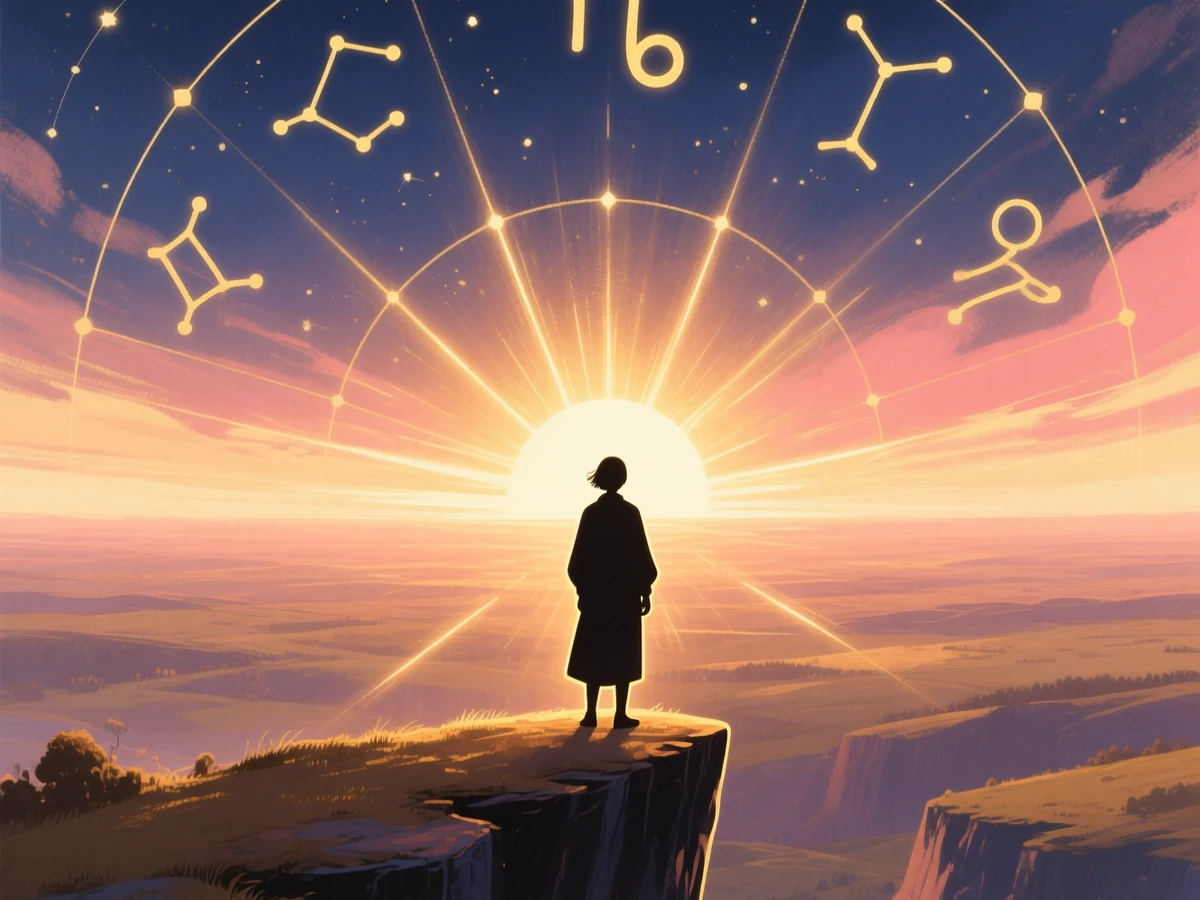
You know that feeling — the one where you're sitting in a meeting, or at a dinner party, or reading someone's confident opinion online, and something in your chest says no, that's wrong — but you don't say anything? Because everyone else seems to agree, and who are you to push back, and maybe you're the one who's confused?
That feeling is the subject of Emerson's most famous essay. And his opening argument is a punch to the solar plexus:
"To believe your own thought, to believe that what is true for you in your private heart is true for all men, — that is genius."
Not IQ. Not credentials. Not being the smartest person in the room. Genius, for Emerson, is just the courage to say what you actually think — before someone else says it and you kick yourself for staying silent.
Because here's what keeps happening:
"In every work of genius we recognize our own rejected thoughts: they come back to us with a certain alienated majesty."
You read Shakespeare and think: I knew that. You hear a great speech and feel: those are my words. They weren't — but the thought behind them was already in you. You just didn't trust it. So someone braver said it first, and now your own idea comes back to you wearing the borrowed robes of someone else's authority.
The Aboriginal Self
But what is this inner authority? Emerson asks the question directly, and the answer is one of the strangest and most beautiful passages in all of English prose:
"Who is the Trustee? What is the aboriginal Self, on which a universal reliance may be grounded? What is the nature and power of that science-baffling star, without parallax, without calculable elements, which shoots a ray of beauty even into trivial and impure actions, if the least mark of independence appear?"
A "science-baffling star, without parallax." A light source that cannot be triangulated from outside, because it is the center from which all triangulation proceeds.
"The inquiry leads us to that source, at once the essence of genius, of virtue, and of life, which we call Spontaneity or Instinct. We denote this primary wisdom as Intuition, whilst all later teachings are tuitions."
Intuition versus tuition. What you were born knowing, versus what you were taught. Emerson is placing a bet: the born knowing is deeper, truer, and more reliable than anything the classroom can provide.
"We lie in the lap of immense intelligence, which makes us receivers of its truth and organs of its activity. When we discern justice, when we discern truth, we do nothing of ourselves, but allow a passage to its beams."
The Sun in the Chart — Atmakaraka
Now here's the part nobody tells you: Vedic astrology agrees. Completely.
In the Jyotish system, the Sun isn't just another planet. It's the Atmakaraka — the "significator of the soul." Look at how Raman lists its significations:
Soul. Self-reliance. Godliness. The planet of exactly what Emerson spent his life trying to articulate.
But the deeper parallel emerges when you read what happens during the Sun's Dasa — the multi-year planetary period when the Sun's influence dominates your life:
"The Sun is basically a spiritual planet and many times, it is his Dasa that triggers metaphysical questions in one's heart."
The Sun's Dasa doesn't hand you comfort. It hands you a mirror. It burns away the borrowed identities, the comfortable half-truths, the relationships maintained by inertia rather than love:
"The results he gives are such as to bring in disillusionment in these areas of life so that the truth of all relationships as being ephemeral and fleeting is brought into sharp focus preparing the ground for the native to realign his sights on the purpose of human birth and the evolution of his soul."
"As Atmakaraka, the Sun's primary concern is not rehabilitation of the native's shattered mundane activities and pursuits but re-orientation of the soul, caught in the dualities of life towards a freedom that is possible only when one steps beyond these dualities."
— B.V. Raman, The Art of Matching Charts
Emerson described that same stripping without any astrological framework:
"There is a time in every man's education when he arrives at the conviction that envy is ignorance; that imitation is suicide; that he must take himself for better, for worse, as his portion."
Imitation is suicide. Try living someone else's chart. It doesn't fit. It will never fit. Trying is a slow death.
Against Conformity
"Society everywhere is in conspiracy against the manhood of every one of its members. Society is a joint-stock company, in which the members agree, for the better securing of his bread to each shareholder, to surrender the liberty and culture of the eater."
Society's deal is simple: give up your individuality and we'll make sure you eat. Reasonable — if all you want is bread. But if you want to be alive, you have to renegotiate.
"Whoso would be a man must be a nonconformist."
"Insist on yourself; never imitate. Your own gift you can present every moment with the cumulative force of a whole life's cultivation; but of the adopted talent of another, you have only an extemporaneous, half possession."
Your gift. Yours. It comes with the full weight of everything you've lived behind it. Someone else's gift, no matter how dazzling, is something you're renting. You can perform it, but you can't be it.
In astrological terms, conformity is the attempt to live someone else's chart. It's the 7th-house person trying to be a 10th-house person because society rewards public achievement. It's the contemplative Jupiter-dominated soul trying to act like a Mars-driven warrior because the culture valorizes aggression. The horoscope says: this is your distribution. This is where your bindus fell. Trust it.
Raman learned this the hard way. At twenty-two, invited to give his first public lecture at the Bombay Astrological Society, he prepared obsessively, read his notes nervously for twenty-five minutes without looking at the audience, and sat down to the chairman's withering remark:
"We had expected a better performance from the grandson of Mr. B. Suryanarain Rao."
— Chairman, Bombay Astrological Society, August 4, 1935
He was crushed. He was imitating — performing "grandson of a great man" instead of being himself. But that humiliation became what he later called "the stepping stone for my becoming an orator who can hold vast audiences spellbound." The imitation had to die before the original could be born.
Satwa Guna — The Force That Ennobles
There's one more term from Raman that deserves a moment: Satwa Guna.
Most astrology books translate this as "good nature." Raman pushes back:
"Sattwa Guna is usually translated as 'good nature' in most astrological texts. But this is rather inadequate. Sattwa may be understood as that which ennobles one and uplifts the soul."
That which ennobles and uplifts. Not niceness. Not agreeableness. Not being liked. The force that makes you stand up when sitting down would be easier. The voice that says this is true even when saying it costs you.
Emerson:
"A man is relieved and gay when he has put his heart into his work and done his best; but what he has said or done otherwise shall give him no peace. It is a deliverance which does not deliver."
When you act from Satwa — from the authentic center — relief floods in. When you don't, there's a specific kind of unease that no amount of external success can cure. The promotion that doesn't satisfy. The applause that doesn't warm. The life that looks perfect from the outside and feels hollow from within.
Relief. Energy. The unmistakable rightness of being aligned with your own nature.
"A man is relieved and gay when he has put his heart into his work and done his best."
Unease. Hollowness. Success that doesn't satisfy. Emerson's devastating phrase:
"A deliverance which does not deliver."
The Sun doesn't care about your reputation. It cares about your soul. And when its period comes, it will burn away everything that isn't genuinely yours — every borrowed opinion, every comfortable compromise, every identity you adopted because someone else wrote the script — until nothing remains but the iron string.
The Paradox — Individual and Universal
And here's the final twist that both traditions arrive at, from completely different starting points: the deepest individuality turns out to be universal.
"Self-existence is the attribute of the Supreme Cause, and it constitutes the measure of good by the degree in which it enters into all lower forms."
The more authentically you you become, the more you're participating in something that transcends you. Your deepest personal truth isn't personal at all — it's the universe expressing itself through the particular instrument that is you.
The Sun in your chart is uniquely placed. No one else has your Sun in your sign, in your house, with your aspects. And yet the Sun itself — the cosmic principle, the Atmakaraka — is the same for everyone. One light. Infinite refractions. Each refraction unique. The light, universal.

"These roses under my window make no reference to former roses or to better ones; they are for what they are; they exist with God to-day. There is no time to them. There is simply the rose; it is perfect in every moment of its existence."
— Emerson, Self-Reliance
Be the rose. Don't reference other roses. The Sun doesn't consult other suns before shining.
Neither should you.
"Trust thyself: every heart vibrates to that iron string."
— Emerson, Self-Reliance
Achilles' heel. Siegfried's leaf. The debilitated planet. Why perfection is impossible — and why the crack is where the pearl forms.
The Invisible Ledger: Where Emerson Meets Jyotish
A 12-article series bridging Transcendentalism and Vedic Astrology
Based on the essays of Ralph Waldo Emerson and the astrological works of Dr. B.V. Raman