The Crack in Everything — Achilles' Heel, Neecha Bhanga, and the Redemption of Weakness
Article 3 explored the Sun as the soul's planet. But every planet — even the Sun — has a sign where it falls to zero strength. Every gift has a gap. Every hero has a heel.
Article 4 of 12 • Vulnerability & Redemption • Topics: Debilitation, Exaltation, Neecha Bhanga, Nemesis, the Wounded Oyster
"There is a crack in everything God has made."
"When a planet occupies its Neechabhaga (debilitation point) it gives no Ochchabala."
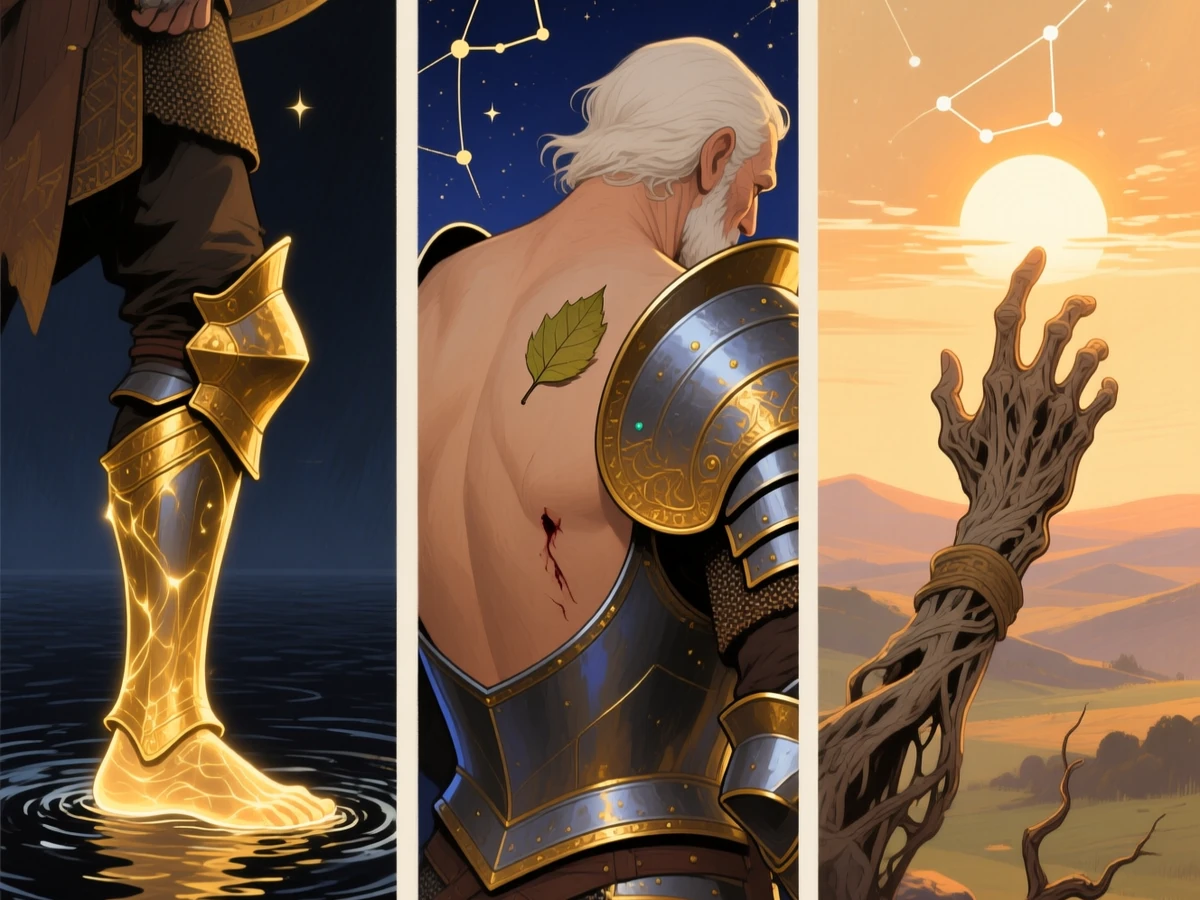
Emerson loved collecting stories about heroes who were almost — but not quite — bulletproof.
Achilles
Dipped in the river of invulnerability — but his mother's grip left a gap. The heel.
Siegfried
Bathed in dragon blood for invincibility — but a leaf fell on his back. One mortal patch.
Tithonus
Aurora asked for his immortality — but forgot to ask for eternal youth. Alive forever. Ancient.
"And so it must be. There is a crack in everything God has made. It would seem, there is always this vindictive circumstance stealing in at unawares — this back-stroke, this kick of the gun, certifying that the law is fatal; that in nature nothing can be given, all things are sold."
Every gift comes with a gap. Every armor has a seam. The universe requires it. A being without vulnerability would stand outside the system of balance — and the system doesn't allow exceptions.
The Mathematics of the Crack
Vedic astrology formalizes Emerson's intuition with the precision he would have envied. Every planet has one sign where it blazes at maximum power — its "deep exaltation point" — and one sign where it falls to absolute zero — its "deep debilitation point."
"When a planet occupies its Ochchabhaga, it gives one rupa or 60 Shashtiamsas of Ochchabala. When it occupies the Neechabhaga it gives no Ochchabala. From the Neechabhaga to the Ochchabhaga, there is a gradual increase… From the exaltation point to the debilitation point there is a gradual decrease till the minimum is reached."
| Planet | Exalted In | Debilitated In | Strength Range |
|---|---|---|---|
| Aries 10° | Libra 10° | ||
| Taurus 3° | Scorpio 3° | ||
| Capricorn 28° | Cancer 28° | ||
| Virgo 15° | Pisces 15° | ||
| Cancer 5° | Capricorn 5° | ||
| Pisces 27° | Virgo 27° | ||
| Libra 20° | Aries 20° |
Full power at one point. Zero at the opposite. A smooth gradient between. No planet escapes. The system guarantees that every source of strength carries a built-in vulnerability. This is Emerson's crack, expressed as degrees of a circle.
The Wound That Heals — Neecha Bhanga
But here's where it gets genuinely exciting: both traditions say the crack is sometimes the best thing about you.
"Has he a defect of temper that unfits him to live in society? Thereby he is driven to entertain himself alone, and acquire habits of self-help; and thus, like the wounded oyster, he mends his shell with pearl."
"Our strength grows out of our weakness. The indignation which arms itself with secret forces does not awaken until we are pricked and stung and sorely assailed."
"Blame is safer than praise."
Vedic astrology has a concept for exactly this: Neecha Bhanga — the cancellation of debilitation.
Under certain conditions — when the ruler of the sign where a planet is debilitated happens to be strong, or when a benefic planet aspects the fallen one — the debilitated planet doesn't just recover. It becomes exceptionally powerful. More powerful, sometimes, than a normally-placed planet ever could be.
Think of it as the difference between someone who's always had it easy and someone who rebuilt themselves from rubble. The first doesn't know what their strength costs. The second knows exactly.
Raman's own life illustrated this. His family passed through what he called "a phase of poverty the memory of which even at this distance of time I have not been able to shake off completely." He studied in village schools alongside farmers' children. His father went blind. His grandfather's finances collapsed. And yet — or because of this — he became the most influential Vedic astrologer of the 20th century. The debilitation cancelled. The pearl formed.
"The wise man throws himself on the side of his assailants. It is more his interest than it is theirs to find his weak point. The wound cicatrizes and falls off from him like a dead skin, and when they would triumph, lo! he has passed on invulnerable."
You Can't Have One End Without the Other
Emerson also noticed that trying to avoid the crack is the most dangerous move of all:
"The ingenuity of man has always been dedicated to the solution of one problem — how to detach the sensual sweet from the moral sweet; that is, to get a one end, without an other end."
We all want the reward without the price. The strength without the vulnerability. The exaltation without the debilitation. And the universe's answer, every single time:
No.
"The parted water reunites behind our hand. Pleasure is taken out of pleasant things, profit out of profitable things, power out of strong things, as soon as we seek to separate them from the whole."
"Drive out nature with a fork, she comes running back."
You can't cheat the 337. You can't have a north pole without a south pole. You can't have Achilles without the heel.
The Furies and the Angry Planet
Emerson invokes the Greek concept of Nemesis — the cosmic enforcer who ensures no transgression goes unanswered:
"This is that ancient doctrine of Nemesis, who keeps watch in the universe, and lets no offense go unchastised. The Furies, they said, are attendants on justice, and if the sun in heaven should transgress his path, they would punish him."
Raman, via the Prasna Marga, identifies a strikingly similar mechanism — the "angry planet":
"Jupiter represents the one supreme divinity. If he is favourable, all deities will favour the native. If he is not favourable, all the deities will be unfavourable."
Three Traditions, One Law
Greek
Nemesis — the goddess who punishes hubris
Emersonian
"Vindictive circumstance" — the back-stroke, the kick of the gun
Vedic
The "angry planet" — the specific planetary force behind suffering
The Furies and the angry planet are the same figure wearing different masks. Nemesis and Karma are the same law enforced by different agencies.
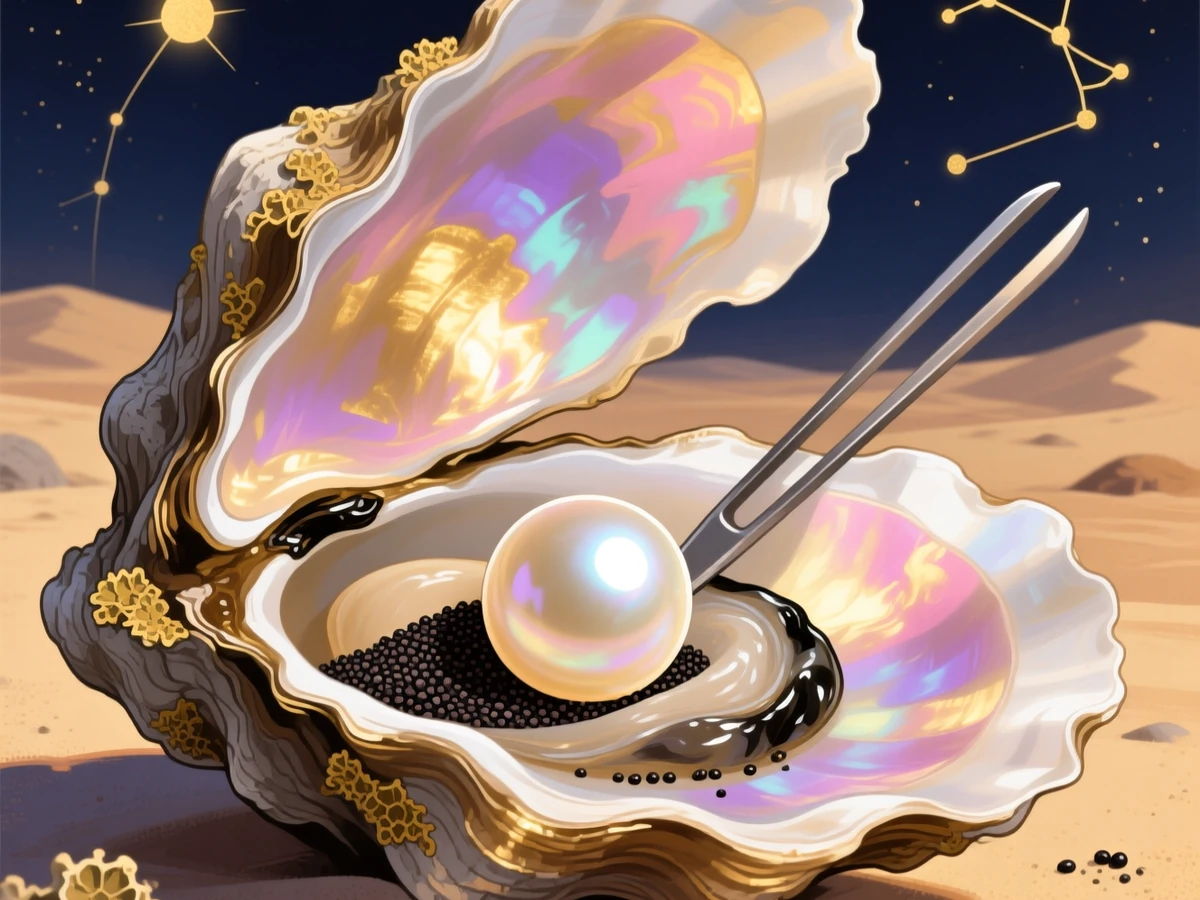
And honestly? You wouldn't want a world without the crack. Because the heel is where the story begins. The debilitated planet, under the right conditions, produces the most remarkable work precisely because it had to fight for everything it has.
"The good are befriended even by weakness and defect. No man had ever a defect that was not somewhere made useful to him. The stag in the fable admired his horns and blamed his feet, but when the hunter came, his feet saved him, and afterwards, caught in the thicket, his horns destroyed him. Every man in his lifetime needs to thank his faults."
The crack isn't a design flaw. It is the design.
"Like the wounded oyster, he mends his shell with pearl."
— Emerson, Compensation
A worm in Fiji, a philosopher in Concord, and the science of right timing. Why Muhurtha and Emerson's eternal present point to the same truth.
The Invisible Ledger: Where Emerson Meets Jyotish
A 12-article series bridging Transcendentalism and Vedic Astrology
Based on the essays of Ralph Waldo Emerson and the astrological works of Dr. B.V. Raman