The 337-Point Constant — Ashtakvarga, Polarity, and the Mathematics of Being
In Article 1, we saw how Emerson and Raman independently arrived at the same conviction: the universe keeps perfect accounts. Now let's look at the mathematics behind that conviction.
Article 2 of 12 • Polarity & Balance • Topics: Ashtakvarga, Bindu/Rekha, Dosha Samya, Cosmic Redistribution
"For everything you have missed, you have gained something else; and for everything you gain, you lose something."
"The sum total of benefic points of all planets will be 337 for any horoscope. This is constant."
Every horoscope ever cast
337
benefic points. Always. For everyone.
I want to tell you the most mind-bending fact in all of Vedic astrology.
Every horoscope that has ever been cast — for a queen or a beggar, for Leonardo da Vinci or the baby born five minutes ago in a hospital you've never heard of — contains exactly 337 benefic points.
Not approximately. Not "around." Exactly. Every single time.
How Ashtakvarga Works
This comes from a system called Ashtakvarga, and here's the short version: each of the seven visible planets scatters "dots of light" — called bindus — across the twelve zodiac signs. Where a planet drops a bindu, that sign gets a point of positive energy. Where it doesn't, that sign gets a shadow — a rekha. The totals per planet are fixed.
| Planet | Total Bindus | Distribution |
|---|---|---|
| 48 | ||
| 49 | ||
| 39 | ||
| 54 | ||
| 56 | ||
| 52 | ||
| 39 | ||
| TOTAL | 337 | Constant for every chart ever cast |
What changes — endlessly, uniquely, kaleidoscopically — is where those points land. One chart might have the career house blazing and the marriage house dark. Another gets the reverse. Same total. Different spending pattern.
"The total number of benefic and malefic points in a sign is always 56. Therefore if the bindus in a particular Rasi is subtracted from 56, the remainder represents rekhas or malefic units."
"Generally, a planet is said to become highly benefic if he secures in his own Ashtakavarga more than 5 bindus. A planet having less than 4 bindus will affect the bhava it is in, adversely."
Emerson's Polarity — The Same Law Without the Math
Emerson didn't know about Ashtakvarga. But he spent decades watching people, and he noticed the same pattern:
"No creatures are favorites, but a certain compensation balances every gift and every defect. A surplusage given to one part is paid out of a reduction from another part of the same creature."
He saw it in politics:
"The farmer imagines power and place are fine things. But the President has paid dear for his White House. It has commonly cost him all his peace, and the best of his many attributes."
He saw it everywhere:
"If riches increase, they are increased that use them. If the gatherer gathers too much, nature takes out of the man what she puts into his chest, swells the estate, but kills the owner. Nature hates monopolies and exceptions."
The estate swells. The owner dies. The White House glitters. The peace evaporates. The giraffe reaches the high leaves. The giraffe can't drink.
If the total is always 337, then what exactly are we envying when we envy someone else's life? We're envying their distribution. We're looking at someone whose bindus landed in the 10th house — career, recognition, public glory — and thinking they got a better deal. But we're not seeing the houses where their chart is dark.
"The waves of the sea do not more speedily seek a level from their loftiest tossing, than the varieties of condition tend to equalize themselves. There is always some leveling circumstance that puts down the overbearing, the strong, the rich, the fortunate, substantially on the same ground with all others."
The sea always returns to level. Always. Your neighbor's spectacular success is a high wave. You're just not close enough to see the trough behind it.
Dosha Samya — Applied Compensation in Marriage
The Vedic tradition applies this principle to something beautifully practical: choosing a marriage partner. The system is called Dosha Samya — the balancing of afflictions.
When two charts are matched for marriage, the astrologer doesn't look for perfection. Perfection doesn't exist — that's the whole point of the 337. Instead, the astrologer looks for complementary imperfection. If the bride's chart has Mars troubling the 7th house, you want a similar affliction in the groom's chart. Not to double the problem — to balance it.
"Where the Doshas or afflictions are quite strong and no balancing of these afflictions is made while matching, then the Doshas can take the shape of much suffering, emotional alienation and physical separation."
Two cracked cups that fit together hold water. Complementary afflictions create a stable, workable union where both partners understand difficulty from the inside.
One heavily afflicted chart, one smooth — creates dangerous asymmetry. Someone is trying to get "a one end without an other end," and nature doesn't allow it.
You don't marry your mirror. You marry your complement. This is Emerson's polarity applied to the most intimate domain of human life.
The Compensatory Spark
So here's the takeaway, and it takes about a lifetime to absorb:
You weren't shortchanged. Neither was anyone else. The budget is the same for everyone — 337 points of cosmic light, distributed across twelve houses, expressing itself through seven planets. Your job isn't to get more. It's to figure out where yours landed — and to stop wasting energy envying someone else's allocation while your own sits unused in houses you haven't bothered to explore.
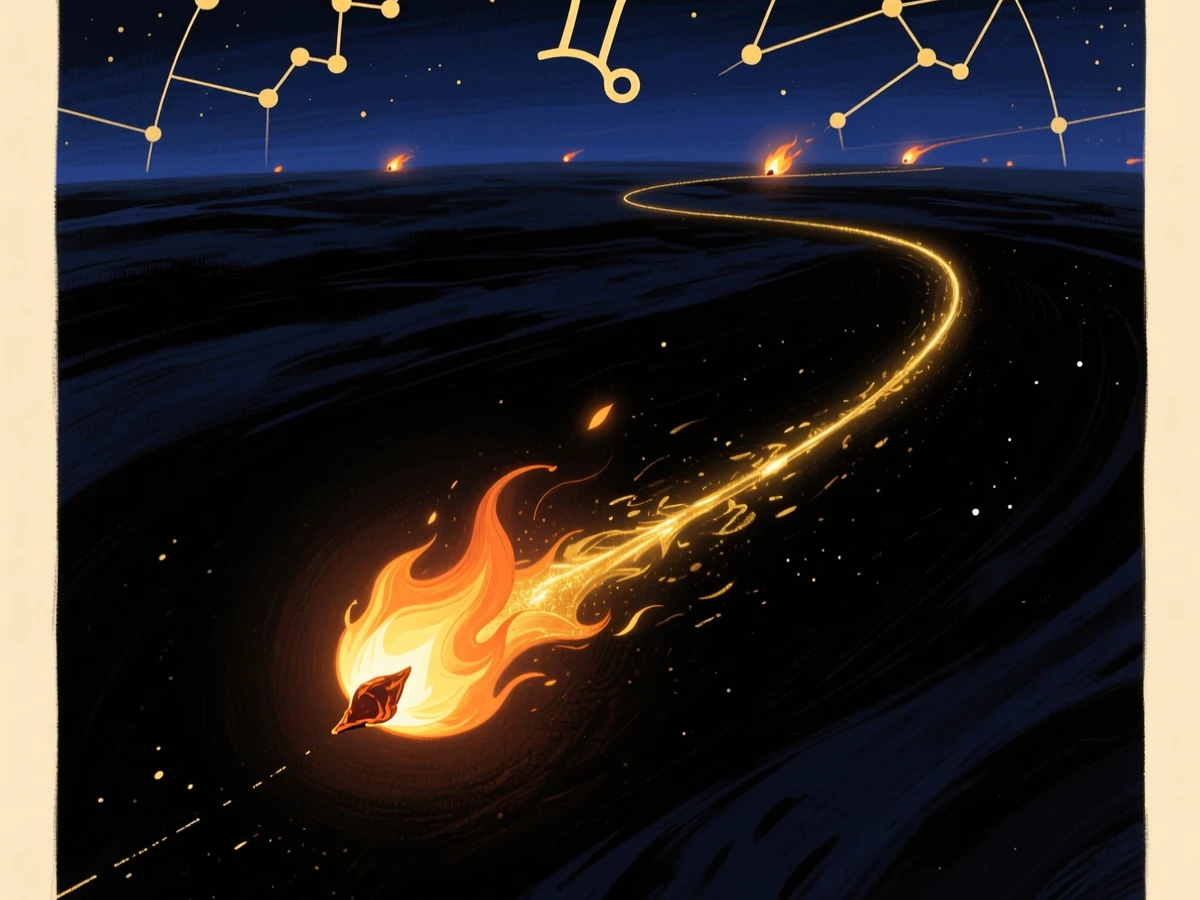
"The lonely Earth amid the balls / That hurry through the eternal halls, / A makeweight flying to the void, / Supplemental asteroid, / Or compensatory spark, / Shoots across the neutral Dark."
— Emerson, Compensation (opening poem)
The Earth itself is a compensatory spark. Flung into darkness to balance some equation we can't see. And so is every person born on it. A spark. A balance. A unique arrangement of 337 points of light.
Your job isn't to get more points. It's to understand where yours landed.
"Nature hates monopolies and exceptions."
— Emerson, Compensation
The Sun as Atmakaraka, Emerson's "aboriginal Self," and why imitation is suicide. What happens when the planet of the soul wakes up in your chart.
The Invisible Ledger: Where Emerson Meets Jyotish
A 12-article series bridging Transcendentalism and Vedic Astrology
Based on the essays of Ralph Waldo Emerson and the astrological works of Dr. B.V. Raman