Graha and Bhava Balas Part 5: Angular, Odd/Even & Drekkana Strengths
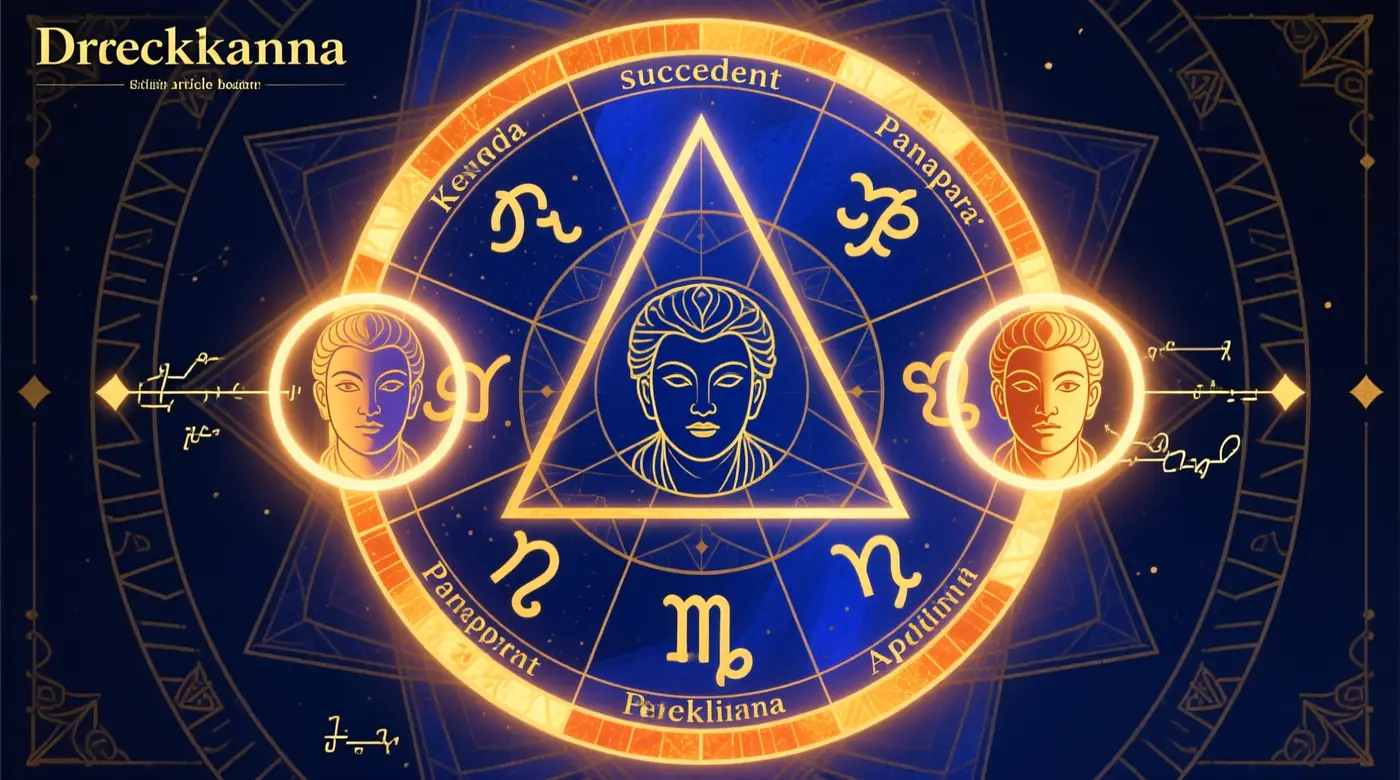
The Final Three Pieces
We're in the home stretch! We've calculated two major components of Sthanabala (Positional Strength):
-
-
Now we complete the picture with three quick, elegant calculations that measure different facets of planetary placement. Each adds a final layer of nuance to our understanding of positional power.
By the end of this article, you'll have the complete Sthanabala for all seven planets in the Standard Horoscope—a comprehensive measure of how well-placed each planet is in the zodiac.
Ojayugmarasyamsa Bala: The Gender Preference
Signs (Rasis) have gender: odd signs (Aries, Gemini, Leo, Libra, Sagittarius, Aquarius) are masculine ( Oja ), while even signs (Taurus, Cancer, Virgo, Scorpio, Capricorn, Pisces) are feminine ( Yugma ).
Planets also have gender preferences. Some gain strength in masculine signs, others in feminine signs. This holds true for both the Rasi (birth chart sign) and Navamsa (9th divisional chart) placements.
The Gender Classification
Masculine (Purusha)
Sun, Mars, Jupiter
Prefer odd signs
Feminine (Stree)
Moon, Venus
Prefer even signs
Hermaphrodite (Napumsaka)
Mercury, Saturn
Prefer odd signs
The Scoring System
When a planet occupies its preferred gender:
- In Rasi: 15 shashtiamsas
- In Navamsa: 15 shashtiamsas
- Both match: 30 shashtiamsas total
Example: Standard Horoscope Calculations
| Planet | Rasi Sign | Navamsa Sign | Rasi Points | Navamsa Points | Total |
|---|---|---|---|---|---|
| Sun (Masculine) | Libra (Odd) | Libra (Odd) | 15.0 | 15.0 | 30.0 |
| Moon (Feminine) | Aquarius (Odd) | Scorpio (Even) | 0.0 | 15.0 | 15.0 |
| Mars (Masculine) | Scorpio (Even) | Gemini (Odd) | 0.0 | 15.0 | 15.0 |
| Mercury (Neutral/Odd) | Libra (Odd) | Sagittarius (Odd) | 15.0 | 15.0 | 30.0 |
| Jupiter (Masculine) | Gemini (Odd) | Taurus (Even) | 15.0 | 0.0 | 15.0 |
| Venus (Feminine) | Virgo (Even) | Capricorn (Even) | 15.0 | 15.0 | 30.0 |
| Saturn (Neutral/Odd) | Leo (Odd) | Pisces (Even) | 15.0 | 0.0 | 15.0 |
Source: Example 10, Article 31
Notice that Sun, Mercury, and Venus score maximum points (30), occupying their preferred gender in both Rasi and Navamsa. This creates harmony between outer expression (Rasi) and inner nature (Navamsa).
Kendra Bala: The Power of Angular Houses
The 12 houses divide into three categories based on proximity to the four angles (Ascendant, 4th, 7th, 10th):
Kendra
Panapara
Apoklima
Kendra
Panapara
Apoklima
Kendra
Panapara
Apoklima
Kendra
Panapara
Apoklima
The Three House Types
- Kendras (1st, 4th, 7th, 10th): Angular houses—maximum power and visibility → 60 shashtiamsas
- Panaparas (2nd, 5th, 8th, 11th): Succedent houses—moderate stability → 30 shashtiamsas
- Apoklimas (3rd, 6th, 9th, 12th): Cadent houses—weakest position → 15 shashtiamsas
Sign vs House Debate
B.V. Raman follows Parasara's method: count Kendras from the Ascendant sign (not Bhava/house). So a planet in the 10th sign from Ascendant gets 60 points, even if it's not in the 10th Bhava . This differs from Bhava-based approaches.
Example: Standard Horoscope
| Planet | Sign from Ascendant | Category | Kendra Bala |
|---|---|---|---|
| Sun | 10th (Libra from Capricorn) | Kendra | 60.000 |
| Moon | 2nd (Aquarius from Capricorn) | Panapara | 30.000 |
| Mars | 11th (Scorpio from Capricorn) | Panapara | 30.000 |
| Mercury | 10th (Libra from Capricorn) | Kendra | 60.000 |
| Jupiter | 6th (Gemini from Capricorn) | Apoklima | 15.000 |
| Venus | 9th (Virgo from Capricorn) | Apoklima | 15.000 |
| Saturn | 8th (Leo from Capricorn) | Panapara | 30.000 |
Source: Example 11, Article 32
Sun and Mercury, both in the 10th sign (Libra), enjoy maximum angular strength. Jupiter and Venus languish in Apoklima positions (cadent houses), receiving minimal Kendra Bala.
Drekkana Bala: The Decanate Preference
Each sign divides into three Drekkanas (decanates) of 10° each. Planetary gender determines which third is most favorable:
First Drekkana (0°-10°)
Masculine planets gain strength here:
Sun, Mars, Jupiter
15 shashtiamsas
Middle Drekkana (10°-20°)
Hermaphrodite planets gain strength here:
Mercury, Saturn
15 shashtiamsas
Last Drekkana (20°-30°)
Feminine planets gain strength here:
Moon, Venus
15 shashtiamsas
Example: Standard Horoscope
| Planet | Gender | Degree in Sign | Drekkana | Match? | Drekkana Bala |
|---|---|---|---|---|---|
| Sun | Masculine | 0° 53' 55" in Libra | First (0°-10°) |
|
15.0 |
| Moon | Feminine | 11° 17' 19" in Aquarius | Middle (10°-20°) |
|
0.0 |
| Mars | Masculine | 19° 30' 34" in Scorpio | Middle (10°-20°) |
|
0.0 |
| Mercury | Hermaphrodite | 1° 31' 34" in Libra | First (0°-10°) |
|
0.0 |
| Jupiter | Masculine | 24° 0' 49" in Gemini | Last (20°-30°) |
|
0.0 |
| Venus | Feminine | 21° 9' 56" in Virgo | Last (20°-30°) |
|
15.0 |
| Saturn | Hermaphrodite | 4° 22' 41" in Leo | First (0°-10°) |
|
0.0 |
Source: Example 12, Article 36
Only Sun and Venus occupy their preferred Drekkanas. The remaining five planets get zero Drekkana Bala—a harsh binary that rewards precision in decanate placement.
Total Sthanabala: The Complete Picture
Now we sum all five components to reveal each planet's total positional strength:
STHANABALA = Ochchabala + Saptavargaja + Ojayugmarasyamsa + Kendra + Drekkana
| Component | Planets (Shashtiamsas) | ||||||
|---|---|---|---|---|---|---|---|
| Sun | Moon | Mars | Mercury | Jupiter | Venus | Saturn | |
| Ochchabala | 3.00 | 32.75 | 37.06 | 54.50 | 56.33 | 1.95 | 34.08 |
| Saptavargaja Bala | 90.00 | 49.75 | 90.00 | 135.00 | 71.25 | 116.25 | 97.50 |
| Ojayugmarasyamsa Bala | 30.00 | 15.00 | 15.00 | 30.00 | 15.00 | 30.00 | 15.00 |
| Kendra Bala | 60.00 | 30.00 | 30.00 | 60.00 | 15.00 | 15.00 | 30.00 |
| Drekkana Bala | 15.00 | 0.00 | 0.00 | 0.00 | 0.00 | 15.00 | 0.00 |
| TOTAL STHANABALA | 198.00 | 126.50 | 172.06 | 279.50 | 157.58 | 178.20 | 177.30 |
Source: Example 13, Article 40
Ranking by Sthanabala
- Mercury: 279.50 — Dominant positional strength (near-exalted, excellent varga relationships, angular)
- Sun: 198.00 — Strong despite weak Ochchabala (angular position, good vargas boost it)
- Venus: 178.20 — Balanced (weak exaltation offset by strong Saptavargaja)
- Saturn: 177.30 — Solid across components
- Mars: 172.06 — Good overall, moderate in most categories
- Jupiter: 157.58 — High Ochchabala dragged down by weak Kendra/Apoklima position
- Moon: 126.50 — Weakest Sthanabala (poor varga relationships, no Drekkana boost)
Practical Application
Mercury dominates positionally—during Mercury Dasa/Bhukti, expect powerful manifestation of Mercury significations (intellect, communication, commerce). Moon , despite moderate Ochchabala, has weak overall Sthanabala due to poor varga relationships—Moon periods may struggle to deliver consistent results. Jupiter , though near-exalted, suffers from Apoklima placement—its blessings manifest subtly, not prominently.
What's Next: Directional Strength
We've completed Sthanabala —the first of six Shadbalas. Now we move to Digbala , or Directional Strength.
In Part 6, you'll learn:
- The four cardinal directions in a horoscope (East/Ascendant, South/10th, West/7th, North/4th)
- Which planets thrive in which directions (e.g., Sun/Mars love the South, Moon/Venus love the North)
- How to calculate Digbala arc —the angular distance from a planet's powerless point to its current position
- Why direction matters as much as position in measuring planetary power
Just as location matters in real estate ("location, location, location!"), direction matters in astrology. A planet in the right direction shines brilliantly; in the wrong direction, it struggles.
Milestone Achieved: You can now calculate complete Sthanabala—a sophisticated measure blending exaltation dignity, varga relationships, gender harmony, angular power, and decanate precision. This is the foundation of all Shadbala calculations.