Graha and Bhava Balas Part 6: Directional Strength (Digbala)
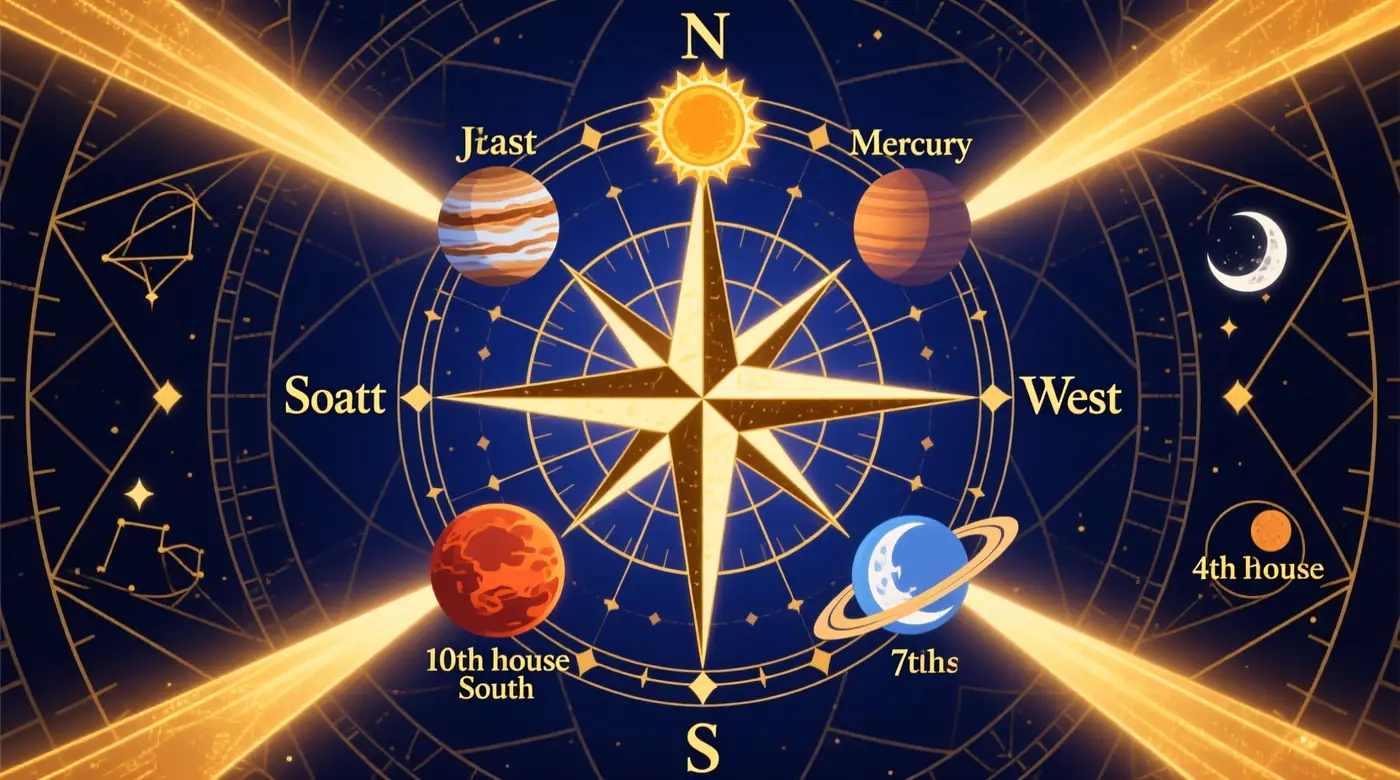
Location, Location, Direction
We've mastered Sthanabala —the strength planets gain from their zodiacal position (exaltation, varga relationships, angular placement). Now we explore a different dimension of power: Digbala , or Directional Strength.
Think of a solar panel. Its output depends not just on what it is (high-quality silicon, good manufacturing), but on where it faces. Point it south in the Northern Hemisphere and it generates maximum power. Face it north and it barely functions. Same panel, different orientation, vastly different results.
Planets work the same way. Each has an optimal direction in the horoscope where it shines brightest, and a powerless point 180° opposite where it struggles. The ancient sages mapped these directional preferences with precision.
The Cosmic Compass
In Vedic astrology, the chart's four angular houses (Kendras) represent the cardinal directions:
NORTH
4th House
(Nadir/IC)
EAST
1st House
(Ascendant)
SOUTH
10th House
(Midheaven/MC)
WEST
7th House
(Descendant)
Technical Note: B.V. Raman uses the Bhavamadhya (midpoint of each house) as the precise directional marker, not just the cusp. So "4th house" means the midpoint of the 4th Bhava, which may differ from the 4th house cusp.
Each Planet's Power Direction
The ancient sage Parasara assigned each planet a direction where it achieves maximum Digbala (60 shashtiamsas):
| Planet | Powerful Direction | House | Powerless Point (180° opposite) |
|---|---|---|---|
| Jupiter | East | 1st (Ascendant) | 7th (West) |
| Mercury | East | 1st (Ascendant) | 7th (West) |
| Sun | South | 10th (Midheaven) | 4th (North) |
| Mars | South | 10th (Midheaven) | 4th (North) |
| Saturn | West | 7th (Descendant) | 1st (East) |
| Moon | North | 4th (Nadir) | 10th (South) |
| Venus | North | 4th (Nadir) | 10th (South) |
East Lovers (Ascendant)
Jupiter, Mercury
Planets of wisdom and intellect thrive at the horizon of self-awareness (1st house)—where consciousness dawns.
South Lovers (Midheaven)
Sun, Mars
Hot, masculine planets reach peak power at the meridian (10th house)—the zenith of public visibility and authority.
West Lover (Descendant)
Saturn
The slow, patient planet of maturity gains strength at the setting horizon (7th house)—where day transitions to night, representing partnerships and reflection.
North Lovers (Nadir)
Moon, Venus
Cool, feminine planets flourish at the invisible nadir (4th house)—the realm of emotions, home, and private life beneath the surface.
The Gradient of Power: Digbala Arc
Planetary strength doesn't jump from zero to 60 suddenly. It increases gradually as a planet moves from its powerless point toward its powerful direction. This arc of increase is called the Digbala arc .
"A planet when approaching its powerful point gains Digbala and while reaching the powerless point it gradually loses Digbala."
Power Gradient Example: Sun (powerful at 10th house midpoint)
Powerless (4th) → Weak → Maximum (10th) → Weak → Powerless (4th again)
Maharishi Parasara's Formula
To measure this arc, Parasara gives us a simple subtraction:
Adjustment Rule
If the difference exceeds 180°, subtract it from 360°. This ensures we always measure the shorter arc toward the powerful point.
Powerless Points by Planet
- Sun, Mars: Subtract 4th house midpoint (North is powerless)
- Jupiter, Mercury: Subtract 7th house midpoint (West is powerless)
- Moon, Venus: Subtract 10th house midpoint (South is powerless)
- Saturn: Subtract 1st house midpoint/Ascendant (East is powerless)
Once you have the Digbala arc, simply divide by 3 to get the final Digbala in shashtiamsas:
Complete Example: Standard Horoscope
Let's calculate Digbala for all seven planets. First, we need the Bhavamadhyas (house midpoints) from our Standard Horoscope:
| House | Direction | Bhavamadhya (Midpoint) |
|---|---|---|
| 1st | East (Ascendant) | 298° 27' |
| 4th | North (Nadir) | 36° 36' |
| 7th | West (Descendant) | 118° 27' |
| 10th | South (Midheaven) | 216° 36' |
Step 1: Calculate Digbala Arcs
| Planet | Longitude | Powerless Point | Calculation | Digbala Arc |
|---|---|---|---|---|
| Sun | 180° 54' | 36° 36' (4th) | 180° 54' − 36° 36' = 144° 18' | 144° 18' |
| Moon | 311° 17' | 216° 36' (10th) | 311° 17' − 216° 36' = 94° 41' | 94° 41' |
| Mars | 229° 31' | 36° 36' (4th) |
229° 31' − 36° 36' = 192° 55'
Adjusted: 360° − 192° 55' = 167° 5' |
167° 5' |
| Mercury | 181° 32' | 118° 27' (7th) | 181° 32' − 118° 27' = 63° 5' | 63° 5' |
| Jupiter | 84° 0' | 118° 27' (7th) |
84° 0' − 118° 27' = −34° 27'
Adjusted: Add 360° = 325° 33' Exceeds 180°: 360° − 325° 33' = 34° 27' |
34° 26' |
| Venus | 171° 10' | 216° 36' (10th) |
171° 10' − 216° 36' = −45° 26'
Adjusted: Add 360° = 314° 34' Exceeds 180°: 360° − 314° 34' = 45° 26' |
45° 26' |
| Saturn | 124° 23' | 298° 27' (1st) |
124° 23' − 298° 27' = −174° 4'
Adjusted: Add 360° = 185° 56' Exceeds 180°: 360° − 185° 56' = 174° 4' |
174° 4' |
Source: Example 14, Article 44
Step 2: Calculate Final Digbala (Arc ÷ 3)
| Planet | Digbala Arc | ÷ 3 | Digbala (Shashtiamsas) |
|---|---|---|---|
| Sun | 144° 18' | ÷ 3 | 48.10 |
| Moon | 94° 41' | ÷ 3 | 31.56 |
| Mars | 167° 5' | ÷ 3 | 55.10 |
| Mercury | 63° 5' | ÷ 3 | 21.09 |
| Jupiter | 34° 26' | ÷ 3 | 11.50 |
| Venus | 45° 26' | ÷ 3 | 15.15 |
| Saturn | 174° 4' | ÷ 3 | 58.02 |
Source: Example 15, Article 45
Interpreting the Results
Ranking by Digbala (directional strength):
Near-Perfect Digbala (50-60 shashtiamsas)
- Saturn: 58.02 — Almost at its powerful point (7th house/West). Nearly perfect directional alignment.
- Mars: 55.10 — Strong south direction (10th house tendency), approaching meridian power.
- Sun: 48.10 — Decent southern strength, though not at peak Midheaven position.
Moderate Digbala (20-40 shashtiamsas)
- Moon: 31.56 — Moderate northern strength, about halfway to 4th house power.
- Mercury: 21.09 — Weak directional placement, far from East (1st house).
Weak Digbala (Below 20 shashtiamsas)
- Venus: 15.15 — Poor directional strength, far from North (4th house).
- Jupiter: 11.50 — Weakest Digbala, distant from East (Ascendant).
Comparing Sthanabala vs Digbala
Notice the contrast between positional and directional strength:
- Mercury: Highest Sthanabala (279.50) but weak Digbala (21.09)—great position, poor direction
- Saturn: Moderate Sthanabala (177.30) but excellent Digbala (58.02)—correctly oriented compensates for average position
- Jupiter: Good Sthanabala (157.58) undermined by terrible Digbala (11.50)—wrong direction sabotages good placement
What's Next: Temporal Strength
We've now mastered two of the six Shadbalas:
-
-
In Part 7, we enter the realm of Kala Bala , or Temporal Strength—the power planets gain from when events occur. This is the most complex Shadbala component, spanning multiple calculations:
- Nathonnatha Bala — Day vs night strength (diurnal/nocturnal planets)
- Paksha Bala — Lunar fortnight strength (waxing vs waning Moon)
- Thribhaga Bala — Strength from the three divisions of day/night
Time becomes the lens through which we measure planetary power. The same planet at different times—different hours, days, months, years—wields different strength.
Key Takeaway: Digbala reveals that orientation matters . A planet facing its natural direction (Sun south, Moon north, Jupiter east, Saturn west) amplifies its significations. Poor directional placement mutes even a well-positioned planet.