Prasna Marga Chapter 30: Nashta Jataka (Lost Horoscopes) - A Modern Guide
A chapter-by-chapter modern English guide to the classical Vedic astrology text by Harihara, translated by B.V. Raman.
Chapter 30 of 32 • Stanzas 1–33 • Topics: Nashta Jataka, Unknown Birth Times, Mathematical Rectification, Omens

What happens when a person wants to know their destiny but has absolutely no record of their birth date or time? Chapter 30 addresses this very common problem through a branch of astrology known as Nashta Jataka (Lost Horoscopy).
The premise is that the exact moment a person asks an astrologer to construct their chart is not random. The universe is perfectly synchronized. By casting a horary chart (Prasna) for the moment of the question, and combining it with mathematical formulas and deep observation of the environment, the astrologer can actually reverse-engineer the client's natal chart.
"To ascertain the four factors beginning from the birth star of the querist, the method implied in the verse 'moortitwe' is explained in the following few stanzas."
1. The Kuta Method (Mathematical Rectification)
Prasna Marga, Chapter XXX, Stanzas 2–4
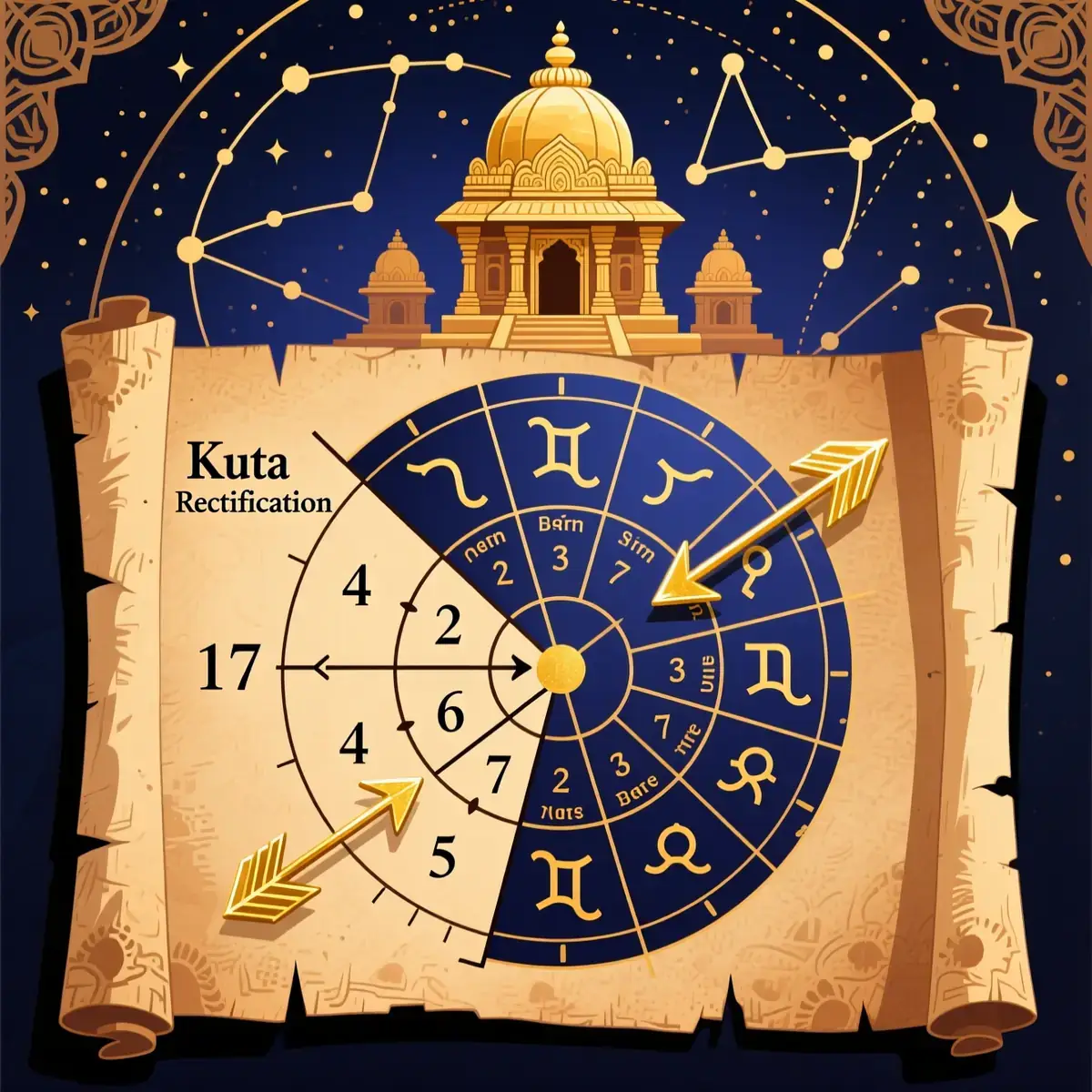
The text provides a highly specific algorithm using a "Base Number" (Kuta) of 49 to extract the four pillars of the natal chart: the Birth Star, Ascendant, Sun sign, and Jupiter sign.
The Formula for the Birth Star:
- Take the Base Number: 49 .
- Subtract the numerical value of the Arudha Lagna (e.g., Aries=12, Taurus=5... Scorpio=11).
- Multiply the remainder by 7 .
- Divide that product by 27 .
- The remainder gives the birth star, counting from Aswini.
Similar variations of this formula are used to derive the birth positions of the Sun (deducting 21 from 49), the Ascendant (deducting 14), and Jupiter (deducting 7). Note: Jupiter's 12-year cycle helps narrow down the exact year of birth.
2. Environmental Omens (Nimittas)
Prasna Marga, Chapter XXX, Stanzas 5–9
If the mathematical methods yield conflicting results, the astrologer breaks the tie using Nimittas (omens) observed at the exact moment the client asks the question. The environment provides a clue to the client's natal Moon sign:
"The science of nimittas is a deep one based perhaps on the appreciation of the fact that in Nature everything is interrelated and not isolated." — B.V. Raman
3. The Body Mapping Method (Sparsa)
Prasna Marga, Chapter XXX, Stanzas 29–33
Another method to determine the birth star is to observe which body part the querent unconsciously touches while asking the question. The body is mapped to the 27 Nakshatras:
- Head: Krittika
- Forehead: Rohini
- Ears: Aridra
- Neck: Makha
- Hands: Hasta
- Heart: Anuradha
- Navel: Sravana
- Feet: Bharani
4. Determining the Month of Birth
Prasna Marga, Chapter XXX, Stanzas 14–15
To find the solar month (which dictates the Sun sign), the astrologer looks at the placement of the Sun in the horary chart relative to the Arudha Lagna:
- If the Sun occupies the Arudha sign, the birth month is Gemini.
- If in the 12th from Arudha, the birth month is Cancer.
- If in the 11th from Arudha, the birth month is Leo.
- If the horary Ascendant falls in the first 15 degrees of a sign, the birth occurred in the Northern course of the Sun (Winter/Spring). If in the last 15 degrees, it occurred in the Southern course (Summer/Fall).
Key Takeaways from Chapter 30
- The Holographic Universe: Nashta Jataka relies on the principle that the moment a question is asked contains the exact "DNA" of the person asking it.
- Triangulation is Key: Because mathematical formulas can sometimes yield conflicting results, the astrologer must triangulate the answer using math, body language (sparsa), and environmental omens (nimittas).
- Jupiter Marks the Year: Because Jupiter takes roughly 12 years to orbit the Sun, determining the natal Jupiter sign is the key to locking down the client's approximate birth year.