Prasna Marga Chapter 26: Koopa Prasna - A Modern Guide
A chapter-by-chapter modern English guide to the classical Vedic astrology text by Harihara, translated by B.V. Raman.
Chapter 26 of 32 • Stanzas 1–70 • Topics: Koopa Prasna, Locating Water, Chandra Gupti Chakra, Vastu Purusha
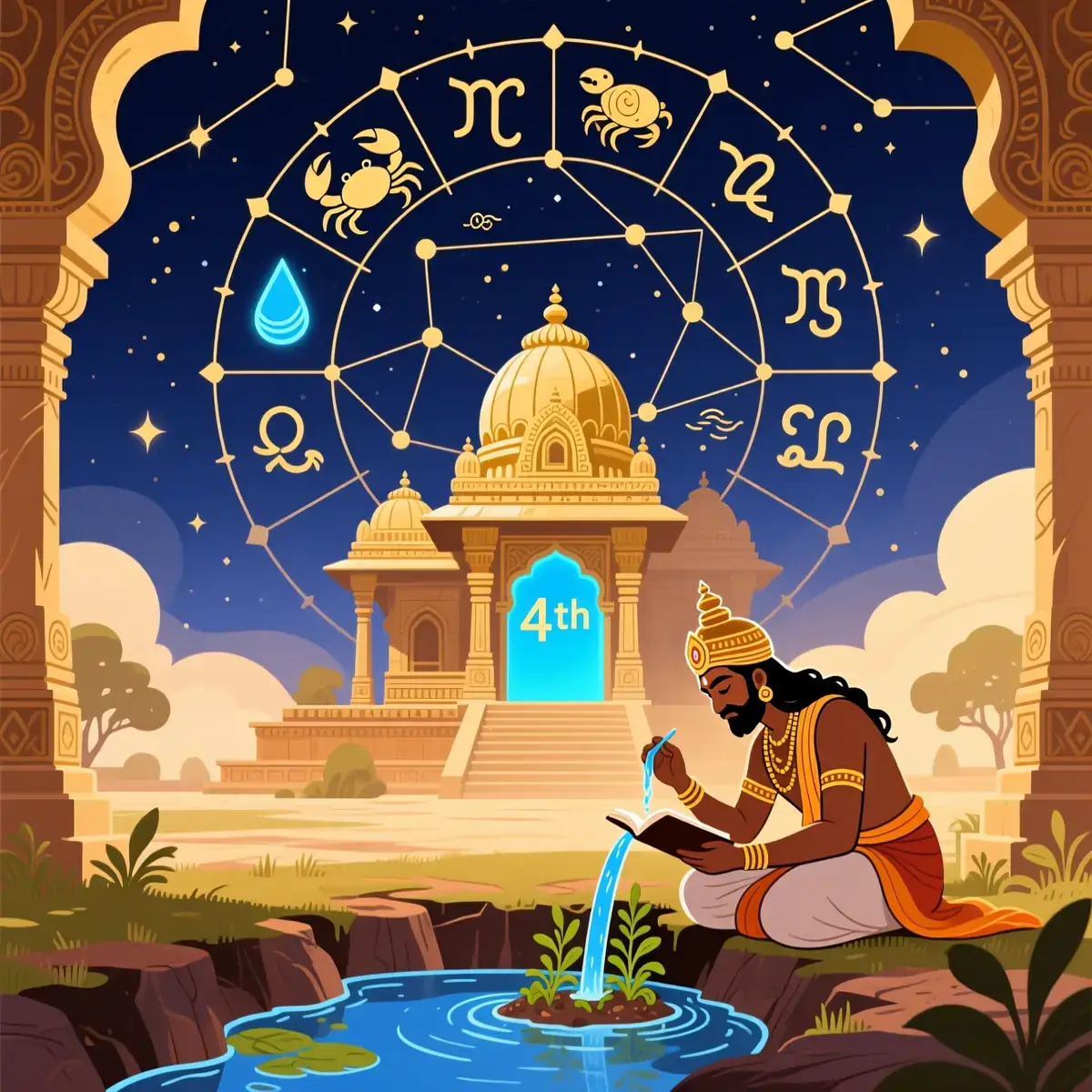
Chapter 26 introduces a highly specialized and practical application of horary astrology: Koopa Prasna . This is the ancient art of water divination—determining exactly where to dig a well, how deep the water lies, and what it will taste like.
In an era before geological surveys and ground-penetrating radar, the astrologer acted as the civil engineer, using planetary geometries, mathematical grids (the Chandra Gupti Chakra), and deep environmental observation to locate the life-giving element.
"In this chapter, I shall be detailing 'Kupa Prasna', explaining whether water can be had if a well is dug at a particular place."
1. The Primary Diagnosis: Is There Water?
Prasna Marga, Chapter XXVI, Stanzas 4–15
Before drawing complex charts, the astrologer looks for immediate validation from the environment and the horary chart.
Positive Indicators (Water Exists)
- The First Letter: If the first letter of the question is a "watery alphabet" (e.g., specific soft vowels or consonants).
- Body Language: If the questioner unconsciously touches their neck or face while asking.
- Planetary Alignment: If the Ascendant is a Watery Sign (Cancer, Scorpio, Pisces) and is occupied by the Moon. Also, if Venus and the Moon are exalted.
- Omens: Sighting a rainbow at the exact moment of the query guarantees the presence of an old, buried well.

2. The Chandra Gupti Chakra (The Water Grid)
Prasna Marga, Chapter XXVI, Stanzas 19–27
Once the presence of water is confirmed, the astrologer must pinpoint the exact spot to dig. They construct a mathematical grid called the Chandra Gupti Chakra .
- A grid of 28 squares is drawn, representing the 28 Nakshatras (including Abhijit) and the 8 cardinal directions.
- The astrologer calculates a specific daily star (Dinarsha) based on the exact time of the query.
- By counting from the Dinarsha to the Ascendant Star, and then to the Moon's Star through the grid pattern, a specific square is isolated.
The resulting square on the grid provides the exact compass direction (e.g., South-East) where the well should be dug.
3. How Deep Must We Dig?
Prasna Marga, Chapter XXVI, Stanzas 58–64
The depth of the water and the nature of the terrain are read from the planets occupying the Ascendant:
- The Sun: The water will be very deep in the ground.
- Mars: The water will be trapped between hard rocks.
- Moon & Venus: The well will be full and the water close to the surface.
- Moon & Mercury: There will be a sandy bottom from which the water sprouts easily.
Measuring Depth: The exact depth is calculated using Graha Rasmis (Planetary Rays). For example, Saturn contributes 21 rays, the Sun 16. In dry deserts, these numbers translate to the "average height of a man," meaning you may have to dig dozens of feet deep.
4. The Taste of the Water
Prasna Marga, Chapter XXVI, Stanzas 51–53, 60
Not all water is drinkable. The astrologer predicts the taste of the water based on the planet occupying or aspecting the 4th house (the house of ground/earth):
| Planet | Taste / Quality |
|---|---|
| Jupiter | Sweet, pure, and highly drinkable. |
| Venus | Good taste, slightly sour or mineral-rich. |
| Moon | Saltish. |
| Mars | Bitter taste. |
| Saturn | Brackish, pungent, and very small in quantity. |
| Rahu | Insipid, tasteless, or completely dry. |
5. The Rules of Vastu (Architecture)
Prasna Marga, Chapter XXVI, Stanzas 55–57
Even if astrology indicates water is present, one must respect the energetic architecture of the land (Vastu Sastra). The land is viewed as a living entity, the Vastu Purusha .
Wells must be dug in the spots corresponding to the "eyes, face, or mouths" of the Vastu Purusha (generally the North-East). Digging a well in the area corresponding to Agni (fire / South-East) or the astrological sign of Virgo is strictly forbidden, as it is believed to cause tragic or unnatural death to the owner.
Key Takeaways from Chapter 26
- Watery Signs Dominate: The presence of Cancer, Scorpio, or Pisces on the Ascendant, occupied by the Moon or Venus, guarantees water.
- The Subconscious Tell: If a person asks about a well while subconsciously touching their neck or face, the water is close and plentiful.
- The Chandra Gupti Grid: An advanced mathematical grid used to translate time (the exact minute of the query) into physical space (the exact compass direction to dig).
- Planetary Terrains: The Sun indicates deep digging, Mars indicates rocks, and Mercury/Moon indicates a soft sandy bottom.
- Vastu Compliance: Astrological location must always be balanced against architectural harmony (Vastu) to ensure the safety of the household.