Prasna Marga Chapter 15: The Roots of Suffering and Spiritual Remedies - A Modern Guide
A chapter-by-chapter modern English guide to the classical Vedic astrology text by Harihara, translated by B.V. Raman.
Chapter 15 of 32 • Stanzas 1–186 • Topics: Dridha & Adridha Karma, The Evil Eye, Ancestral Karma, Spiritual Remedies
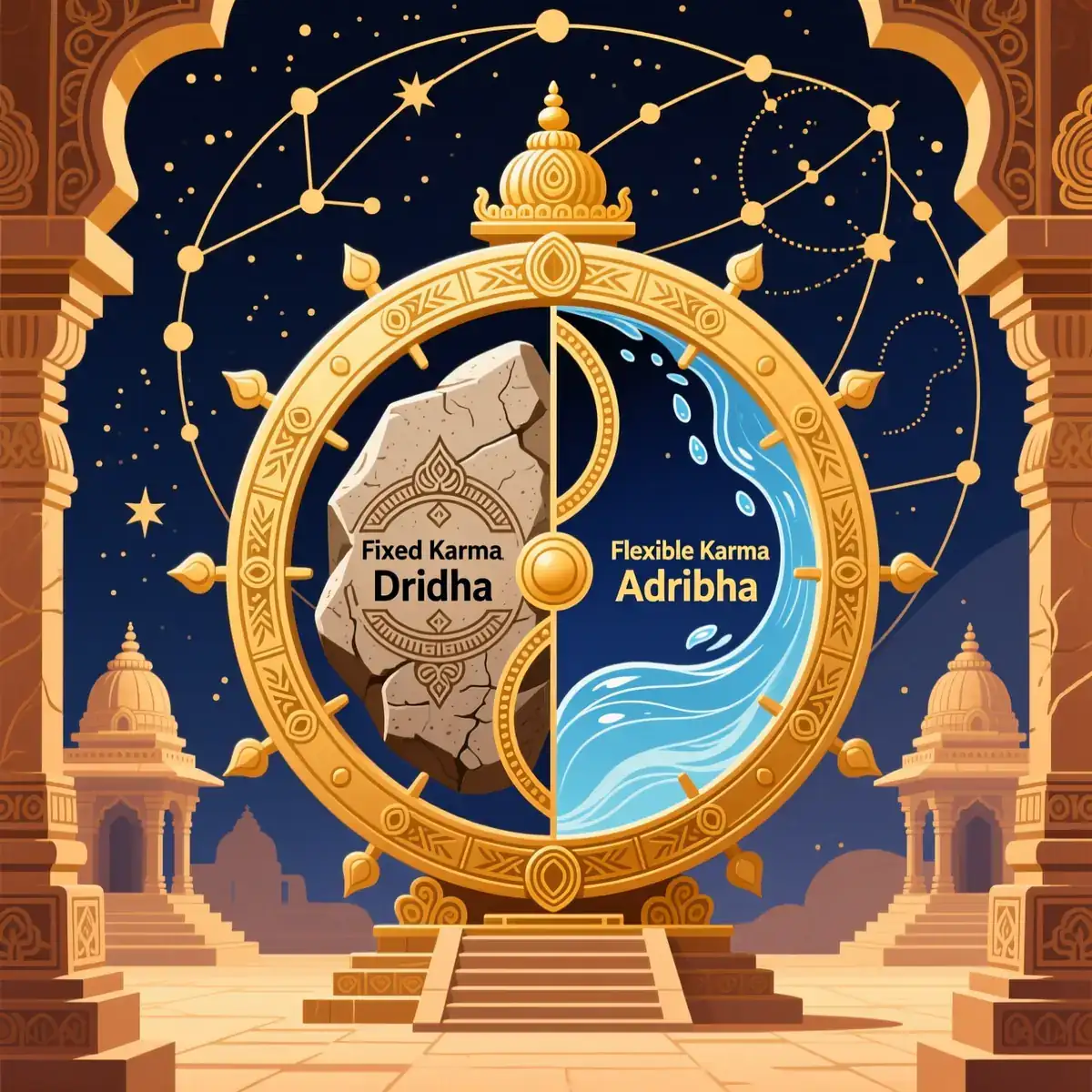
Why do bad things happen? Chapter 15 is the philosophical core of Prasna Marga . It moves away from predicting what will happen and asks why it is happening.
The text categorizes human misery into specific karmic roots—from intentional harm caused to others in the past, to ancestral baggage, to the subtle psychological phenomenon known as the "Evil Eye." It also provides the framework for mitigating this suffering through conscious action.
"The good and bad effects are the resultant of two kinds of Karma — Dridha and Adridha. These can again be subdivided into three types of action, viz., mental, verbal and physical."
1. The Two Types of Karma
Prasna Marga, Chapters XIV & XV
Vedic astrology does not believe in blind, unavoidable fate. It divides Karma into two categories, determined by whether the action creating the karma was intentional or accidental:
Dridha Karma (Fixed)
Karma created deliberately, with full awareness and intent. If the indicator planet is in the Moon's sign or Hora , the suffering is the result of a deliberate past action and is difficult to change.
Adridha Karma (Flexible)
Karma created accidentally or out of ignorance. If the indicator planet is in the Sun's sign or Hora , the suffering is unintended and can be easily mitigated through remedies and changed behavior.
Furthermore, karma is categorized by how it was enacted:
•
Mental (5th House):
Entertaining evil thoughts or ill will.
•
Verbal (2nd House):
Abusive language, lies, or cruel words.
•
Physical (10th House):
Actions that cause physical harm or destruction.
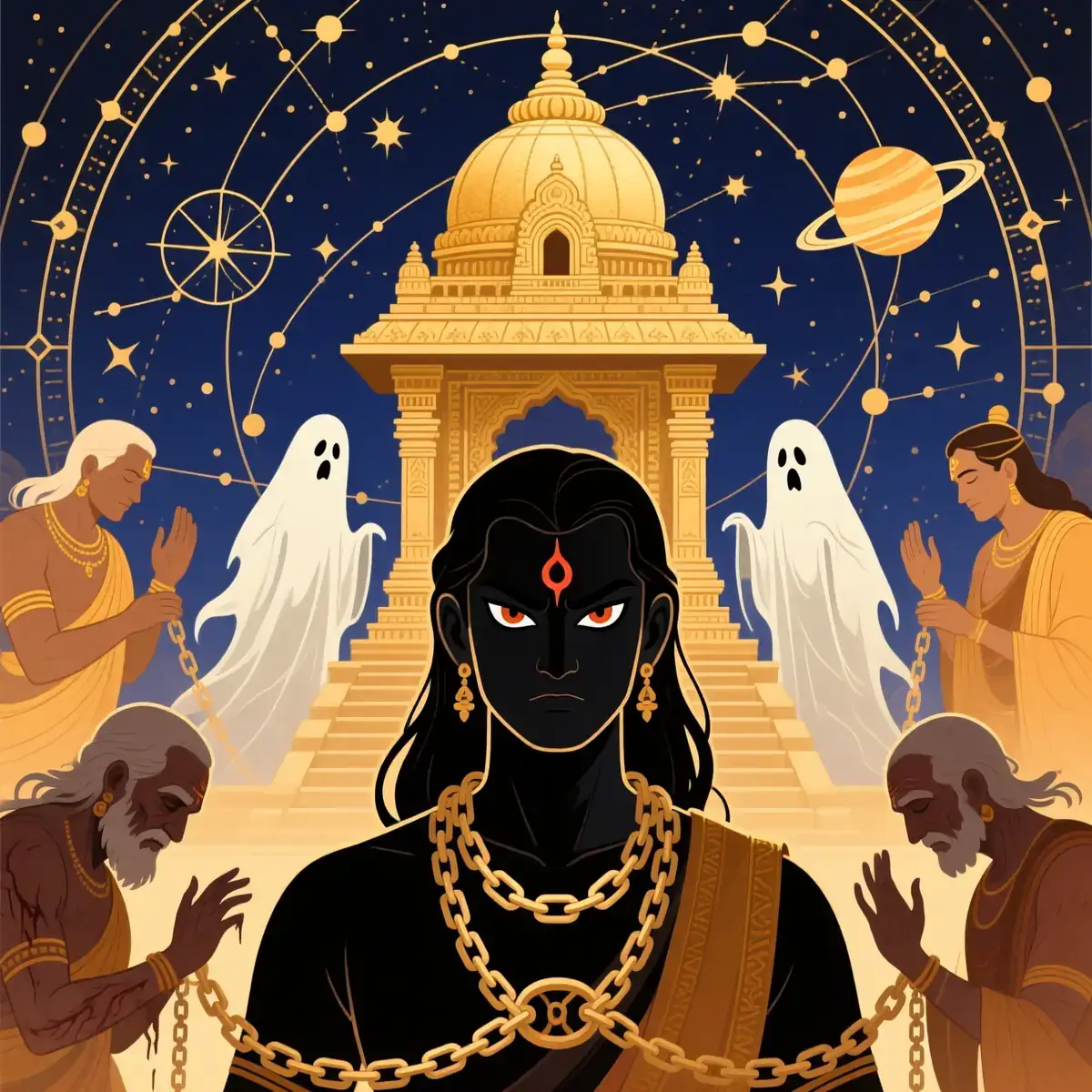
2. The 11 Sources of Human Misery
Prasna Marga, Chapter XV, Stanzas 1–41
When a person suffers, the text instructs the astrologer to locate the "Planet of Harm" (Badhaka) and see who or what has been offended. This isn't literal "anger from a god"—it's a metaphorical way of describing imbalances in universal laws.
| Astrological Indicator | Source of Misery | Modern Interpretation |
|---|---|---|
| Malefics in the 9th House | Wrath of Deities / Dharma | Betrayal of one's own highest spiritual principles or life purpose. |
| Sun/Mars in "House of Harm" | Parental Curses | Unresolved generational trauma or disrespecting one's roots. |
| 6th Lord in the 9th House | Curse of Preceptors | Disrespecting teachers, mentors, or abusing acquired knowledge. |
| Rahu in "House of Harm" | Anger of Serpent Gods | Environmental destruction, specifically cutting trees or poisoning earth. |
| Lord of 2nd or 11th afflicted | Misappropriated Property | Taking wealth that belongs to the community or a charitable cause. |
3. The Psychology of the "Evil Eye"
Prasna Marga, Chapter XV, Stanzas 51–53
Drishti Badha (the Evil Eye) is often misunderstood as superstition. In Prasna Marga, it is described as a vulnerability to negative psychological energy. The text explicitly lists who is most susceptible to "picking up" this negative energy:
- Overpowered by extreme fear or sorrow.
- Maddened with joy or excessively wealthy.
- Fatigued by extreme indulgence or exhaustion.
- Displaying immense beauty or wearing excessive ornaments in public.
- Experiencing intense life transitions (pregnancy, puberty, grief).
The Modern Translation: When your nervous system is dysregulated—either too high (manic joy/pride) or too low (exhaustion/fear)—your energetic boundaries drop, making you highly susceptible to the projections, jealousy, or negativity of others.
4. Troubles from Ghosts (Pretas)
Prasna Marga, Chapter XV, Stanzas 42–50
When Gulika (the shadow planet) occupies the "House of Harm," the text states the misery is caused by Pretas (ghosts).
"If the obsequies of a person have not been properly performed, his soul without getting the necessary liberation will be wandering as a ghost molesting his kith and kin."
Modern Context: This speaks directly to unresolved grief and generational trauma . When families fail to properly mourn, honor, or acknowledge the tragic or unnatural deaths of their ancestors (indicated by Gulika's connection to Mars or Saturn), that unhealed energy haunts the living descendants, manifesting as inherited anxiety or repeated family misfortunes.
5. Remedial Measures (Pariharas)
Prasna Marga, Chapter XV, Stanzas 12–19
The ancient system never diagnostics an illness without providing a cure. The remedies are tailored to the planet causing the affliction, aiming to rebalance that specific energy:
- Sun / Mars Affliction: Requires illumination (lighting lamps, finding clarity, bringing things into the open).
- Moon / Venus Affliction: Requires nourishment (offering milk, ghee, feeding the hungry, nurturing others).
- Jupiter Affliction: Requires respect (honoring teachers, supporting education, offering beautiful things).
- Saturn Affliction: Requires service (feeding the poor, giving away clothing, serving the marginalized).
Key Takeaways from Chapter 15
- Intent Matters: Dridha (intentional) karma is hard to change. Adridha (unintentional) karma is easily healed.
- The 3 Vectors: You create karma through your thoughts (5th house), words (2nd house), and actions (10th house).
- The Vulnerability of Extremes: You are most susceptible to negative energy (the Evil Eye) when you are emotionally or physically dysregulated.
- Ancestral Shadows: Unmourned trauma and ignored family history act like "ghosts" that disrupt the present.
- Action-Based Healing: Remedies are not just prayers; they require physical action (feeding, serving, creating light) corresponding to the afflicted planet.
Find Your Astrological Remedy
Looking to rebalance your planetary energies? Our remedy tool calculates your chart and suggests practical, action-based remedies based on ancient Vedic principles.
The mental, verbal or bodily nature of the Karma is revealed by the position of a malefic planet in the 5th, 2nd or 10th house.