Prasna Marga Chapter 1: Introduction to Vedic Astrology - A Modern Guide
A chapter-by-chapter modern English guide to the classical Vedic astrology text by Harihara, translated by B.V. Raman.
Chapter 1 of 32 • Stanzas 1–47 • Topics: Prayer, Branches of Astrology, Qualifications, Karma Theory
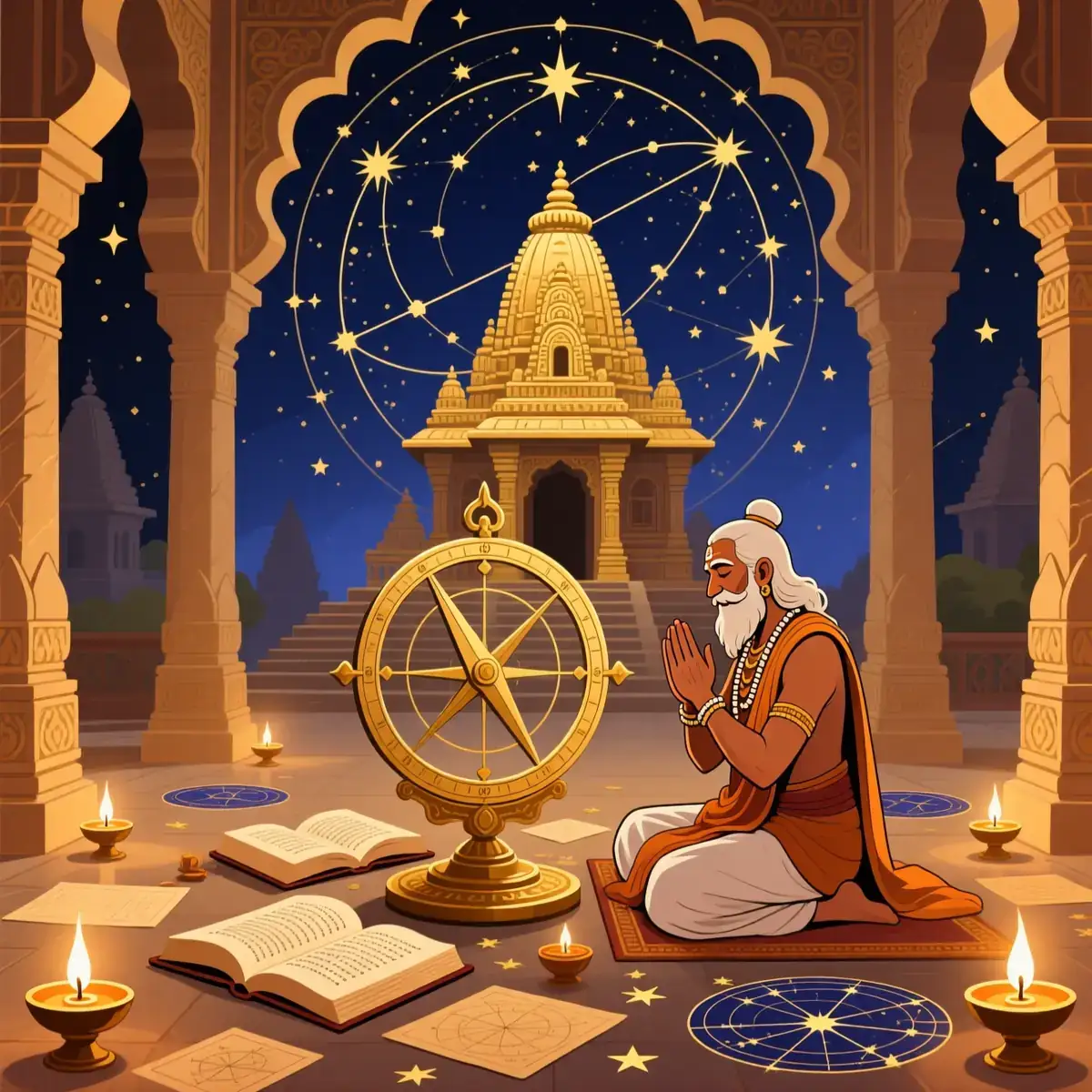
Prasna Marga begins, as all classical Indian texts do, with a prayer. But it quickly moves into something far more practical: a complete framework for understanding what astrology actually is, who is qualified to practice it, and why both birth charts and question-based charts (horary astrology) are needed to understand a person's life.
This first chapter lays the entire foundation. If you understand the ideas here — especially the relationship between karma and astrology — the rest of the book will make much more sense.
1. Opening Prayers
Prasna Marga, Chapter I, Stanzas 1–4
The author, Harihara, opens with four prayers asking for divine guidance. He prays to Lord Vishnu for an enlightened, expansive, and perfected mind. He then salutes his teachers and the planets, asking that his words carry truth. He honors his personal teacher (Guru Mangalasseri) and his village deity Lord Siva before beginning the text.
"I offer my sincere prayers to God Vishnu so that my mind may become enlightened, extensive and perfect."
"I salute my preceptors and the planets, so that they may bless my speech with purity and truth."
Why this matters: In Vedic tradition, there is a deeply held belief that technical knowledge alone does not make someone a good astrologer. One must also have Vaksiddhi — the "gift of correct speech" — which is believed to come through sincere prayer and devotion to one's teacher. This is why every classical text begins with an invocation: the author is asking not just for knowledge, but for the ability to communicate that knowledge truthfully.
2. The Three Branches of Astrology
Prasna Marga, Chapter I, Stanzas 5–8
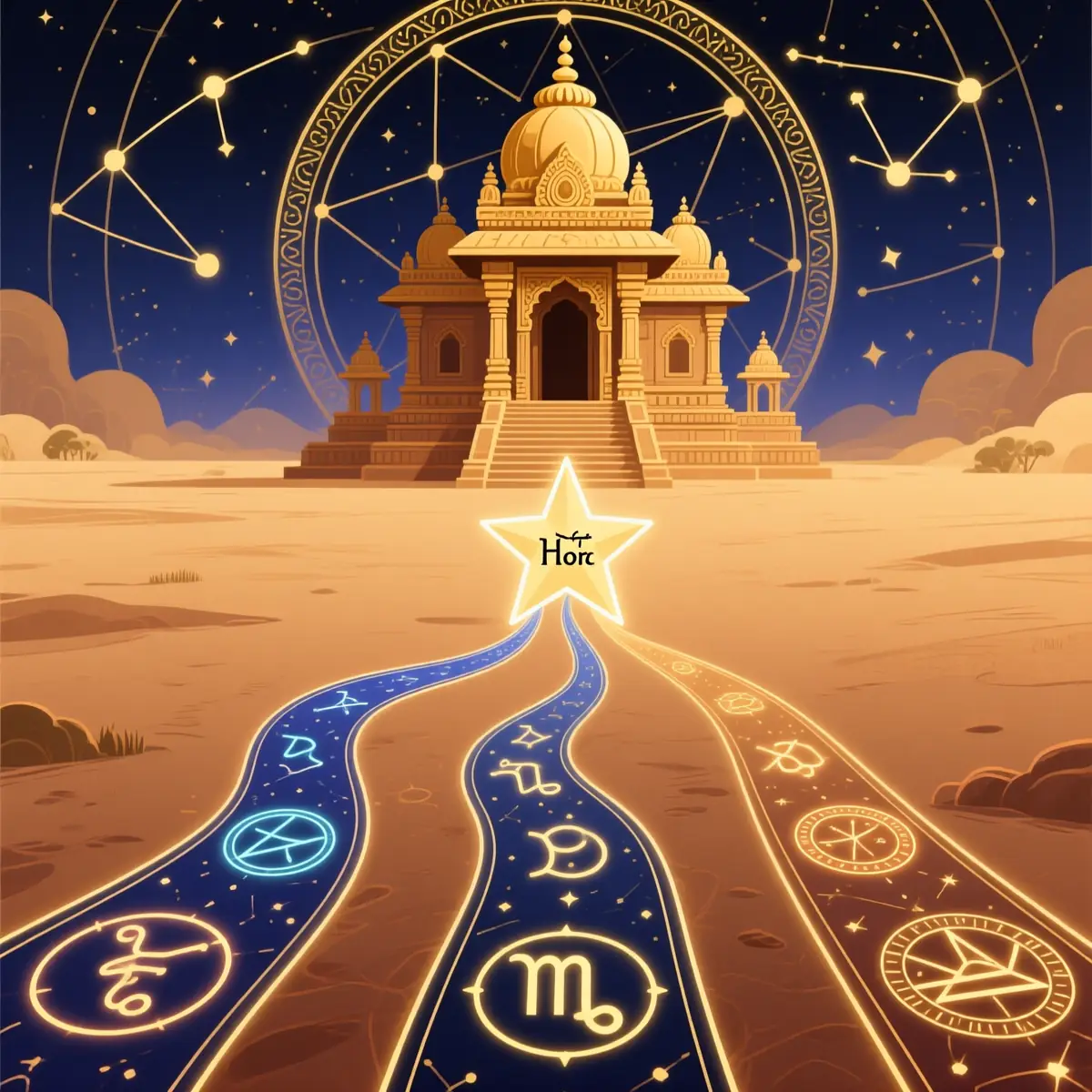
Vedic astrology is not a single subject — it is a vast field divided into three main branches (called Skandhas ) and six sub-disciplines (called Angas ).
The Three Main Branches
Ganita
Astronomy & Mathematics
Planetary positions, eclipses, orbital calculations —
the mathematical foundation of astrology.
Hora
Predictive Astrology
Birth charts, horary charts (Prasna), choosing good times
(Muhurtha), and interpreting omens.
Samhita
Worldly Phenomena
Weather prediction, national events, natural disasters,
crop forecasts, and omens in nature.
The Six Sub-Disciplines
| Name | What It Covers | Branch |
|---|---|---|
| Jataka | Predictions based on the birth chart (rising sign at birth) | Hora |
| Gola | Spherical astronomy — planetary orbits and movements | Ganita |
| Nimitta | Omens — interpreting signs and signals at a specific moment | Hora & Samhita |
| Prasna | Horary astrology — predictions based on the time a question is asked | Hora |
| Muhurtha | Electional astrology — choosing the best time for important actions | Hora |
| Ganita | Mathematical astronomy — calculating planetary longitudes and eclipses | Ganita |
"Samhita deals with the varying fortunes of the people, changes in weather and progress of the animal kingdom. It sketches also the nature and shape of meteors, shooting stars and all the wonderful natural phenomena."
Modern context: Think of Ganita as the "science" layer (like modern astronomy), Hora as the "personal consulting" layer (like a personal astrology reading), and Samhita as the "world events" layer (like geopolitical or weather forecasting). All three are considered essential parts of a complete astrological education.
3. Who Can Study Astrology?
Prasna Marga, Chapter I, Stanzas 9–14
The text first explains a key distinction: astrology has two sides. Pramana (the astronomical, demonstrable side) can be verified with calculations and measurements. Phala (the predictive, fruit-bearing side) deals with cause and effect — the results of past actions showing up in a person's life.
Astrology as the "Eye" of the Vedas
The text places astrology (Jyotisha) as the most important of the six limbs of Vedic knowledge, comparing it to eyesight:
| Vedic Limb | Body Part | Purpose |
|---|---|---|
| Jyotisha (Astrology) | Eyes | Seeing the future and understanding cosmic patterns |
| Chhandas | Feet | Vedic meters and hymn structures |
| Vyakarana | Face | Grammar and language rules |
| Kalpa | Hands | Ritual procedures and ceremonies |
| Siksha | Nose | Phonetics and pronunciation |
| Nirukta | Ears | Word meanings and etymology |
"As astrology is the eye of the Vedas, it is given the pride of place. No person possessing all the organs intact but without eyesight can have an individuality."
Open to Everyone
While Stanza 13 initially suggests the study should be limited to Brahmins, the very next stanza (Stanza 14) broadens the door wide open. It states that even people from other cultures (the text mentions Yavanas/Greeks and Mlechchas/Middle Eastern peoples) who are skilled in astrology are honored as highly as sages.
"When even Mlechchas and Yavanas well versed in astrology are held in the same esteem as Rishis, who would deny respect to an astrologer who happens to be a Brahmin?"
B.V. Raman, the translator, provides important context: the term "Brahmin" in the original text does not refer to a caste by birth, but to a person of pious character. He cites the Mahabharata: "Everyone is born a sudra and becomes a Brahmin through his deeds." The Bhagavad Gita says the same — classification is by nature and work, not by birth.
The key point: Astrology is open to anyone who approaches it with sincerity, discipline, and a desire for truth. This was a remarkably inclusive stance for an ancient text, and it reflects the historical fact that Indian, Greek, and Middle Eastern astronomical traditions were exchanging knowledge freely in the classical period.
4. Qualifications of an Astrologer
Prasna Marga, Chapter I, Stanzas 15–18
What does it take to be a true astrologer — a Daivajnya (literally, "one who knows the divine")? The text sets a very high bar:
- Mastery of the science — deep knowledge of astrological principles
- Strong mathematics — ability to calculate planetary positions accurately
- Religious and ethical life — personal discipline and moral integrity
- Truthfulness — commitment to honest predictions, even when the truth is difficult
- Humility — free from arrogance and conceit
- Knowledge of Vedas, mantras, and tantras — spiritual grounding
- Understanding of planetary motions — the ten types of astronomical calculations
- Initiation by a teacher — receiving a secret mantra from a qualified Guru
"That person, who has mastery of this science, who has a good knowledge of mathematics, who leads a religious life, who is truthful, who is free from conceit and who is well versed in the Vedas, mantras and tantras, he alone can be called a Daivajnya or seer."
"All the predictions made by such a person will come true and will never be false."
Varahamihira (the most famous ancient astrologer, cited throughout Prasna Marga) adds further qualifications: noble bearing, agreeable appearance, humility, disciplined personal habits, and proficiency in ceremonies. But the most important quality is intuition — developed through disciplined living, faith, and austerity.
Modern context: Today we might frame these qualifications as: strong technical skills, mathematical literacy, ethical practice, continuous learning, mentorship under an experienced practitioner, and intellectual humility. The text's core message is that astrology demands both scientific rigor and personal integrity.
5. The Ten Types of Astronomical Calculation
Prasna Marga, Chapter I, Stanzas 19–20
An astrologer was expected to know ten kinds of mathematical calculations. These correspond to the computational skills needed to track celestial objects accurately:
- Kali Day — The number of days since the start of the Kali Yuga (a continuous day count, similar to a Julian Day Number in modern astronomy)
- Mean Positions — Where planets would be if they moved at a constant speed (assumes circular orbits)
- True Positions — Corrected planetary positions accounting for elliptical orbits
- Solar Eclipses — Calculating when and where solar eclipses occur
- Lunar Eclipses — Predicting lunar eclipses
- Planetary Wars — When two planets come within 1 degree of each other (Graha Yuddha)
- Lunar Conjunctions — The Moon's alignment with planets
- Combustion — When planets get too close to the Sun and become invisible (each planet has a specific threshold, e.g., Jupiter at 11 degrees, Mars at 17 degrees)
- Heliacal Rising & Setting — When planets first become visible after or disappear before conjunction with the Sun
- Planetary-Constellation Conjunctions — When planets align with specific star groups (Nakshatras)
Modern context: Today, these calculations are handled by computer software and ephemerides. But in the classical era, an astrologer needed to perform all of these by hand — making mathematical skill an absolute requirement.
6. The Five Siddhantas (Astronomical Systems)
Prasna Marga, Chapter I, Stanzas 21–23
Ancient Indian astronomy had multiple competing systems for calculating planetary positions, called Siddhantas . The text lists five and ranks their accuracy:
| Siddhanta | Accuracy Rating |
|---|---|
| Surya Siddhanta | Most accurate |
| Romasa Siddhanta | More accurate |
| Brahma Siddhanta | Accurate |
| Vasishta Siddhanta | Not accurate (archaic) |
| Poulasa Siddhanta | Not accurate (archaic) |
"Brahma Siddhanta is accurate. Romasa is more accurate and Surya is the most accurate. Vasishta and Poulasa are not accurate. The first three can be relied upon."
B.V. Raman notes that Hindu astronomy actually references 18 Siddhantas in total, but only five were considered authoritative by Varahamihira. Interestingly, Varahamihira's own ranking in his Pancha-Siddhantika differs slightly from Prasna Marga's, but both agree that the Surya Siddhanta is the best.
Modern context: Think of these as competing astronomical models, similar to how modern science has different coordinate systems or ephemeris standards (JPL DE440, VSOP2013, etc.). The key takeaway is that accuracy of the underlying calculations was taken very seriously.
7. How to Begin Studying Astrology
Prasna Marga, Chapter I, Stanzas 24–27
The text prescribes a specific method for beginning one's astrological education:
- Receive initiation into a mantra from a qualified Guru at an auspicious time. Properly practice this mantra to honor its presiding deity.
- Choose the right moment to start — begin studying when Jupiter is in the ascendant (Lagna) and the Moon occupies favorable divisions (specifically mridu /soft constellations like Mrigasira, Anuradha, Revati, or seeghra /swift ones like Aswini, Hasta, Pushyami).
- Worship the nine planets (Navagrahas) and your teacher before beginning study.
"Mantras when properly practised and recited give the desired results. So does this science when properly cultivated."
The Navagraha worship is explained as more than ritual: the planets are believed to have both physical and subtle (spiritual) aspects. The worship creates a "resonance between the thought-vibrations of the individual and those released from the planetary bodies."
8. The Importance of Varahamihira
Prasna Marga, Chapter I, Stanzas 28–32
The text strongly recommends two books as essential reading for any astrologer:
- Brihat Jataka by Varahamihira — the foundational text on natal astrology (birth chart reading). Described as "short but very suggestive, pregnant with ideas."
- Krishneeya — a text focused on Prasna (horary astrology).
"One wearing the garland of Varahamihira in his neck along with the necklace of Krishneeya can win laurels in any astrological assembly."
Special emphasis is placed on the Dasadhyayi , a commentary on the first ten chapters of Brihat Jataka. The author considers it so essential that he compares studying astrology without it to "trying to cross an ocean without a boat" (Stanza 32).
The Dasadhyayi is unique because it reads hidden, deeper meanings into Varahamihira's verses. For example, the very first stanza of Brihat Jataka, which appears to be a simple prayer to the Sun, is shown by the Dasadhyayi to contain encoded methods for casting unknown horoscopes and even a count of the total number of stanzas in the entire work (383), embedded through a numerical cipher system.
Modern context: Varahamihira (c. 505–587 CE) is to Vedic astrology what Ptolemy is to Western astrology — the most cited classical authority. His works remain studied today, and Prasna Marga treats them as required reading.
9. Karma and the Role of Astrology
Prasna Marga, Chapter I, Stanzas 33–37
These stanzas present one of the most important ideas in the entire book: the theory of Karma and how astrology relates to it.
According to Prasna Marga, a person is born to experience the consequences of actions from past lives. Some of this karma is experienced in heavenly or hellish states between lives, but the remainder must be lived through in human form.
Two Types of Karma
Sanchita Karma
The total accumulated karma from all past lives. Exhausted through experiences between lifetimes (in "heaven" or "hell").
Prarabdha Karma
The portion of karma that must be experienced in this life. Can only be resolved by living through it. This is what the birth chart reveals.
"Just as a lamp illumines objects in darkness, astrology reveals to us the effects of our previous Karma, good or bad. All the planets indicate clearly whether we are enjoying or suffering now as a result of our actions in our previous birth."
A critical distinction: The text explicitly states that planets do not cause events — they only indicate them. Planets are an index, a readout of karma, not the source of fortune or misfortune. This is a point that almost all classical writers agree on, and it is foundational to the Vedic astrological worldview.
10. The Importance of Good Timing (Muhurtha)
Prasna Marga, Chapter I, Stanzas 38–44
Having explained that astrology reveals karma, the text now asks: if everything is predetermined by past actions, what is the point of choosing auspicious times? The answer is profound — timing matters because new karma is constantly being created.
"What is done at an auspicious moment results in happiness. What is done at an inauspicious time, begets evil. However remote our deeds, the results are bound to be experienced in the family."
An important idea surfaces here: accumulated karma does not only affect the individual who created it — its effects can ripple through the family and descendants. This is why choosing the right time for important actions (marriage, starting a business, building a house) is taken so seriously.
Why Do We Need Horary (Prasna) Charts?
The text raises a natural question in Stanza 40: if the birth chart already shows everything about a person's life from birth to death, what is the point of a horary (question-based) chart?
The answer (Stanzas 41–44) introduces a brilliant diagnostic framework:
| Birth Chart | Prasna Chart | Conclusion |
|---|---|---|
| Good period | Bad indicators | The person is suffering from bad karma created in this life |
| Bad period | Good indicators | The person is benefiting from good karma created in this life |
| Both charts show similar patterns | The person is experiencing karma from a past life | |
This is why Prasna Marga considers both charts essential: the birth chart shows the overall karmic blueprint, while the Prasna chart acts as a real-time diagnostic tool that reveals whether current circumstances stem from past-life karma or from actions taken in this life.
11. Birth Charts and Horary Charts Are Read the Same Way
Prasna Marga, Chapter I, Stanzas 45–47
The chapter ends with a key practical principle: a Prasna (horary) chart should be read exactly like a birth chart . The same rules, the same house significations, the same planetary analysis — all apply.
"A person goes to an astrologer prompted by Providence to know his future. Therefore there is a close similarity between Prasna and Jataka."
"As Prasna Lagna is similar to Janma Lagna, all events should be read from Prasna as you would do in a horoscope."
The reasoning is elegant: just as a person's birth time is cosmically significant (regulated by karma), so too is the moment when a person feels compelled to ask a question. The impulse to seek an astrologer is itself guided by a "Divine force," making the question-time chart a valid mirror of the person's karmic situation.
The author notes that while the two chart types are read similarly, there are some differences in technique which are detailed later in Chapters 14 and 17. Unless otherwise stated, however, all principles that apply to reading birth charts also apply to Prasna charts.
Key Takeaways from Chapter 1
- Vedic astrology has three branches: Ganita (astronomy), Hora (personal prediction), and Samhita (world events), further divided into six sub-disciplines.
- Anyone can study astrology regardless of background — what matters is sincerity, discipline, and ethical character.
- A qualified astrologer needs both technical mastery (mathematics, astronomy) and personal qualities (truthfulness, humility, spiritual practice).
- Planets do not cause events — they indicate karma. Astrology is a readout of past actions, not a mechanism of fate.
- Both birth charts and horary (Prasna) charts are needed: the birth chart shows the overall karmic blueprint, while the Prasna chart reveals whether current events stem from past-life or present-life karma.
- The Surya Siddhanta is the most accurate of the five classical astronomical systems.
- Brihat Jataka by Varahamihira and its commentary Dasadhyayi are considered essential reading.
Try Prasna Marga Calculations
Experience the Prasna Marga system in action with our free Horary Astrology tool, which applies these ancient principles automatically.
Just as a lamp illumines objects in darkness, astrology reveals to us the effects of our previous Karma