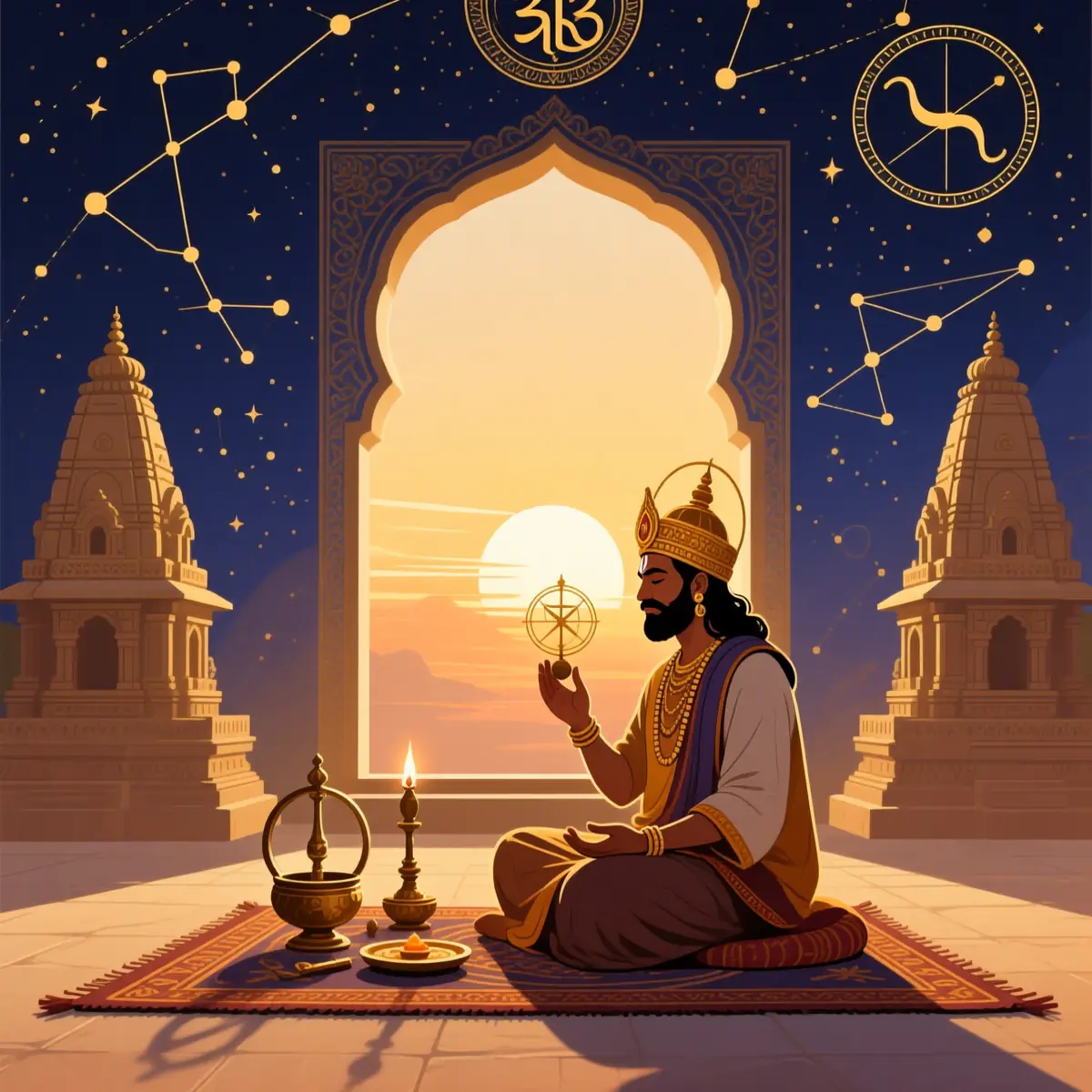
If Chapter 1 was about what astrology is, Chapter 2 is about how it is actually practiced.
This is one of the longest and most detailed chapters in the entire book. It reads almost like a
training manual for the working astrologer — covering everything from how to start your morning,
to how to read a client's body language, to the science of breath analysis.
The core idea is that a horary reading involves far more than just looking at a chart. The astrologer
must observe 14 different factors simultaneously: the time, the place, their own breath,
the client's direction, posture, dress, mood, touch, words, and any omens in the environment.
Everything happening at the moment of the question is considered meaningful.
1. The Astrologer's Morning Routine
Prasna Marga, Chapter II, Stanzas 1–2
The chapter opens with a surprisingly detailed description of how an astrologer should begin each day:
Rise early in the morning
Pray to the family deity
Bathe and perform daily spiritual practices (Nitya Karmas)
Recite mantras (Mantra Japa) invoking the presiding deity
Study the day's planetary positions using an almanac
Remain calm, free from anxiety, and ready to receive visitors
"An astrologer should get up early in the morning, pray to the family Deity, cleanse the various parts of the body, bathe, do his Nitya Karmas and perform mantra japa... study the planets with the help of an almanac and remain calm without being ruffled by any anxieties, ever expecting the visit of someone anxious to have his difficulties solved."
When someone arrives, the astrologer must carefully observe their appearance, dress, movements,
and actions — while also monitoring their own breathing pattern. This dual observation
(internal and external) is the foundation of the practice described in the rest of this chapter.
2. How the Client Should Approach
Prasna Marga, Chapter II, Stanzas 3–6
The person asking a question (the querent) also has responsibilities:
Choose an auspicious lunar day, constellation, and weekday for the visit
Come early in the morning with a humble attitude
Bring respectful offerings (traditionally flowers, betel leaves, or small gifts)
The text also establishes a professional code of ethics:
Professional Ethics: An astrologer should never give unsolicited predictions
or make predictions for people who are merely testing the astrologer's abilities. However,
anyone who genuinely wants to know their future — whether they explicitly ask or not —
deserves a reading.
"Those who have a desire to know the future, whether they ask or not, deserve to be given predictions on the basis of Arudha at the time of Prasna."
3. Arudha Lagna — The Directional Rising Sign
Prasna Marga, Chapter II, Stanzas 7–11
One of the most important concepts in Prasna Marga is the Arudha Lagna —
a rising sign determined not by the time of day, but by the direction the client faces
when asking their question. Each of the eight compass directions corresponds to specific zodiac signs:
Direction
Zodiac Sign(s)
East
Aries & Taurus
South-East
Gemini
South
Cancer & Leo
South-West
Virgo
West
Libra & Scorpio
North-West
Sagittarius
North
Capricorn & Aquarius
North-East
Pisces
If the direction is ambiguous, the astrologer should draw a circle with all directions marked,
invoke the deities, and ask the client to place a gold piece on the circle.
The sign corresponding to that direction becomes the Arudha Lagna for the reading.
Modern context: The Arudha Lagna creates an additional chart layer independent of the
birth chart. It represents the immediate, situational "signature" of the question itself —
a snapshot of the moment's energy based on physical positioning rather than planetary calculation.
4. The 14 Factors to Observe
Prasna Marga, Chapter II, Stanza 12
When a question is put to the astrologer, the text lists 14 critical factors
that must be observed simultaneously:
Exact time (Samaya)
Nature of the location (Desa)
Astrologer's breath pattern (Swarayu)
Astrologer's mental state (Avastha)
What the client touches (Sparsa)
Directional rising sign (Arudha Rasi)
Direction faced (Dik)
Letters of words uttered (Prasnakshara)
Client's posture (Sthiti)
Client's movements (Cheshta)
Client's mental attitude (Bhava)
Direction of the client's gaze (Vilokana)
Client's clothing (Vasanam)
Ominous sounds or signs (Nimittas)
This is remarkable because it shows that the ancient system treated the horary consultation as a
holistic event. The chart is just one input. The astrologer's own body, the client's behavior,
and the environment are all considered part of the answer.
5. How to Read the Results
Prasna Marga, Chapter II, Stanzas 13–15
The astrologer must observe omens throughout the entire consultation — from leaving their own house,
while traveling to the client, upon entering the client's home, and during the preparation of the
astrological chart (Chakra). Results are synthesized from:
The Sutra and Thrisphuta calculations
The Ashtamangala number (from cowrie shells)
The Arudha sign and gold piece position
The rising sign (Lagna) and Moon's position
Planetary states and house (Bhava) significations
The reading should reveal: God's grace or displeasure, trouble from enemies, diseases,
and appropriate remedies.
"Prasna takes into account not only the external influences, the planets, but also the internal ones, the psychic impulses which mould life."
A key condition for accuracy: The astrologer must be calm and centered, and the client must
be sincere and humble. When both conditions are met, the reading will be reliable.
6. The 22 Inauspicious Times for Queries
Prasna Marga, Chapter II, Stanzas 16–21
Not every moment is suitable for asking a question. The text lists 22 doshas
(afflictions or unfavorable conditions) that make a query unreliable. These include:
#
Dosha (Affliction)
Explanation
1
Inauspicious constellations
11 specific Nakshatras (Bharani, Krittika, Aridra, Aslesha, Makha, etc.)
2
Gandantha
Junction points between water and fire signs in the Nakshatras
3
Ushna & Visha periods
Specific toxic time segments within constellations
4
Evil lunar days
The 4th, 8th, 9th, and 14th tithis (Riktha Thithis)
5
Vishti Karana
A specific half-lunar-day calculation
6
Junctional points
Transition moments between tithis, nakshatras, rasis, or amsas
7
Gulikodaya
The time when Gulika rises (specific to each weekday)
8
Vyathipatha
An evil yoga (planetary combination)
9
Eclipses
3 days before and after any eclipse
10
Ekargala
A calculated evil yoga
11
Mrityu & Dagdha Yogas
Specific day-constellation combinations indicating "death" or "burning"
12
Malefics in Lagna
Sun, Mars, Saturn, or Rahu rising or aspecting the ascendant
13
Dusk (Pradosha)
The transition period at sunset
14
Midnight (Nishi)
Queries at midnight
15
Sankranti
When the Sun moves from one sign to another
16
Hostile birth-star relations
Query constellation is the 3rd, 5th, or 7th from the client's birth star
17
8th house conflicts
Query Lagna is 8th from birth Lagna, or query Moon is 8th from natal Moon
Modern context: While modern practitioners may not follow all 22 conditions strictly,
the underlying principle is important: timing affects the quality of a reading.
An astrologer should be aware of the planetary conditions at the moment of consultation
and factor them into the interpretation.
7. The Influence of Location
Prasna Marga, Chapter II, Stanzas 22–27
The environment where the question is asked also influences the reading:
Favorable Locations
Gardens with flowering trees
Clean, well-maintained spaces
Places with precious metals or gems
Homes celebrating auspicious events
Homes with healthy, smiling families
Unfavorable Locations
Cremation grounds
Bleak, deserted, or rugged places
Homes with illness or poverty
Places near lifeless trees or stagnant water
Any spot that "sickens the mind"
8. The Science of Breath (Swara Sastra)
Prasna Marga, Chapter II, Stanzas 28–64
This is the longest section in the chapter and one of the most unique features of Prasna Marga.
Swara Sastra is the science of reading one's own breathing pattern as a predictive tool.
Every morning, the astrologer checks which nostril their breath flows through more strongly.
Basic Rule: Left vs Right Nostril
Day
Favorable Nostril
Monday, Wednesday, Thursday, Friday
Left nostril (Ida / Moon)
Sunday, Tuesday, Saturday
Right nostril (Pingala / Sun)
Breathing through the wrong nostril for the day predicts specific troubles:
Wrong nostril on Sunday: Full body pain
Wrong nostril on Monday: Quarrels
Wrong nostril on Tuesday: Danger to self or relatives
Wrong nostril on Wednesday: Distant, unplanned travel
Wrong nostril on Thursday: Calamities to the country
Wrong nostril on Friday: Failure in all undertakings
Wrong nostril on Saturday: Monetary loss, crop failure
The Five Elements in Breath
The breath is further classified by the element (Bhuta) it carries. This is determined by
how far the breath extends from the nostril (measured in finger-widths):
Element
Breath Distance
Favorable For
Prithvi (Earth)
16 finger-widths
Building houses, coronation ceremonies
Apa (Water)
12 finger-widths
Digging wells, marriages
Teja (Fire)
8 finger-widths
Combat, confrontation
Vayu (Air)
6 finger-widths
Travel, movement
Akasa (Ether)
3 finger-widths
Temple building, spiritual initiation
The Three Channels (Nadis)
Ida
Left nostril Moon-governed Good for starting travel
Pingala
Right nostril Sun-governed Good for arriving at destinations
Sushumna
Central / both Fire-governed Only for yogic practice
"If one wants to succeed easily in any undertaking in life, one should start when the breath is in the left and reach his destination when the breath is in the right."
Breath Analysis for Health Questions
Client asks from the same side as active nostril → Illness will be cured
Client asks from the opposite side → Illness will be difficult to treat
Question asked during inhalation → Relief
Question asked during exhalation → Danger
Breath Analysis for Pregnancy
Seeing a pregnant woman while breathing through the right nostril → Male child
Seeing her while breathing through the left nostril → Female child
Breath flowing through both sides equally → Twins
Modern context: While this may seem esoteric, Swara Sastra has parallels in modern
understanding of the nasal cycle — a well-documented biological phenomenon where airflow
alternates between nostrils every 2–4 hours, linked to autonomic nervous system dominance.
Yoga traditions (Pranayama) have long used nostril-specific breathing for therapeutic purposes.
9. Touch Analysis (Sparsa)
Prasna Marga, Chapter II, Stanzas 65–76
When a client approaches, the body part they unconsciously touch reveals information about their situation:
Auspicious Touches
Chest, heart area, or touching auspicious objects — predict good outcomes
Inauspicious Touches
Navel, nose, mouth, hair, nails, teeth, joints, palms, or soles — predict difficulties
The text then maps eight directions to body parts and symbolic animals (Yonis):
Direction
Animal Symbol
Body Part
East
Flag (Dhwaja)
Head
South-East
Smoke (Dhuma)
Nose
South
Lion (Simha)
Mouth / Face
South-West
Dog
Eyes / Ears
West
Bull (Vrishabha)
Neck
North-West
Ass (Khara)
Arms / Hands
North
Elephant (Gaja)
Chest
North-East
Crow (Kaka)
Legs
The combination of the client's facing direction and the body part they touch creates a matrix
of predictions. For example: a person facing East who touches their head
indicates gaining money; touching the chest while facing East indicates receiving ornaments.
"In any query regarding longevity, the cure of a sick man will depend on the Avastha, state of the messenger or astrologer at the time of query."
10. Reading the Client's Recent Past from the Chart
Prasna Marga, Chapter II, Stanzas 77–101
This section teaches a remarkable verification technique. By analyzing the Arudha Lagna
and its 5th and 8th houses, the astrologer can describe what happened to the client
on their way to the consultation — effectively proving the chart's accuracy before
the main reading even begins.
For example, each planet in the 8th house from Arudha indicates a specific event
that happened to the client on the corresponding day of the week:
Planet in 8th
Indicates
Sun
Royal displeasure or army trouble (last Sunday)
Moon
Client went hungry or ate poorly (last Monday)
Mars
A fall or injury (last Tuesday)
Mercury
Work obstruction or speech problems (last Wednesday)
Jupiter
Delayed religious duties or lost articles (last Thursday)
Venus
Separation from a loved one (last Friday)
Saturn
Ate late or faced great danger (last Saturday)
Rahu
Leg pain from stones or thorns
The types of people encountered en route are also indicated: Rahu/Saturn suggest low-ranking people;
Jupiter/Venus suggest learned or pious people; Sun suggests officials or authority figures;
Moon/Venus suggest women.
11. Letter Analysis (Pranakshara)
Prasna Marga, Chapter II, Stanzas 104–114
The first syllable of the client's question carries meaning. This is a form of
phonetic divination — reading the future through the sounds in spoken words.
If the question begins with a vowel: The issue relates to longevity; physical troubles are temporary
If the question begins with a consonant: Longevity may be affected; physical symptoms are less concerning
The consonants are further classified into five groups, each governed by a different element
(Air, Fire, Indra/Neutral, Water, or an extremely inauspicious category). The text also describes
eight Ganas (syllable pattern groups), each presided over by a different element or deity,
producing outcomes ranging from "world renown" and "exceptional prosperity" to "poverty" and "death."
Each Sanskrit consonant group is also mapped to a planet, allowing the astrologer to determine
the rising sign from the first letter of the query itself — an independent way to verify the
Lagna calculation.
12. Reading the Client's Body Language
Prasna Marga, Chapter II, Stanzas 102–131
The text devotes considerable attention to observing the client's physical presentation.
This covers four areas:
Direction (Stanzas 102–103)
Men: Cardinal directions (East, South, West, North) are favorable; intermediate directions are not
Women: The reverse applies
South is always negative for longevity questions
Posture & Movement (Stanzas 115–119)
Good Signs
Left foot forward
Standing firmly
Sitting at ease, facing the astrologer
Seated on a good seat, at an elevated place
Sitting, then standing, then sitting again
Bad Signs
Right foot forward
Leg shaking
Sitting on a low or bad seat
Multiple halts on the way (predicts equal delays)
A stranger crossing between client and astrologer
Behaviour Patterns (Stanzas 120–124)
A long list of inauspicious behaviors is given, including: shaking or wringing hands,
looking sideways, forgetting the purpose of the visit, striking their own body or nearby
objects, weeping, disheveled hair, sleepiness, uncleanliness, carrying inauspicious objects
(rope, broom, leather, ashes), or appearing sickly.
Mood & Dress (Stanzas 125–129)
Good mood indicators: Handsome appearance, healthy, modest bearing, happy face, eyes wide open looking at auspicious objects
Bad mood indicators: Face distorted by anger, sorrow, or exhaustion; eyes half-closed; looking downward or at inauspicious objects
Good dress: White, neat clothes; fine ornaments; fragrant white flowers
Bad dress: Wet, torn, or dirty clothes; red or blue colors; red flowers
The synthesis rule (Stanzas 130–131): If the astrologer is calm and the client's
posture, movements, and appearance are favorable, predict good outcomes. If unfavorable, predict
difficulties. Mixed signs yield mixed results, proportional to the balance of good and bad indicators.
13. Omens at the Time of the Query (Tatkala Lakshanas)
Prasna Marga, Chapter II, Stanzas 132–158
The chapter concludes with an extensive catalog of omens — environmental signs that
occur at the exact moment of the query. These are interpreted differently depending
on what topic the question concerns.
Marriage Questions
Good omen: Seeing someone in fresh clothes, or two people approaching together
Bad omen: Two people bidding farewell and parting ways
Questions About Children
Good: Seeing a book, pen, jingling bangles, child ornaments, a pregnant woman, or smiling children
Bad: Seeing someone cleaning themselves, walking away, or a brilliantly burning fire (indicates miscarriage)
Health Questions
Good: Seeing a living being, or a person on horseback or elephant (indicates immediate cure)
Bad: Standing on a lifeless object (indicates death)
Travel Questions
Good: The messenger gets up and walks immediately
Bad: Sitting or lying down (indicates obstruction)
General Evil Omens
Intermittent cries of "Oh! Oh!"
A flag-post or sacred tree falling
A light unexpectedly going out
A water vessel tumbling over
Hearing words related to "ruin" or "loss"
Sighting of cats, owls, or snakes on the left side
Auspicious Signs
Musical sounds: veena, flute, drum, conch
Sighting of: a pot of curd, colored rice, sugarcane, fresh flowers, garlands, fruits, a cow and calf
Hearing Vedic hymns or pleasant conversation
Seeing: an umbrella, palanquin, a learned scholar, gold, or a mounted mirror
The guiding principle: Everything that suggests abundance, life, beauty, and wholeness
at the moment of the question points toward a positive answer. Everything that suggests loss,
decay, separation, or death points to the contrary.
Key Takeaways from Chapter 2
A horary consultation is not just a chart reading — it is a holistic event involving 14 simultaneous observations.
The Arudha Lagna creates a directional chart based on where the client faces, independent of planetary calculations.
Swara Sastra (breath analysis) provides the astrologer with an internal diagnostic tool linked to their own body's rhythms.
The client's body language (touch, posture, direction, dress, mood) is systematically decoded as part of the reading.
22 doshas define when not to give a reading — timing quality affects reading quality.
The astrologer's own mental state directly affects the accuracy of the prediction. Calm and centered = reliable. Agitated = unreliable.
Environmental omens (sounds, animals, objects, words) at the exact moment of the question carry predictive meaning.
Both the astrologer and client share responsibility: the astrologer must be spiritually prepared, and the client must approach with sincerity.