Why My Tripataki Chart Changes Every Birthday
Part 2 completes JHora’s recovered Tripataki lattice with the intended annual Varshaphala progression.
My birth chart does not change, but my Tripataki chart does. Each birthday begins another year of life, gives me a new Varsha Lagna at the exact solar return, and moves my natal planets through a set of traditional progressions. The result is a different map of influences for that year alone.
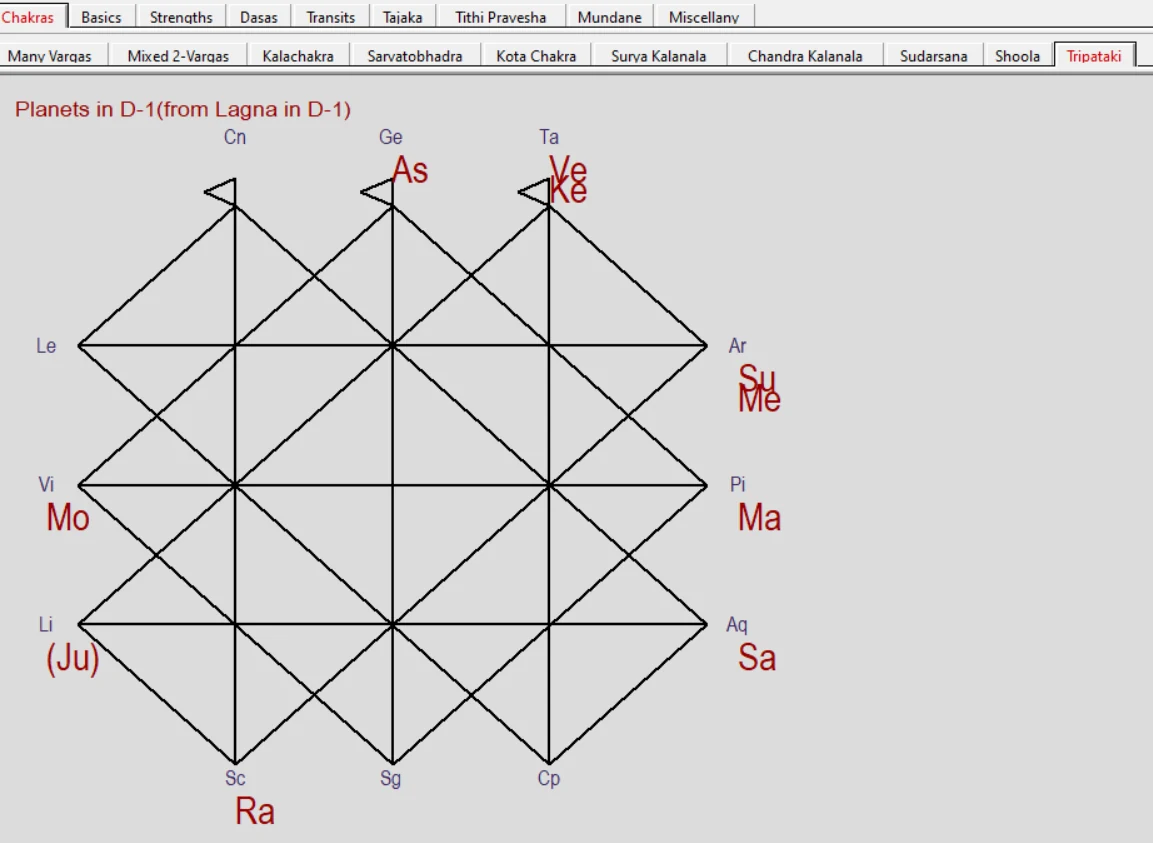
That was the part I could not see in the first recovered JHora screen. It showed the beautiful three-flag lattice with my ordinary D-1 positions: Gemini Lagna, Moon in Virgo and Mars in Pisces. The decompiled code gave us the real renderer and placement geometry, but the intended Vedic use of Tripataki goes further. It is an annual Varshaphala technique, and it should be calculated that way.
What a true annual Tripataki combines
Tripataki joins the birth chart and annual chart in one diagram. The natal chart supplies the starting sign of every planet. The exact sidereal solar return supplies the Varsha Lagna. The running year of life supplies the amount by which each natal planet is progressed.
The Varsha Lagna is placed at the centre flag, the remaining signs continue counter-clockwise, and the progressed planets are written beside their new annual signs. At each outer point, three lines converge. A planet at the other end of one of those lines gives vedha—a piercing influence—to the planet being judged. A planet sharing the same point can also be treated as vedha.
My worked example: the year from April 2026
I was born on 23 April 1994. The VedAstro API finds my next sidereal solar return at 5:42 p.m. on 23 April 2026 in Ipoh. The Ascendant at that moment is Virgo, so Virgo—not my natal Gemini Lagna—occupies the centre flag for this annual Tripataki.
Thirty-two years are complete, so this is my 33rd running year. That number drives the planetary progressions.
| Body | Rule for year 33 | Natal → annual Tripataki |
|---|---|---|
| Varsha Lagna | Solar-return Ascendant | Virgo |
| Moon | 33 ÷ 9, remainder 6 | Virgo → Aquarius, counted six signs forward |
| Sun, Mercury, Jupiter, Venus, Saturn | 33 ÷ 4, remainder 1 | Remain in their natal signs |
| Mars | 33 ÷ 6, remainder 3 | Pisces → Taurus, counted three signs forward |
| Rahu | Remainder 3, reverse | Scorpio → Virgo |
| Ketu | Remainder 3, reverse | Taurus → Pisces |
The human meaning changes with the year
In the annual map, my progressed Moon reaches Aquarius and shares its Tripataki point with Saturn. Traditional practice allows co-location to be read as vedha. Moon–Saturn symbolism can make a year feel serious, disciplined or emotionally weighty. It may ask for patience, realism and steadiness rather than quick reassurance.
Rahu reaches Virgo and shares the centre-flag point with the Varsha Lagna. This marks a year in which identity, direction and personal priorities become unusually intense, unconventional and hungry for change. Jupiter, Venus and the other progressed placements show how that force unfolds, while the year lord, Muntha, Tajaka yogas, annual dashas and the natal horoscope reveal the life areas through which it manifests.
This is what makes the chakra personally useful to me. My permanent natal chart describes the underlying promise of life; Tripataki reveals which parts of that promise are activated and brought into sharper contact during this particular solar year.
The 9/4/6 progression rules
- Moon: divide the running year by 9. Use the remainder as an inclusive forward count from the natal Moon sign; treat zero as 9.
- Sun, Mercury, Jupiter, Venus and Saturn: divide by 4, count forward inclusively and treat zero as 4.
- Mars, Rahu and Ketu: divide by 6 and treat zero as 6. Mars counts forward; Rahu and Ketu count backward.
“Inclusive” matters. A remainder of one keeps a planet in its natal sign; it does not move it one sign ahead. There are also lineage variations: some authorities put Mars in the four-year group, while others place planets directly from the annual chart. The public code states its chosen three-tier method openly so results can be reproduced and compared.
How to calculate your own annual Tripataki
- Choose the calendar year in which the solar return begins.
- Find the exact moment when the sidereal Sun returns to its natal longitude.
- Calculate the Ascendant at that moment and place its sign at the centre flag.
- Compute the running year: completed age plus one.
- Progress each natal planet with the 9/4/6 rules and place it on the lattice.
- Inspect vedha to the progressed Moon and Varsha Lagna, then correlate it with the complete annual and natal charts.
The open-source example performs all of those calculations automatically using three simple HTTPS calls. Change the birth details and TARGET_YEAR, run the file, and it produces both structured JSON and a viewable annual Tripataki SVG.
What came from decompilation—and what completes it
The original 32-bit x86 application registers CTripatakiChakraView. Renderer FUN_00481670 contains the lattice and collision machinery; FUN_00491150 exposes the twelve sector coordinates and five native object-group branches. The wider recovered Tajaka path supplies the annual solar-return concept and calculations.
The binary evidence did not give us a clean, self-contained function applying every traditional Tripataki progression to this view. Instead of pretending that the D-1 display was the finished annual feature, we completed it transparently from documented Varshaphala rules: natal positions, running-year remainders, reverse node counting and Varsha Lagna.
You can inspect every step in Tripataki-Chart-Jagannatha-Hora-Reverse-Engineered. It calls TajikaDateForYear2 for the solar return, AllHouseRasiSigns for Varsha Lagna and AllPlanetRasiSigns for the natal signs, then applies the annual progressions in readable JavaScript.
See how your map changes this year
Use JHora Online to explore the recovered interface, then run the annual JavaScript example for the complete progressed Tripataki calculation.