My Natal Rāśi Chart Revealed a Marriage Across Borders
Part 1 explores the natal Rāśi chart: the foundation on which the rest of a Vedic horoscope is read.
My wife comes from another country and follows a religion different from the one in which I was raised. Long before that became one of the central facts of my life, the pattern was already visible in my natal Rāśi chart—not as a single magical placement, but as several related clues pointing in the same direction.
That is what makes a birth chart feel alive to me. It is not merely a diagram of planets frozen at the moment of birth. Read carefully, it can describe the kinds of people, relationships and life environments through which our story unfolds.
In this first article of the JHora Reverse Engineered series, I will show the actual pattern in my chart, explain it in ordinary language, and show you where to find the same information in the free online version of Jagannatha Hora.
The Rāśi chart is the starting point
The natal Rāśi chart is also called the D-1 chart. It maps the nine grahas—the Sun, Moon, five visible planets, Rāhu and Ketu—into the twelve zodiac signs and twelve houses for the time and place of birth. The Ascendant, or Lagna, fixes the houses and gives the chart its personal orientation.
Other divisional charts add detail, but the Rāśi chart is the foundation. Before asking a specialised question about marriage, career or spirituality, an astrologer first looks here: which house governs the topic, which planet owns that house, where that planet is placed, what joins it, and what aspects it receives.
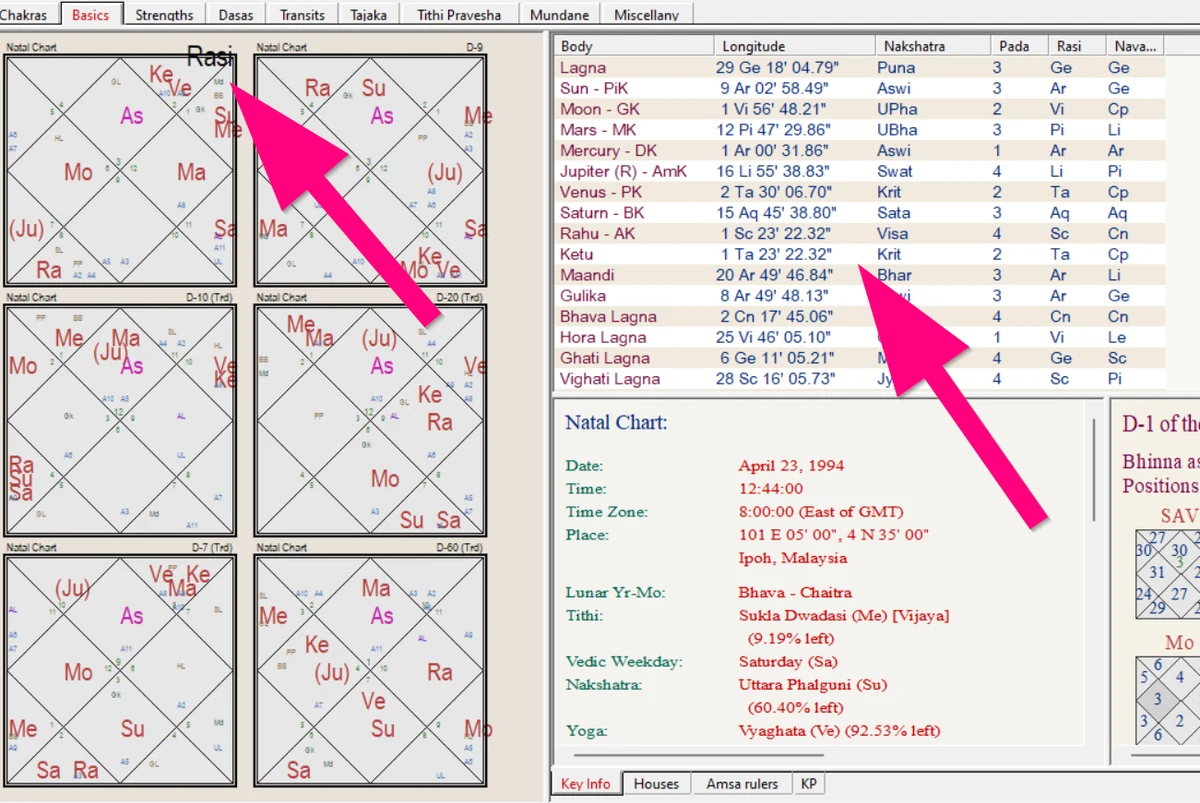
How I found the marriage-across-borders pattern
My Ascendant is Gemini, so the 7th house of marriage and spouse is Sagittarius. Jupiter owns Sagittarius and therefore becomes the 7th lord in this chart. From there, a connected sequence appears:
| Chart factor | My placement | Traditional theme |
|---|---|---|
| 7th lord | Jupiter in Libra, 5th house | Marriage connected with affection, choice and personal attraction |
| Jupiter’s dispositor | Venus in Taurus, 12th house | The spouse significator is tied to distant places, life abroad and unfamiliar environments |
| Venus with Ketu | A conjunction a little over one degree apart | A relationship outside ordinary social expectations or inherited boundaries |
| Navāṁśa confirmation | Venus and Ketu again share Capricorn | The same relationship motif continues in the D-9 marriage chart |
| 9th-house link | Jupiter aspects Saturn in Aquarius, the 9th house | Marriage connects with long-distance experience, worldview, belief and culture |
1. The 7th lord moves into the 5th house
Jupiter, lord of my 7th house, sits in Libra in the 5th house. The 7th house describes committed partnership; the 5th is associated with attraction, affection, courtship and choices of the heart. Their connection is one reason this chart leans toward a relationship formed through personal attachment rather than one based only on convention.
Traditional rule collections also describe the 7th lord in the 5th as capable of bringing a mature or advantageous partner. Such rules are starting points, not complete verdicts: dignity, aspects, conjunctions and the rest of the chart still matter.
2. Jupiter reports to Venus in the 12th house
Jupiter is in Libra, a sign owned by Venus. In astrological language, Venus is Jupiter’s dispositor, so Venus tells us how and where the promise of the 7th lord is expressed. In my chart Venus occupies its own sign, Taurus, in the 12th house.
The 12th house is traditionally associated with distant lands, residence away from one’s birthplace, seclusion, surrender and environments beyond the familiar. Because Venus is both a natural significator of relationships and the ruler receiving my 7th lord, its placement in the 12th makes the foreign or far-away theme directly relevant to marriage.
3. Venus is in a very close conjunction with Ketu
Venus and Ketu are separated by only a little more than one degree in Taurus. Ketu can loosen attachment to established identities and inherited categories. Older astrological texts sometimes express this symbolism through the social language of their era, including unions across caste or community boundaries. In a modern reading, the useful principle is broader and more humane: relationship may cross a boundary that one’s family or surrounding culture normally treats as fixed.
In my life, that symbolism became literal. My wife and I were born in different countries and came from different religious backgrounds. The chart did not force that outcome; it described a recurring relationship pattern that became recognisable in lived experience.
4. The Navāṁśa repeats the Venus–Ketu theme
The Navāṁśa, or D-9, is an important companion chart for marriage and the deeper maturation of planetary promises. There, Venus and Ketu again occupy the same sign—this time Capricorn. Repetition across the D-1 and D-9 gives the theme more weight than an isolated placement would have on its own.
5. Jupiter connects marriage with the 9th house
From Libra, Jupiter casts its Vedic aspect onto Aquarius, where Saturn sits strongly in its own sign in my 9th house. The 9th governs long journeys, philosophy, faith, teachers and the worldview inherited from or developed beyond one’s original setting. This does not by itself mean “a spouse of another religion.” Combined with the 7th-lord, 12th-house and Venus–Ketu pattern, however, it strengthens the theme of partnership reshaping culture and belief.
How to inspect your own natal Rāśi chart
- Open JHora Online and enter your birth date, exact time and birthplace.
- Select the Basics tab.
- Look at the upper-left chart labelled Rāśi or D-1.
- Use the table on the right to confirm each planet’s sign and exact longitude.
- For marriage, begin with the 7th house, its ruling planet, Venus and Jupiter. Then check what joins or aspects them.
- Open the D-9 Navāṁśa and look for repeated themes rather than hunting for a single dramatic placement.
Accurate birth data matters, especially when the Ascendant is near the end of a sign or when you move to divisional charts. If your recorded birth time is approximate, treat house-based conclusions with extra care.
From a decompiled desktop program to an open web feature
This series exists because the calculations inside the classic Jagannatha Hora desktop application were valuable but difficult to inspect or reuse. Our work was not an attempt to imitate the program by guessing from a handful of outputs. We inventoried 7,535 real functions in the native executable, recovered C-like decompilation for 7,533 of them, preserved complete x86 assembly for the remaining two, and traced the surviving calculation paths before porting selected features into readable JavaScript and simple web APIs.
For the natal Rāśi feature, that work is documented in the public repository Natal-Chart-Rasi-Jagannatha-Hora-Reverse-Engineered. It includes a ready-to-run JavaScript example showing how the chart data can be requested with ordinary HTTPS calls. The aim is to make a once-locked calculation understandable, testable and useful to anyone building educational or research tools.
Open code is valuable, but a chart becomes meaningful when it touches a human life. That is why these articles will pair each recovered feature with an explanation, a real example and a practical way for you to explore it yourself.
What story is waiting in your Rāśi chart?
Generate your chart free in the browser, then begin with the houses and planets connected to the question that matters most to you.