Part 10: Motional & Natural Strength
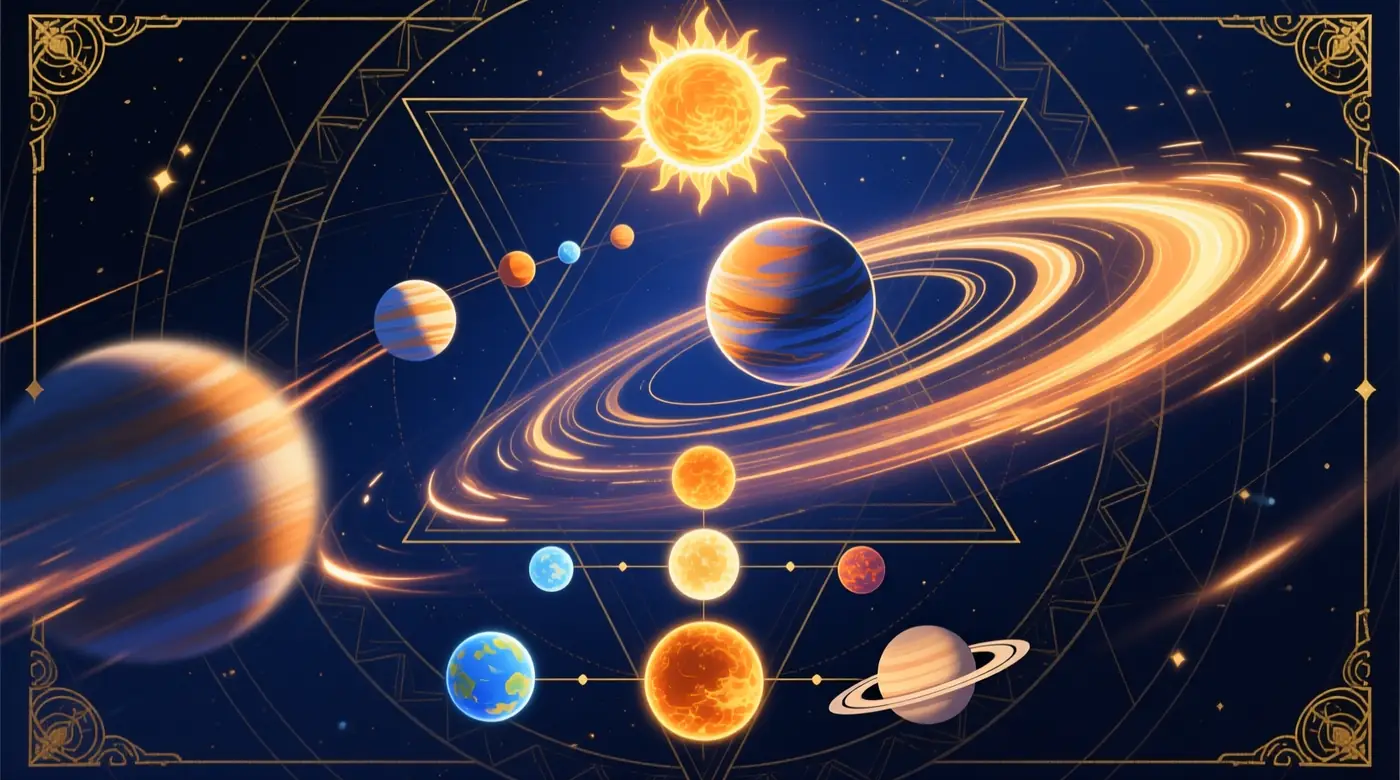
Chestabala: The Power of Retrogression
Chesta = motion, particularly Vakra Chesta (retrograde motion). When planets appear to move backward in the sky, they gain special strength.
Who Can Retrograde?
Mars, Mercury, Jupiter, Venus, Saturn
can all retrograde.
Sun and Moon never retrograde
(always direct motion).
The Phenomenon
Retrogression is an optical illusion caused by Earth's orbital motion:
- Superior planets (Mars, Jupiter, Saturn): Retrograde around opposition (180° from Sun)
- Inferior planets (Mercury, Venus): Retrograde around inferior conjunction (between Earth & Sun)
Calculation Complexity
B.V. Raman notes: "The facts relating to the phenomenon of retrogression...are of a complicated nature." Full calculation requires mean longitudes, orbital elements, and Chesta Kendra (arc of retrogression). Modern ephemerides simply mark retrograde planets with "R"—use those for practical work.
Standard Horoscope
No planets retrograde in our example chart → All planets get standard Chestabala based on direct motion calculations.
Result: Calculations yielded varied Chestabala for each planet based on their motion states, with details in full text.
Naisargikabala: The Eternal Ranking
Naisargika = natural, permanent. This strength is fixed for all horoscopes —based purely on planetary luminosity (brightness).
"From Saturn to the Sun...the Naisargika Bala gradually increases." — Varahamihira
The brightest planet (Sun) has maximum natural strength. The dimmest (Saturn) has minimum.
The Permanent Rankings
| Rank | Planet | Naisargika Bala | Luminosity |
|---|---|---|---|
| 1 | Sun (Ravi) | 60.00 | Brightest |
| 2 | Moon (Chandra) | 51.43 | Very Bright |
| 3 | Venus (Sukra) | 42.85 | Bright |
| 4 | Jupiter (Guru) | 34.28 | Moderate |
| 5 | Mercury (Budha) | 25.70 | Dim |
| 6 | Mars (Kuja) | 17.14 | Very Dim |
| 7 | Saturn (Sani) | 8.57 | Dimmest |
Mnemonic: Sun → Moon → Venus → Jupiter → Mercury → Mars → Saturn (brightest to dimmest)
Why This Matters: Naisargikabala ensures luminous planets (Sun, Moon, Venus) maintain baseline strength regardless of chart position. Dark Saturn starts with a handicap, needing excellent Sthanabala/Digbala/Kalabala to compensate.
Shadbala Progress Check
We've now covered 5 of 6 Shadbalas :
-
-
-
-
-
Remaining: Drikbala (Aspect Strength) — How planets influence each other through aspects
What's Next: Aspect Strength
In Parts 11-12, we explore Drikbala (Aspect Strength)—the most interactive Shadbala. Planets don't exist in isolation; they aspect (look at) each other across the zodiac, exchanging rays that strengthen or weaken.
We'll learn:
- The 6 mathematical formulas for aspect strength at different angles
- Special aspects of Mars, Jupiter, and Saturn (beyond the universal 7th house aspect)
- How to calculate Drishti Pinda (total aspect strength received)