596 Vedic Astrology Calculations. One Line of Python.
The VedAstro Python library gives you instant access to the world's most comprehensive Vedic astrology engine — planet positions, divisional charts, dasa periods, compatibility reports, and AI-powered features, all from a single pip install.

Whether you're building a horoscope app, a matchmaking platform, or a research tool, VedAstro's Python library removes every barrier between you and professional-grade Vedic astrology calculations. No complicated setup. No local binaries. No astrology expertise required to get started. Just install the library, set your API key, and start computing — the heavy lifting runs on VedAstro's cloud engine.
What You're Getting
596+
Calculations — the largest collection in any astrology programming library
47
Ayanamsa systems — Lahiri, Raman, KP, Fagan-Bradley & 43 more
D1–D60
Divisional charts — full Parashari varga system coverage
AI-Powered
Birth time auto-fill and natural language horoscope search
Zero Deps
Everything runs in the cloud — your app stays lightweight
Open Source
MIT licensed, community maintained, fully auditable on GitHub
Simple by Design
The VedAstro Python library is a thin, elegant wrapper around the VedAstro REST API. You write Python; the cloud does the calculation.
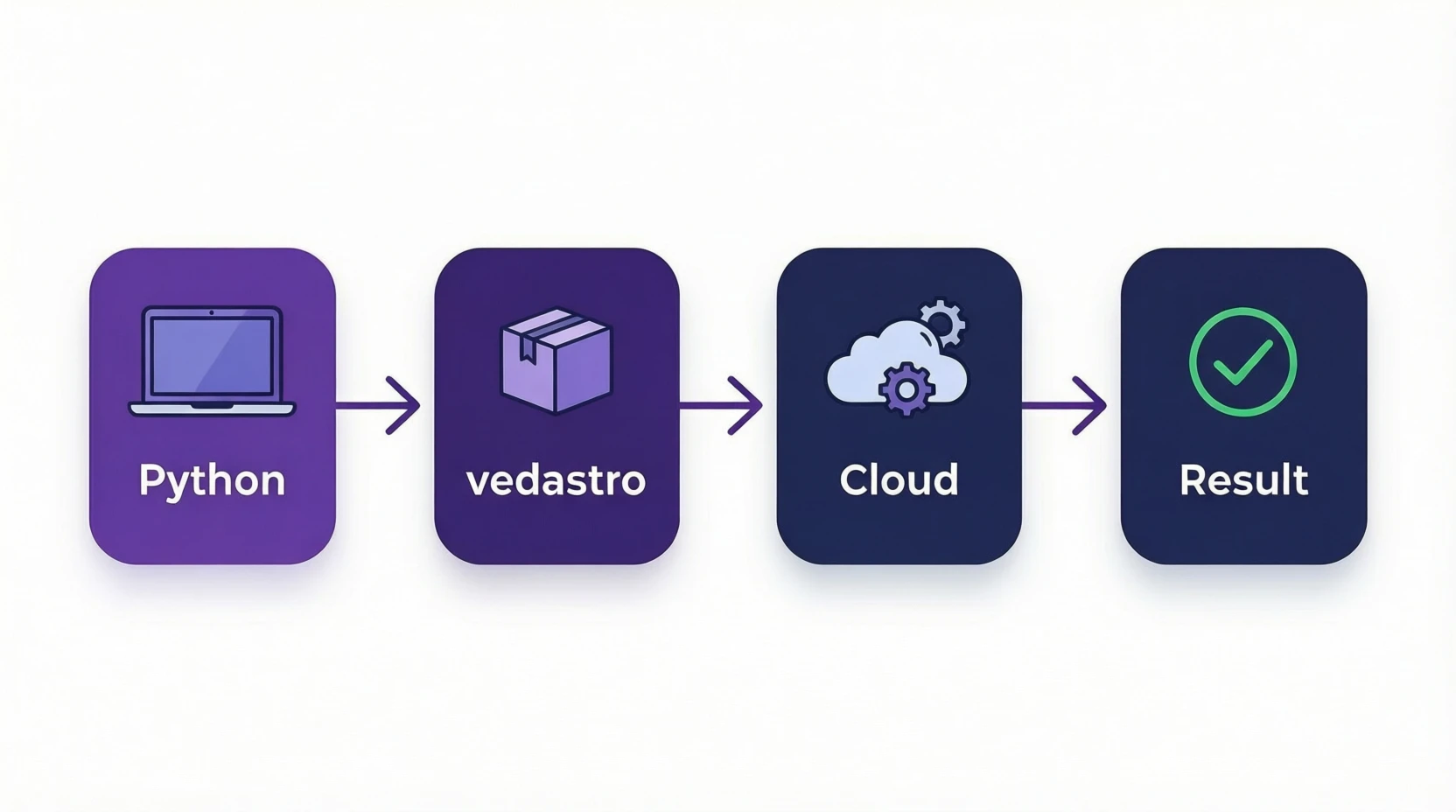
No heavy installation
The library itself is tiny — everything runs server-side
Always up to date
Calculation improvements roll out on the server automatically
Scales with you
From personal projects to production apps, same code works
Up and Running in 30 Seconds
Install the library from PyPI

pip install vedastroThat's it. No DLLs, no C extensions, no ephemeris files to download.
Ready to Unlock 596+ Calculations?
Get unlimited access for just $1/month — no rate limits, all features included
Instant activation • Cancel anytime • 99.9% uptime guarantee
See It in Action
Get a complete planetary dataset for any birth chart in three lines:
from vedastro import *

Calculate.SetAPIKey('your-api-key')

geo = GeoLocation("Tokyo, Japan", 139.83, 35.65)
birth_time = Time(hour=23, minute=40, day=31, month=12, year=2010, offset="+08:00", geolocation=geo)

result = Calculate.AllPlanetData(PlanetName.Sun, birth_time)
Tools.Print(result)
Full Kuta-based compatibility analysis between two horoscopes:
from vedastro import *

Calculate.SetAPIKey('your-api-key')

romeo = Time("23:40 31/12/1996 +08:00", GeoLocation("Tokyo, Japan", 139.83, 35.65))
juliet = Time("14:30 15/06/1997 -05:00", GeoLocation("New York, USA", -74.006, 40.7128))

match = Calculate.MatchReport(romeo, juliet)
Tools.Print(match)
Pull dasa periods for any date range at any depth of sub-periods:
from vedastro import *
import json

Calculate.SetAPIKey('your-api-key')

geo = GeoLocation("Tokyo, Japan", 139.83, 35.65)
birth_time = Time("23:40 31/12/2010 +08:00", geo)
start = Time("00:00 01/01/2020 +08:00", geo)
end   = Time("23:59 31/12/2025 +08:00", geo)

dasa = Calculate.DasaAtRange(birth_time, start, end, levels=3, precision_hours=100)
print(json.dumps(dasa, indent=4))
Ask a plain-English question and get the most relevant passages from classical Vedic books — no exact keywords needed:
from vedastro import *

Calculate.SetAPIKey('your-api-key')

# see which classical texts are searchable
print(Calculate.GetAvailableSourceTexts())

# natural-language semantic search across all texts
passages = Calculate.SearchSourceText("effects of Saturn in the 7th house", topK=5)

for p in passages:
    print(p["sourceName"], p["pageNumber"], p["text"])
Remove rate limits and get instant access to all 596+ calculations
596 Calculations Across Every Major Category
| Category | What's Included |
|---|---|
| Positions, longitudes, strengths, aspects, conjunctions, retrograde status | |
| House signs, lords, bhava chart, all house data | |
| D1 through D60 — Navamsha, Drekkana, and all varga charts | |
| Sign-based calculations, planet-in-sign queries | |
| Vimshottari dasa periods with configurable depth and precision | |
| Auspicious time finding, event predictions over any date range | |
| Kuta scoring, full compatibility reports, BaZi integration, AI chat analysis | |
| Birth time auto-fill from partial data, natural language horoscope search |
Full method reference: vedastro.org/API.html
47 Ayanamsa Systems — Vedic, Western, and KP
Switch ayanamsa systems with a single line
Lahiri
Modern Vedic standard
Raman
VedAstro default
Krishnamurti
KP System
Fagan-Bradley
Western sidereal
Calculate.SetAyanamsa(Ayanamsa.Lahiri)
Calculate.SetAyanamsa(Ayanamsa.Fagan_Bradley)
Calculate.SetAyanamsa(Ayanamsa.Krishnamurti)
Start Free. Scale When You're Ready.
Free
Rate-limited
'FreeAPIUser'No signup required — ideal for exploration and development
Subscriber
Unlimited access
High-speed access to all 596+ calculations for production apps
Calculate.SetAPIKey('your-key-here')Ready-to-Run Examples
The GitHub repository includes a full set of demo scripts to get you started immediately
| Demo File | What It Shows |
|---|---|
demo_all_astro_data.py | All planet and house data for a birth chart |
demo_all_astro_data_json_output.py | Same output in JSON format |
demo_all_astro_data_csv.py | Export a full birth chart to CSV using pandas |
demo_all_planet_data.py | Detailed planet positions with degree parsing |
demo_bhava_chart_data.py | Bhava chart house signs and planet placements |
demo_custom_ayanamsa.py | Switching between ayanamsa systems |
demo_horoscope_prediction_names.py | Horoscope prediction event names |
demo_match_checker.py | Full compatibility report between two charts |
demo_vimshottari_dasa.py | Vimshottari dasa periods for a date range |
demo_rag_vedic_books.py | Semantic search of classical Vedic texts (RAG) |
demo_code_from_api_builder.py | Auto-generated code from the API Builder tool |

Open Source at Its Core
The VedAstro Python library is fully open source under the MIT License. You can read the code, verify every API call, and contribute improvements back to the community. The library is maintained alongside the main VedAstro engine — when new calculations are added to the API, the Python wrapper updates to match.
Note: vedastro/calculate.py is auto-generated from the main VedAstro repository to stay in sync with the live API surface. All other library files are open to contributions.
Ready to Build?
Install the library, try the free tier, and see how fast you can go from zero to a working Vedic astrology application. When your project is ready for the real world, your API key is one click away.
pip install vedastroMade and funded by users — Support VedAstro