免费高级Dart吠陀占星库与API
VedAstro Dart库让你即时访问世界上最全面的吠陀占星引擎——行星位置、分盘图、运程周期、相容性报告以及AI驱动的功能,全部通过轻量级SDK实现。
无论你正在开发占星应用、配对平台还是研究工具,VedAstro 的 Dart 库消除了你与专业级吠陀占星计算之间的所有障碍。无需复杂的设置,无需本地二进制文件,无需占星学专业知识即可开始。只需安装库,设置 API 密钥,即可开始计算——繁重的工作由 VedAstro 的云引擎完成。
你要拿到什么
684
为吠陀占星应用提供的托管计算
47
Ayanamsa系统——Lahiri、Raman、KP、Fagan-Bradley及其他43个
D1–D60
分区图——完整的帕拉沙里瓦尔加系统覆盖
AI驱动
命盘预测与古典文献检索
轻量级
所有设备都运行在云端——你的应用保持轻量级
开源
MIT授权,社区维护,GitHub上完全可审计
设计简单
VedAstro Dart库是VedAstro REST API的简洁优雅封装。你编写Dart代码;云端完成计算。
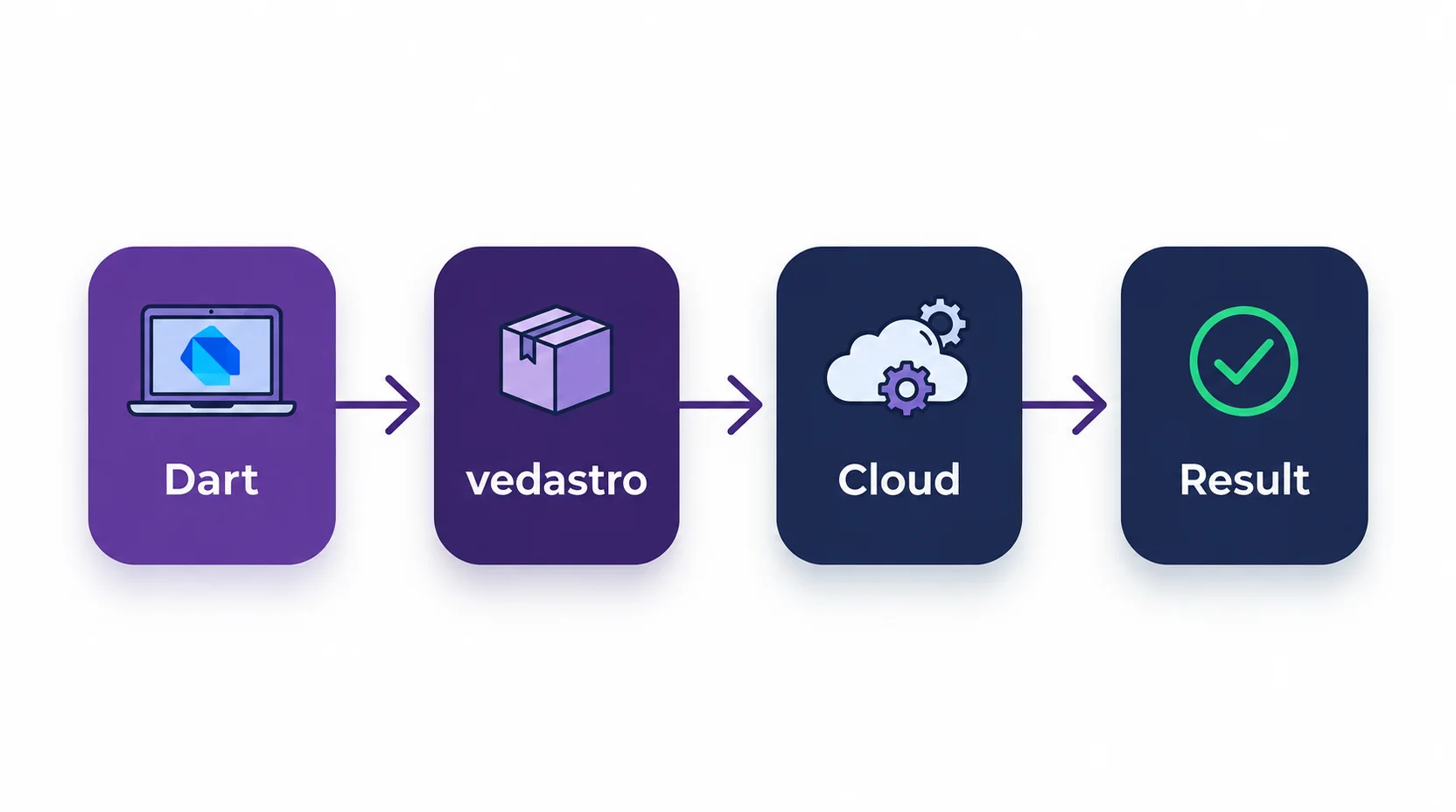
没有重型安装
这个库本身很小——所有设备都运行在服务器端
始终保持最新
计算改进会自动在服务器上推出
和你一起上天
从个人项目到生产应用,代码都一样
安装 Dart SDK
Dart >=3.0.0 <4.0.0 且需联网
dependencies:
  vedastro:
    git:
      url: https://github.com/VedAstro/VedAstro.Dart.git
将此 Git 依赖项添加到 pubspec.yaml,然后运行 dart pub get。该包目前在 pub.dev 上不可用。调用为异步;使用完毕后请关闭客户端。仓库演示导入 support.dart,因此请从克隆的仓库中运行它们。
FreeAPIUser 每分钟允许 5 次请求。请控制多调用示例,或使用您的订阅密钥。位置信息需先输入经度,再输入纬度。
看看实际操作
使用免费密钥进行一次太阳星座计算,作为起点。
import 'package:vedastro/vedastro.dart';

Future<void> main() async {
  final client = VedAstroClient(apiKey: 'FreeAPIUser');

  final birth = Time.of(
    '14:30 25/10/1992 +05:30',            // HH:mm dd/MM/yyyy +HH:mm
    GeoLocation.of('Mumbai', 72.8777, 19.0760), // name, longitude, latitude
  );

  final sun = await client.calculate().planetRasiD1Sign(PlanetName.sun, birth);
  print(Response.string(sun, 'Name'));                        // Libra
  print(Response.string(sun, ['DegreesIn', 'DegreeMinuteSecond']));

  client.close();
}
在您的 Dart 项目中将文件保存为 main.dart 并运行 dart run main.dart。
出生星图基础
从克隆的SDK仓库中运行;辅助文件包含在其中。
import 'package:vedastro/vedastro.dart';

import 'support.dart';

/// Reads a full birth chart: every planet's sign, degree and constellation, plus the
/// house cusps.
///
///     dart run example/birth_chart_basics.dart
Future<void> main() async {
  final client = demoClient();
  final birth = demoBirth();
  final pace = demoShouldPace(client);

  demoHeading('Planets');
  for (final planet in [
    PlanetName.sun,
    PlanetName.moon,
    PlanetName.mars,
    PlanetName.mercury,
    PlanetName.jupiter,
    PlanetName.venus,
    PlanetName.saturn,
  ]) {
    final result = await client.calculate().planetRasiD1Sign(planet, birth);
    demoField(
      planet.wireName,
      '${Response.string(result, 'Name')} '
      '${Response.string(result, ['DegreesIn', 'DegreeMinuteSecond'])}',
    );
    await demoPace(enabled: pace);
  }

  demoHeading('House signs');
  for (final house in [
    HouseName.house1,
    HouseName.house4,
    HouseName.house7,
    HouseName.house10
  ]) {
    final sign = await client.calculate().houseSignName(house, birth);
    demoField(house.wireName, sign);
    await demoPace(enabled: pace);
  }

  demoHeading('Constellations');
  for (final planet in [PlanetName.sun, PlanetName.moon]) {
    final star = await client.calculate().planetConstellation(planet, birth);
    demoField(planet.wireName, star);
    await demoPace(enabled: pace);
  }

  client.close();
}每日帕南加
从克隆的SDK仓库中运行;辅助文件包含在其中。
import 'package:vedastro/vedastro.dart';

import 'support.dart';

/// The five limbs of the day, plus the inauspicious windows that depend on sunrise.
///
///     dart run example/daily_panchanga.dart
Future<void> main() async {
  final client = demoClient();
  final now = Time.now(GeoLocation.of('Kuala Lumpur', 101.6869, 3.1390));
  final pace = demoShouldPace(client);

  demoHeading('Panchanga for ${now.stdTime}');

  final tithi = await client.calculate().lunarDay(now);
  demoField('Tithi', Response.string(tithi, 'Name'));
  demoField('Paksha', Response.string(tithi, 'Paksha'));
  demoField('Phase', Response.string(tithi, 'Phase'));
  await demoPace(enabled: pace);

  final yoga = await client.calculate().nithyaYoga(now);
  demoField('Nithya yoga', Response.string(yoga, 'Name'));
  await demoPace(enabled: pace);

  final karana = await client.calculate().karana(now);
  demoField('Karana', karana);
  await demoPace(enabled: pace);

  demoHeading('Sun and Rahu');
  demoField('Sunrise', await client.calculate().sunriseTime(now));
  await demoPace(enabled: pace);
  demoField('Sunset', await client.calculate().sunsetTime(now));
  await demoPace(enabled: pace);
  demoField('Rahu kala', await client.calculate().rahuKala(now));

  client.close();
}涵盖每个主要领域的684次计算
| 类别 | 包含内容 |
|---|---|
| 位置、经度、强度、相位、合相、逆行状态 | |
| 宫位星座、主宰、宫位图、所有宫位数据 | |
| D1至D60——Navamsha、Drekkana及所有varga图 | |
| 基于符号的计算,行星与星座查询 | |
| 带有明确起始规则和可配置深度的维姆绍塔里命盘周期 | |
| 吉时测定,任何日期范围的事件预测 | |
| Kuta评分、完整兼容性报告、BaZi集成、AI聊天分析 | |
| 出生时间自动填充,来自部分数据,自然语言星座运势搜索 |
完整方法参考:vedastro.org/API.html
47 阿亚南萨系统 — 吠陀、西方和开普敦
通过SDK特定设置切换阿亚纳姆萨系统
拉希里
现代吠陀标准
拉曼
古典吠陀体系
克里希那穆提
KP系统
法根-布拉德利
西恒星星
import 'package:vedastro/vedastro.dart';

import 'support.dart';

/// Ayanamsa is the difference between the tropical and the sidereal zodiac, and the
/// choice shifts every position by up to a degree. VedAstro supports 47 systems.
///
///     dart run example/custom_ayanamsa.dart
Future<void> main() async {
  final birth = demoBirth();
  final base = demoClient();

  demoHeading('The same moment, read four ways');
  for (final ayanamsa in [
    Ayanamsa.lahiri, // the Indian government standard
    Ayanamsa.raman,
    Ayanamsa.krishnamurti, // KP
    Ayanamsa.faganBradley, // Western sidereal
  ]) {
    // Reuse the same API key; only
    // the ayanamsa differs. The ayanamsa travels with each request, so it is safe to
    // keep several clients side by side.
    final scoped = VedAstroClient(
      apiKey: base.apiKey,
      silent: true,
      defaultAyanamsa: ayanamsa,
    );

    final sun =
        await scoped.calculate().planetRasiD1Sign(PlanetName.sun, birth);
    final ayanamsaValue = await scoped.calculate().ayanamsaDegree(birth);

    demoField(
      ayanamsa.wireName,
      '${Response.string(sun, 'Name')} '
      '${Response.string(sun, ['DegreesIn', 'DegreeMinuteSecond'])} '
      '| ayanamsa $ayanamsaValue',
    );

    scoped.close();
    // Four clients x two calls each outruns the free tier; a paid key would not need
    // this.
    await demoPace(enabled: demoShouldPace(base));
  }

  demoHeading('Which ayanamsa is in force');
  demoField('Client default', base.ayanamsa?.wireName ?? 'the API default');
  demoField('Ayanamsas available', Ayanamsa.values.length);

  base.close();
}在此克隆的仓库内运行此示例。查看源码。
自由开始。准备好了再秤。
免费
速率限制
'FreeAPIUser'无需注册——非常适合探索和开发
final client = VedAstroClient(apiKey: 'your-key-here');现成型示例
克隆仓库以运行这些示例及其附带的辅助工具。展开一个示例以阅读并复制其源代码。
import 'package:vedastro/vedastro.dart';

import 'support.dart';

/// A batch of charts, paced for the free tier.
///
///     dart run example/batch_processing.dart
///
/// The point of this example is not the loop; it is what the loop does *not* do. The
/// SDK never retries and never throttles, so pacing is yours to own - and it has to
/// be central, because the per-key limit is shared across every process you run.
Future<void> main() async {
  final client = demoClient();
  final pace = demoShouldPace(client);

  // A small set of people to chart.
  final people = <String, Time>{
    'Asha': Time.of(
      '14:30 25/10/1992 +05:30',
      GeoLocation.of('Mumbai', 72.8777, 19.0760),
    ),
    'Bala': Time.of(
      '06:45 02/07/1988 +08:00',
      GeoLocation.of('Kuala Lumpur', 101.6869, 3.1390),
    ),
    'Chen': Time.of(
      '21:10 19/12/2000 +08:00',
      GeoLocation.of('Singapore', 103.8198, 1.3521),
    ),
  };

  demoHeading('Ascendants');
  for (final entry in people.entries) {
    final sign =
        await client.calculate().houseSignName(HouseName.house1, entry.value);
    demoField(entry.key, sign);
    // The free tier allows five calls a minute; a paid key does not need this.
    await demoPace(enabled: pace);
  }

  demoHeading('Suns');
  for (final entry in people.entries) {
    final sun =
        await client.calculate().planetRasiD1Sign(PlanetName.sun, entry.value);
    demoField(entry.key, Response.string(sun, 'Name'));
    await demoPace(enabled: pace);
  }

  // WHAT A PRODUCTION BATCH WOULD ADD ---------------------------------------
  //
  // - A CONCURRENCY LIMIT. Six calls at once is fine; six hundred is not. A
  //   fixed-size pool (or a package such as `pool`) keeps the pressure bounded.
  //
  // - A RETRY ON VedAstroException ONLY. That means the request never completed, so
  //   trying again is reasonable. An ApiException means the API rejected the call -
  //   repeating it verbatim will fail the same way.
  //
  // - CACHING KEYED BY THE CHART INPUT. `birth.stdTime` plus the location is the
  //   natural key; the same person is charted many times.
  //
  // - PROGRESS AND A FAILURE LIST, so one bad date does not abandon the whole run:
  //
  //     final failures = <String, Object>{};
  //     for (final entry in people.entries) {
  //       try { ... } catch (failure) { failures[entry.key] = failure; }
  //     }

  demoHeading('Done');
  // ignore: avoid_print
  print('   charted ${people.length} people, ${people.length * 2} calls');

  client.close();
}import 'package:vedastro/vedastro.dart';
import 'support.dart';
/// Reads a full birth chart: every planet's sign, degree and constellation, plus the
/// house cusps.
///
/// dart run example/birth_chart_basics.dart
Future<void> main() async {
final client = demoClient();
final birth = demoBirth();
final pace = demoShouldPace(client);
demoHeading('Planets');
for (final planet in [
PlanetName.sun,
PlanetName.moon,
PlanetName.mars,
PlanetName.mercury,
PlanetName.jupiter,
PlanetName.venus,
PlanetName.saturn,
]) {
final result = await client.calculate().planetRasiD1Sign(planet, birth);
demoField(
planet.wireName,
'${Response.string(result, 'Name')} '
'${Response.string(result, ['DegreesIn', 'DegreeMinuteSecond'])}',
);
await demoPace(enabled: pace);
}
demoHeading('House signs');
for (final house in [
HouseName.house1,
HouseName.house4,
HouseName.house7,
HouseName.house10
]) {
final sign = await client.calculate().houseSignName(house, birth);
demoField(house.wireName, sign);
await demoPace(enabled: pace);
}
demoHeading('Constellations');
for (final planet in [PlanetName.sun, PlanetName.moon]) {
final star = await client.calculate().planetConstellation(planet, birth);
demoField(planet.wireName, star);
await demoPace(enabled: pace);
}
client.close();
}import 'package:vedastro/vedastro.dart';
import 'support.dart';
/// Every planet's sign right now, from one call.
///
/// dart run example/current_planets.dart
Future<void> main() async {
final client = demoClient();
// "Now" at the place you care about. The API needs a location, not just a time.
final now = Time.now(GeoLocation.of('Kuala Lumpur', 101.6869, 3.1390));
demoHeading('Now: ${now.stdTime}');
final signs = await client.calculate().allPlanetRasiSigns(now);
for (final entry in Response.list(signs, [])) {
demoField(
Response.string(entry, 'Planet'),
Response.string(entry, 'Sign'),
);
}
demoHeading('Full data for the Moon');
final moon = await client.calculate().allPlanetData(PlanetName.moon, now);
demoField('Sign', Response.string(moon, 'Sign'));
demoField('Constellation', Response.string(moon, 'Constellation'));
demoField(
'Degrees', Response.string(moon, ['DegreesIn', 'DegreeMinuteSecond']));
client.close();
}import 'package:vedastro/vedastro.dart';
import 'support.dart';
/// Ayanamsa is the difference between the tropical and the sidereal zodiac, and the
/// choice shifts every position by up to a degree. VedAstro supports 47 systems.
///
/// dart run example/custom_ayanamsa.dart
Future<void> main() async {
final birth = demoBirth();
final base = demoClient();
demoHeading('The same moment, read four ways');
for (final ayanamsa in [
Ayanamsa.lahiri, // the Indian government standard
Ayanamsa.raman,
Ayanamsa.krishnamurti, // KP
Ayanamsa.faganBradley, // Western sidereal
]) {
// Reuse the same API key; only
// the ayanamsa differs. The ayanamsa travels with each request, so it is safe to
// keep several clients side by side.
final scoped = VedAstroClient(
apiKey: base.apiKey,
silent: true,
defaultAyanamsa: ayanamsa,
);
final sun =
await scoped.calculate().planetRasiD1Sign(PlanetName.sun, birth);
final ayanamsaValue = await scoped.calculate().ayanamsaDegree(birth);
demoField(
ayanamsa.wireName,
'${Response.string(sun, 'Name')} '
'${Response.string(sun, ['DegreesIn', 'DegreeMinuteSecond'])} '
'| ayanamsa $ayanamsaValue',
);
scoped.close();
// Four clients x two calls each outruns the free tier; a paid key would not need
// this.
await demoPace(enabled: demoShouldPace(base));
}
demoHeading('Which ayanamsa is in force');
demoField('Client default', base.ayanamsa?.wireName ?? 'the API default');
demoField('Ayanamsas available', Ayanamsa.values.length);
base.close();
}import 'package:vedastro/vedastro.dart';
import 'support.dart';
/// The five limbs of the day, plus the inauspicious windows that depend on sunrise.
///
/// dart run example/daily_panchanga.dart
Future<void> main() async {
final client = demoClient();
final now = Time.now(GeoLocation.of('Kuala Lumpur', 101.6869, 3.1390));
final pace = demoShouldPace(client);
demoHeading('Panchanga for ${now.stdTime}');
final tithi = await client.calculate().lunarDay(now);
demoField('Tithi', Response.string(tithi, 'Name'));
demoField('Paksha', Response.string(tithi, 'Paksha'));
demoField('Phase', Response.string(tithi, 'Phase'));
await demoPace(enabled: pace);
final yoga = await client.calculate().nithyaYoga(now);
demoField('Nithya yoga', Response.string(yoga, 'Name'));
await demoPace(enabled: pace);
final karana = await client.calculate().karana(now);
demoField('Karana', karana);
await demoPace(enabled: pace);
demoHeading('Sun and Rahu');
demoField('Sunrise', await client.calculate().sunriseTime(now));
await demoPace(enabled: pace);
demoField('Sunset', await client.calculate().sunsetTime(now));
await demoPace(enabled: pace);
demoField('Rahu kala', await client.calculate().rahuKala(now));
client.close();
}import 'package:vedastro/vedastro.dart';
import 'support.dart';
/// Divisional (varga) charts: the same moment read at finer resolutions.
///
/// dart run example/divisional_charts.dart
Future<void> main() async {
final client = demoClient();
final birth = demoBirth();
final pace = demoShouldPace(client);
demoHeading('Navamsha (D9)');
for (final planet in [PlanetName.sun, PlanetName.moon, PlanetName.jupiter]) {
final sign = await client.calculate().planetNavamshaD9Sign(planet, birth);
demoField(planet.wireName, Response.string(sign, 'Name'));
await demoPace(enabled: pace);
}
demoHeading('Every planet, one division at a time');
demoField(
'Navamsha D9',
demoTruncate(await client.calculate().allPlanetNavamshaSign(birth), 90),
);
await demoPace(enabled: pace);
demoField(
'Dashamamsha D10',
demoTruncate(await client.calculate().allPlanetDashamamshaSign(birth), 90),
);
await demoPace(enabled: pace);
demoField(
'Dwadashamsha D12',
demoTruncate(await client.calculate().allPlanetDwadashamshaSign(birth), 90),
);
client.close();
}import 'package:vedastro/vedastro.dart';
import 'support.dart';
/// Every way a call can fail, and what each one tells you.
///
/// dart run example/error_handling.dart
Future<void> main() async {
final client = demoClient();
final birth = demoBirth();
// 1. Client-side validation fails before any network call, which is the cheapest
// possible failure: no request, no rate-limit cost, a message naming the field.
demoHeading('1. Validation, before the network');
for (final attempt in <void Function()>[
() =>
Time.of('25/10/1992 14:30', GeoLocation.of('Mumbai', 72.8777, 19.0760)),
() => Time.of(
'10:00 31/02/2020 +00:00', GeoLocation.of('Mumbai', 72.8777, 19.0760)),
() => GeoLocation.of('Swapped', 19.0760, 72.8777),
]) {
try {
attempt();
// ignore: avoid_print
print(' ✗ accepted something it should have rejected');
} on ArgumentError catch (failure) {
// ignore: avoid_print
print(' ✓ rejected: ${failure.message}');
}
}
// 2. An ApiException means the API answered and rejected the call. Retrying the
// identical request will not help.
demoHeading('2. The API rejected the call');
try {
// An intentionally unknown endpoint.
await client.call('NoSuchCalculatorExists', parameters: {'time': birth});
} on ApiException catch (failure) {
demoField('Type', 'ApiException');
demoField('Endpoint', failure.endpoint);
demoField('HTTP status', failure.statusCode);
demoField('Message', demoTruncate(failure.message, 100));
}
// 3. A VedAstroException means the request never completed - DNS, TLS, a reset
// connection. This is the one worth retrying.
demoHeading('3. The request never completed');
final unreachable = VedAstroClient(
apiKey: client.apiKey,
buildTransport: (_) => _UnavailableTransport(),
silent: true,
timeout: const Duration(seconds: 5),
);
try {
await unreachable.calculate().planetRasiD1Sign(PlanetName.sun, birth);
} on VedAstroException catch (failure) {
demoField('Type', failure.runtimeType.toString());
demoField('Message', demoTruncate(failure.message, 100));
} finally {
unreachable.close();
}
// 4. The API key never appears in a message, so an exception is safe to log.
demoHeading('4. The key is redacted');
// ignore: avoid_print
print(' configured key: ${client.apiKey.isEmpty ? "(none)" : "[present]"}');
try {
await client.call('NoSuchCalculatorExists', parameters: {'time': birth});
} on ApiException catch (failure) {
final leaks =
client.apiKey.isNotEmpty && failure.toString().contains(client.apiKey);
// ignore: avoid_print
print(' ${leaks ? "✗ LEAKED" : "✓ not present in the message"}');
}
client.close();
}
// Demonstrate a connection failure without depending on a particular DNS service.
class _UnavailableTransport implements Transport {
@override
Future<TransportResponse> post(
Uri url, String body, Map<String, String> headers) async {
throw VedAstroException('Simulated connection failure');
}
@override
void close() {}
}import 'dart:io';
import 'package:vedastro/vedastro.dart';
import 'support.dart';
/// Runs the whole stack against the real API, through the real HTTP transport.
///
/// Unlike the test suite - which uses a fake transport and needs no network - this
/// spends real API calls, so it is deliberately not part of CI.
///
/// dart run example/live_check.dart
///
/// Set `VEDASTRO_API_KEY` to use a paid key; otherwise the free tier applies and the
/// checks pace themselves.
Future<void> main() async {
final client = demoClient(silent: false);
final birth = demoBirth();
final pace = demoShouldPace(client);
final transport =
client.timeout == null ? 'stream (no deadline)' : 'with a deadline';
// ignore: avoid_print
print('VedAstro Dart SDK — live check');
// ignore: avoid_print
print('transport: $transport\n');
var failures = 0;
Future<void> check(String label, Future<Object?> Function() action) async {
try {
final result = await action();
// ignore: avoid_print
print(' ✓ ${label.padRight(14)} $result');
} catch (failure) {
failures++;
// ignore: avoid_print
print(' ✗ ${label.padRight(14)} $failure');
}
await demoPace(enabled: pace);
}
await check('Sun sign', () async {
final sun =
await client.calculate().planetRasiD1Sign(PlanetName.sun, birth);
return '${Response.string(sun, 'Name')} at '
'${Response.string(sun, ['DegreesIn', 'DegreeMinuteSecond'])}';
});
await check('Ascendant', () async {
final sign =
await client.calculate().houseSignName(HouseName.house1, birth);
return sign;
});
await check('Panchanga', () async {
final tithi = await client.calculate().lunarDay(birth);
return '${Response.string(tithi, 'Name')} (${Response.string(tithi, 'Paksha')})';
});
await check('Numerology', () async {
final number = await client.calculate().birthNumber(birth);
return 'birth number $number';
});
await check('Constellation', () async {
final star =
await client.calculate().planetConstellation(PlanetName.moon, birth);
return star;
});
await check('RAG search', () async {
final passages = await client
.calculate()
.searchSourceText('effects of Saturn in the 7th house');
return '${Response.count(passages, [])} passage(s)';
});
client.close();
// ignore: avoid_print
print('');
if (failures > 0) {
// ignore: avoid_print
print('$failures live check(s) failed.');
exitCode = 1;
return;
}
// ignore: avoid_print
print('All live checks passed.');
}import 'package:vedastro/vedastro.dart';
import 'support.dart';
/// Numerology: the numbers derived from a birth moment and a name.
///
/// dart run example/numerology.dart
Future<void> main() async {
final client = demoClient();
final birth = demoBirth();
demoHeading('From the birth moment');
demoField('Birth number', await client.calculate().birthNumber(birth));
demoField('Destiny number', await client.calculate().destinyNumber(birth));
demoHeading('From a name');
final prediction =
await client.calculate().nameNumberPrediction('Ada Lovelace');
demoField(
'Name number', Response.get(prediction, 'NameNumber') ?? prediction);
demoField('Meaning', Response.string(prediction, 'Meaning'));
client.close();
}import 'package:vedastro/vedastro.dart';
import 'support.dart';
/// The smallest useful program: one client, one moment, one calculation.
///
/// dart run example/quick_start.dart
Future<void> main() async {
final client = demoClient();
final birth = demoBirth();
demoHeading('Position of the Sun');
final sun = await client.calculate().planetRasiD1Sign(PlanetName.sun, birth);
demoField('Sign', Response.string(sun, 'Name'));
demoField('Degrees in sign',
Response.string(sun, ['DegreesIn', 'DegreeMinuteSecond']));
demoHeading('Ascendant');
final ascendant =
await client.calculate().houseSignName(HouseName.house1, birth);
demoField('Rising sign', ascendant);
client.close();
}import 'package:vedastro/vedastro.dart';
import 'support.dart';
/// Semantic search across classical Vedic texts, so an answer can be grounded in a
/// source rather than in a model's memory.
///
/// dart run example/rag_vedic_books.dart
Future<void> main() async {
final client = demoClient();
final pace = demoShouldPace(client);
demoHeading('Which texts are indexed');
final sources = await client.calculate().getAvailableSourceTexts();
for (final source in Response.list(sources, [])) {
// Each entry is a name and the number of chunks indexed for it.
// ignore: avoid_print
print(' - $source');
}
await demoPace(enabled: pace);
const question = 'effects of Saturn in the seventh house';
demoHeading('Searching: "$question"');
final passages = await client.calculate().searchSourceText(question, topK: 3);
for (final passage in Response.list(passages, [])) {
demoField('Source', Response.string(passage, 'sourceName'));
demoField('Page', Response.intValue(passage, 'pageNumber'));
demoField('Score', Response.doubleValue(passage, 'score'));
// ignore: avoid_print
print(' ${demoTruncate(Response.string(passage, 'text'), 220)}\n');
}
client.close();
}import 'dart:convert';
import 'dart:io';
import 'package:vedastro/vedastro.dart';
import 'support.dart';
/// How to use the SDK inside a long-running server.
///
/// This file is written to be **read** — the handler below is the shape you would
/// paste into a Shelf, Dart Frog or `HttpServer` app. Run it to see the same logic
/// print its answers instead of serving them:
///
/// dart run example/server_usage.dart
Future<void> main() async {
// ONE CLIENT, CREATED ONCE -------------------------------------------------
//
// The client is immutable and holds no per-request state, so build it when the
// isolate starts and share it. Building one per request would throw away the
// connection pool and add a TLS handshake to every call.
//
// `silent: true` matters on a server: the start-up banner would otherwise be
// written into a response body.
final vedAstro = VedAstroClient.fromEnvironment(
Platform.environment,
silent: true,
);
// WHAT A HANDLER LOOKS LIKE ------------------------------------------------
Future<(int, String)> sunSignHandler(Map<String, String> query) async {
try {
final birth = Time.of(
query['when']!,
GeoLocation.of(
'query',
double.parse(query['lon']!),
double.parse(query['lat']!),
),
);
final result = await vedAstro.calculate().planetRasiD1Sign(
PlanetName.sun,
birth,
);
return (200, jsonEncode({'sign': Response.string(result, 'Name')}));
} on ArgumentError catch (failure) {
// The caller sent something malformed. Their fault, and cheap to answer.
return (400, jsonEncode({'error': failure.message}));
} on ApiException catch (failure) {
// The API answered and rejected the call. Do not retry the same request.
stderr.writeln(failure); // the key is already redacted
return (502, jsonEncode({'error': 'upstream rejected the request'}));
} on VedAstroException catch (failure) {
// The request never completed. This one is worth a bounded retry.
stderr.writeln(failure);
return (503, jsonEncode({'error': 'upstream unavailable'}));
}
}
// The rest of this file just drives that handler so the output is visible.
demoHeading('A well-formed request');
final ok = await sunSignHandler({
'when': '14:30 25/10/1992 +05:30',
'lon': '72.8777',
'lat': '19.0760',
});
demoField('status', ok.$1);
demoField('body', ok.$2);
demoHeading('A malformed request');
final bad = await sunSignHandler({
'when': '25/10/1992 14:30', // the wrong date order
'lon': '72.8777',
'lat': '19.0760',
});
demoField('status', bad.$1);
demoField('body', demoTruncate(bad.$2, 90));
// NOTES WORTH KEEPING ------------------------------------------------------
//
// - NO REQUEST TIMEOUT is applied by default, on purpose. A calculation can take
// minutes, and a fixed deadline would only ever truncate a valid answer. Set
// `timeout: const Duration(seconds: 30)` only when your own request budget
// demands one.
//
// - CACHE BY CHART INPUT. The same birth details recur constantly, and a cache hit
// costs no API calls at all. A `Map` keyed by the wire time string is enough to
// start; move it to Redis when you run more than one isolate.
//
// - THE FREE TIER IS 5 CALLS PER MINUTE, counted per key across every process. Pace
// centrally rather than per isolate, or two workers will throttle each other.
//
// - RETRY ONLY VedAstroException, and only a bounded number of times with backoff.
// An ApiException means the API actively rejected the call.
//
// - CALL close() ON SHUTDOWN so the HTTP client's connections are released.
//
// - THROW AWAY NOTHING. The SDK never retries and never throttles, so your queue,
// your framework and your observability see exactly what the API did.
demoHeading('Shutting down');
vedAstro.close();
// ignore: avoid_print
print(' client closed');
}import 'dart:io';
import 'package:vedastro/vedastro.dart';
/// Shared helpers for the examples in this folder.
///
/// Every example is a standalone program: `dart run example/quick_start.dart`.
/// They default to the free tier, and honour two environment variables:
///
/// - `VEDASTRO_API_KEY` — use your own key instead of the free tier.
///
/// The free tier allows five calls per minute, so the examples that make several
/// calls pace themselves with [demoPace].
const double demoFreeTierGapSeconds = 13.0;
/// Builds a client for the examples.
///
/// The banner is silenced by default: in a server it would corrupt a response body,
/// and in a demo it is noise.
VedAstroClient demoClient({bool silent = true}) {
final client =
VedAstroClient.fromEnvironment(Platform.environment, silent: silent);
return client;
}
/// A birth moment to calculate with: Mumbai, 25 October 1992 at 14:30 IST.
Time demoBirth() => Time.of(
'14:30 25/10/1992 +05:30',
GeoLocation.of('Mumbai', 72.8777, 19.0760),
);
/// A second birth moment, for the compatibility example.
Time demoPartner() => Time.of(
'09:15 12/03/1995 +05:30',
GeoLocation.of('Delhi', 77.2090, 28.6139),
);
/// Prints a section heading so the output of a demo is easy to scan.
void demoHeading(String title) {
// ignore: avoid_print
print('\n── $title');
}
/// Prints a labelled line.
void demoField(String label, Object? value) {
// ignore: avoid_print
print(' ${label.padRight(18)} $value');
}
/// Waits out the free tier's per-minute allowance.
///
/// `usleep` rather than `sleep` is not needed in Dart, but the gap is: the limit is
/// counted per key across every process, so a tight loop fails even on one machine.
Future<void> demoPace({bool enabled = true}) async {
if (!enabled) return;
await Future<void>.delayed(
Duration(milliseconds: (demoFreeTierGapSeconds * 1000).round()),
);
}
/// Whether the examples should pace themselves, which they skip for a paid key.
bool demoShouldPace(VedAstroClient client) => !client.hasApiKey;
/// Truncates long text so a demo's output stays readable.
String demoTruncate(Object? value, [int limit = 120]) {
final text = value?.toString() ?? '';
return text.length <= limit ? text : '${text.substring(0, limit)}...';
}
由用户创建并资助 — 支持VedAstro