Lahiri Ayanamsa Was Never Meant For Vedic Astrology
Primary-source history, a 1°26′47″ problem, and the first head-to-head benchmark ever run between the Lahiri and Raman ayanamsas.
Reading time: about 30 minutes • Includes a downloadable 14-page research report
Somewhere in India there are collections of palm leaves — the Nadi leaf libraries — that the tradition holds were inscribed thousands of years ago. The story attached to them is astonishing. An entire human life was read out of a thumbprint. A name. A father's name. The village. The year a business would fail. The year a marriage would break.
Whether you accept the full traditional account or not, the comparison it invites is uncomfortable. Imagine the working conditions behind those records. No ephemeris tables printed in a book. No calculators. No software. No internet, no search, nothing to cross-check against. Just palm leaves, memory, long multiplication done by hand, and an enormous amount of time. And yet, on the tradition's own account, the practitioners behind those collections collectively recorded hundreds of thousands of human lives with a level of specific, verifiable accuracy that still makes modern readers uneasy.
Now look at us. We have Swiss Ephemeris on a phone. We have supercomputers, satellite-grade timekeeping, six thousand years of planetary data, and software that renders a complete divisional-chart set in under a second. And no Indian astrologer, no school, no lineage, no institution has produced anything that can stand next to those palm leaves.
Something broke. Something large.
There are many causes, and honest people will weigh them differently. Lineages were disrupted. Patronage collapsed. Classical texts were lost, mistranslated or memorised without understanding. The training pipeline that produced a Nadi reader — decades of apprenticeship under a single teacher — no longer exists anywhere at scale.
But among all of those causes, one stands out because it is technical, it is fixable, and almost nobody is talking about it. Somewhere along the way, Indian astrology quietly handed the most fundamental constant in its entire mathematics — the zero point of the zodiac — to a body that had no interest in astrology at all. And it has been calculating from the wrong starting line ever since.
That constant is the ayanamsa. The version we inherited is called Lahiri. And as this article will show from the committee's own published words, it was never designed for what we are now using it for.
The short version: India's official ayanamsa was fixed in the 1950s by a government calendar-reform committee. Its members were a nuclear physicist, a vice-chancellor, a lawyer, a newspaper editor and three mathematicians. Not one practising astrologer sat on it. Their job was to unify the nation's festivals and panchangas. The ayanamsa they adopted was described by the committee itself as “a measure of compromise” to avoid breaking existing custom. It was never proposed as the ayanamsa that gives the most accurate predictions — and for seventy years, nobody tested whether it does.
First, What Is an Ayanamsa?
Forget astrology for a moment. This part is pure astronomy, and it is not controversial.
The Earth spins on its axis, and that axis wobbles — slowly, like a spinning top that is running down. One full wobble takes about 25,800 years. Astronomers call it precession.
The practical consequence is this: the point where the Sun crosses the celestial equator each March — the vernal equinox — does not stay put against the background stars. It drifts backwards through the constellations by roughly 50.3 arcseconds every year. That is about one full degree every seventy-two years, and one whole sign of the zodiac roughly every 2,160 years.
Vedic astrology uses the sidereal zodiac, which is pinned to the fixed stars rather than to the equinox. So if you want to know where the Sun was relative to the stars on a given date, you cannot just use the position astronomers give you. You have to subtract the accumulated drift.
That subtraction is the ayanamsa. In Sanskrit, ayanāṁśa literally means “the portion of the ayana” — the part of the precession.
So an ayanamsa is not a philosophy, not a lineage secret and not a matter of taste. It is a single number: how far has the zodiac slipped since the reference epoch? And because it is subtracted from every single planetary longitude before anything else is calculated, an error in it does not stay local. It moves everything at once.
Which is why the size of the disagreement matters so much.
The 1°26′47″ Wedge
There are dozens of ayanamsas in circulation. The two that matter most in Indian practice are:
- Lahiri — also called Chitrapaksha. The official Government of India standard. It is the default in virtually every piece of Indian astrology software, and the one printed in the Indian Astronomical Ephemeris. This is what almost every practising Indian astrologer uses today.
- Raman — the ayanamsa used by Dr. B.V. Raman (1912–1998), the most widely published Indian astrologer of the twentieth century, long-time editor of The Astrological Magazine, and author of Hindu Predictive Astrology, Graha and Bhava Balas, Ashtakavarga System of Prediction and dozens more.
Here is the first fact that surprises most people. The two are not drifting apart. They differ by a fixed amount, and it is the same on every chart you will ever cast:
That is roughly one and a half degrees. To see whether that is a rounding error or a catastrophe, you have to know where it lands.
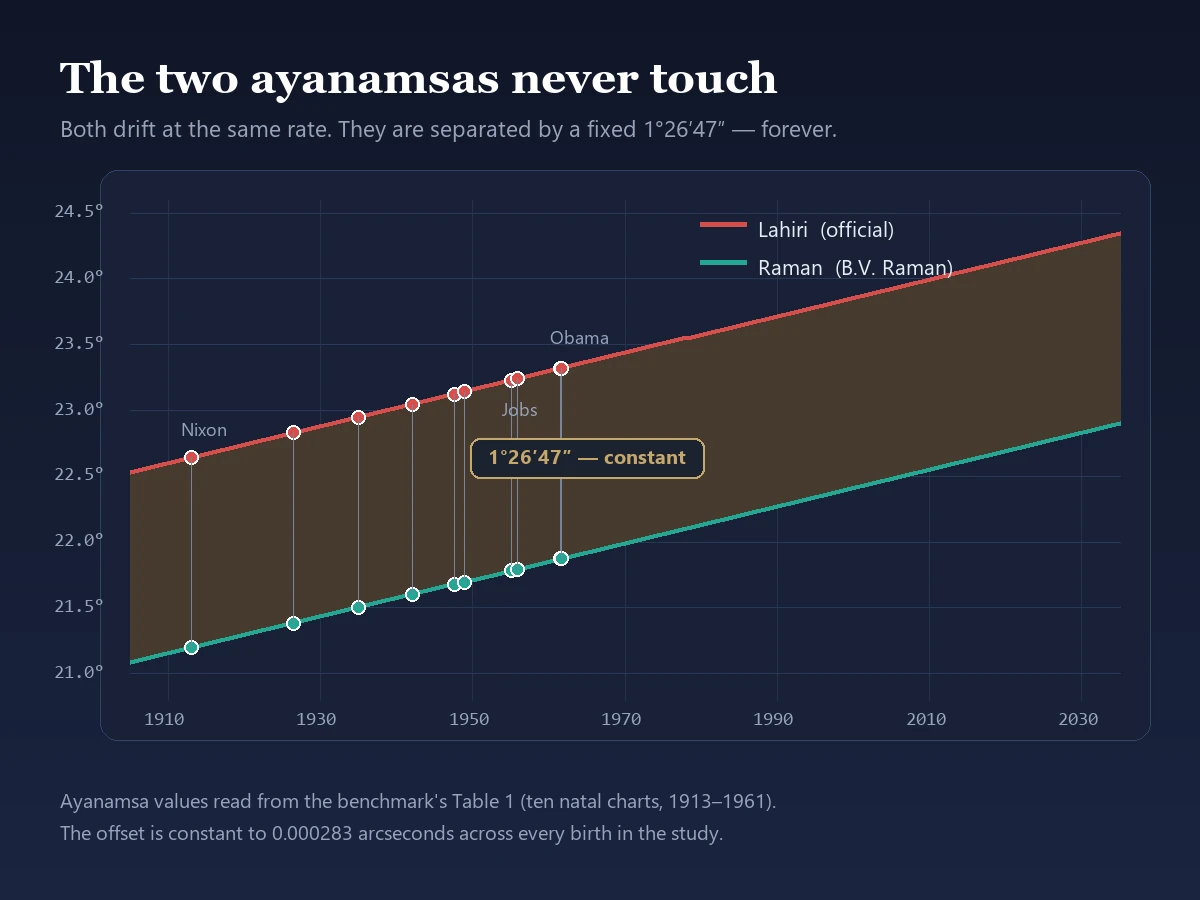
Now the important part. A constant offset sounds harmless. If everything shifts by the same amount, surely the chart just looks slightly rotated and the relationships between planets are preserved?
No. And this is the heart of the whole problem. The zodiac has hard boundaries every 30 degrees. The nakshatras have hard boundaries every 13°20′. The padas have boundaries every 3°20′. Divisional charts have boundaries within those. So a constant shift does not rotate the chart — it pushes planets across fences. And a planet that crosses a fence changes its sign, its house, its dignity, its nakshatra, its pada, and its dasha sequence.
What Half a Degree Actually Does
These are real charts of real public figures, taken from the benchmark we will discuss in a moment. In each case the graha sits near a sign boundary, so the choice of ayanamsa decides which side of the fence it lands on.
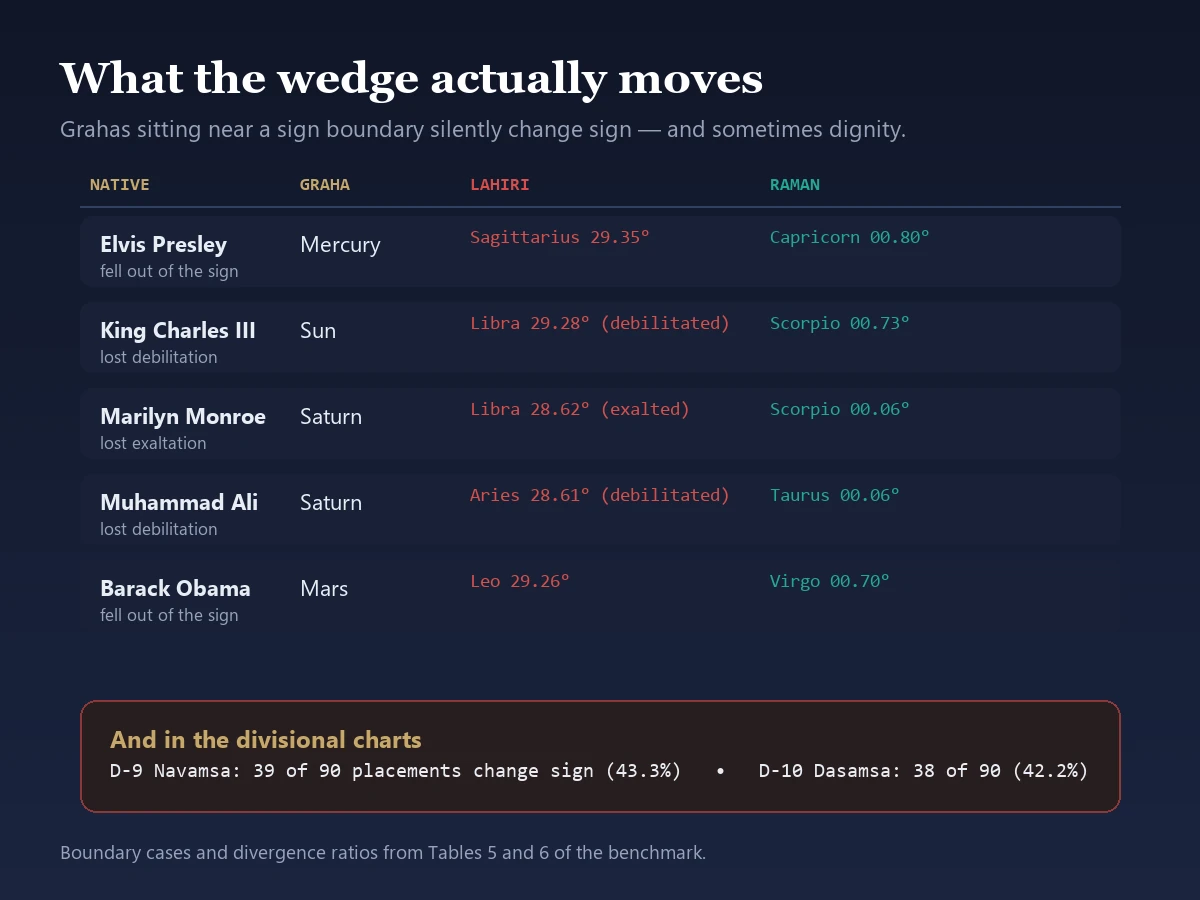
Read the middle two rows again, because they are the ones that should stop you cold:
- Marilyn Monroe's Saturn is exalted in Libra under Lahiri. Under Raman it is in Scorpio — and the exaltation simply vanishes.
- Muhammad Ali's Saturn is debilitated in Aries under Lahiri. Under Raman it is in Taurus, and the debilitation vanishes.
Exaltation and debilitation are among the heaviest weights classical Jyotish places on a planet. We are not arguing about a nuance here. We are looking at whether a graha is at its strongest or its weakest, and the answer depends entirely on which ayanamsa you typed into the box.
Widen the lens, and it gets worse. In the same study, comparing the two ayanamsas across the whole set:
- In the D-9 Navamsa — the chart used for marriage and the inner maturation of a planet — 39 of 90 placements changed sign (43.3%).
- In the D-10 Dasamsa — the chart used for career — 38 of 90 placements changed sign (42.2%).
Nearly half of the divisional chart you are reading is different depending on a number almost nobody examines.
And the effect on timing is not subtle either. Take Steve Jobs, born 24 February 1955. Under Lahiri his Moon sits at 344°30′41″, giving a Saturn mahadasha balance at birth of 1121.63 days, ending 22 March 1958. Under Raman the Moon sits at 345°57′28″, and the balance is 368.87 days, ending 29 February 1956. Same person. Same birth minute. A difference of more than two years in when the first mahadasha ends — which cascades through every subsequent period of the life.
So: who decided we should use Lahiri? And why?
The Committee That Chose It
This is the part that is not a matter of opinion. It is in the public record, in a Government of India report, and you can read it yourself.
After independence, India had a problem that had nothing to do with astrology. The country was using something like thirty different panchangas, produced by different regions and different traditions. They disagreed about when festivals fell. Government offices, railways and courts needed one calendar. In the early 1950s the Government of India constituted the Calendar Reform Committee under the Council of Scientific and Industrial Research to sort this out.
Here is the complete list of members, as printed in the report:
- Prof. M. N. Saha, D.Sc., F.R.S., M.P. — Chairman. Nuclear physicist; Director, Institute of Nuclear Physics, Calcutta. Famed for the Saha ionisation equation.
- Prof. A. C. Banerji, M.A., M.Sc., F.N.I. — Vice-Chancellor, Allahabad University.
- Dr. K. L. Daftari, B.A., B.L., D.Litt. — Nagpur.
- Shri J. S. Karandikar, B.A., LL.B. — Ex-Editor, The Kesari, Poona.
- Dr. Gorakh Prasad, D.Sc. — Reader in Mathematics, Allahabad University.
- Prof. R. V. Vaidya, M.A., B.T. — Senior Lecturer in Mathematics, Madhav College, Ujjain.
- Shri N. C. Lahiri, M.A. — Calcutta. Acted as Secretary of the Committee.
Read that list again and count the astrologers.
A nuclear physicist. A university vice-chancellor. A lawyer. A newspaper editor. Two mathematicians. And a secretary with an M.A. That is the entire body that decided how the zodiac would be measured in India. There is no practising jyotishi on it. There is no representative of any astrological lineage, no author of a predictive text, no hereditary panchanga family.
This is not a criticism of the individuals. They were eminent people doing a hard civic job, and by the standards of calendar science they did it well. It is simply a statement of scope. They were not assembled to evaluate astrology, and they did not claim to.
What they were actually asked to do
The report states its own mandate in plain language:
“The Calendar Reform Committee was asked to make a study of the various Hindu religious calendars, and recommend to the Government a Unified National Calendar for Hindu religious purposes for the whole of India.”
Report of the Calendar Reform Committee, Part A, Introductory section
A unified calendar. For festivals. For the whole country. That is the entire brief. Nothing in it requires — or even mentions — determining which ayanamsa produces the most accurate reading of a birth chart.
What they recommended, and the reason they gave
Now the crucial passage. In its final recommendations, the Committee set the ayanamsa at 23°15′ on 21 March 1956, increasing by about 50.27 arcseconds per year. And it explained exactly why:
“The moments of moon's exit from a nakṣatra division of 13° 20′ each or sun's entry into it, would be calculated with a variable ayanāṁśa i.e., on the supposition that they are fixed with respect to the stars… In the calculation of nakṣatras, however, we have adopted a variable ayanāṁśa, so, that at the time of a particular nakṣatra the moon may be seen in the sky near the star or star-group of that name.”
Report of the Calendar Reform Committee, Final Recommendations, “Religious Calendar”, item (7)
There it is, in the committee's own words. The purpose of the ayanamsa was so that the Moon could be seen in the sky near the star that gives the nakshatra its name.
That is a labelling objective. It is about making sure that when a panchanga says “Moon in Rohini today”, a person can step outside, look up, and find the Moon near Aldebaran. It is a perfectly sensible requirement for a calendar that ordinary people use. It says nothing — absolutely nothing — about whether that same offset produces correct predictions when fed into Vimshottari dasha, divisional charts, or ashtakavarga.
And the figure itself was a compromise, by their own admission
Perhaps most striking of all, the committee did not present 23°15′ as a carefully derived truth. It presented it as a political settlement:
“This recommendation is to be regarded only as a measure of compromise, so that we avoid a violent break with the established custom. But it does not make our present seasons in the various months as they were in the days of Varahamihira or Kalidasa.”
Report of the Calendar Reform Committee, Final Recommendations, “Religious Calendar”
Read that with full weight. The value chosen was selected because it matched what almanac-makers were already doing, so that reform would not disrupt existing practice. It was explicitly not a claim that this was the astronomically or astrologically correct zero point. The committee openly conceded that its own compromise “does not make our present seasons in the various months as they were in the days of Varahamihira or Kalidasa.”
In other words: the number is a continuity device. It was designed to change as little as possible, not to be as correct as possible.
What the committee thought of astrologers
One more passage, because it settles the question of intent beyond any doubt. Describing how Indian calendar-making had declined, the report observed:
“In India, astronomical observations stopped from about 1200 A.D. after the advent of the Turkish invaders, when Indian observatories were either destroyed or abandoned by the astronomers and calendar making fell into the hands of astrologers, who had to depend on ancient treatises.”
Report of the Calendar Reform Committee, Part A, Introductory section
The committee regarded the shift of calendar-making into astrologers' hands as part of the decline it had been convened to correct. These were men who believed astronomers should take the calendar back from astrologers. They were not, in any sense, trying to serve astrology.
Put those four facts together and the conclusion is unavoidable:
- The body that fixed India's official ayanamsa contained no astrologer.
- Its mandate was a unified civil and religious calendar, not astrological accuracy.
- The ayanamsa it adopted was justified solely for nakshatra sky-labelling — so the Moon appears near its named star.
- The value was explicitly a “measure of compromise” chosen to avoid disturbing existing custom.
And then something nobody intended happened. The committee's number was published in the Indian Astronomical Ephemeris. It became the government standard. Software vendors needed a default, so they used it. Textbooks copied it. A generation of students learned it as simply the ayanamsa, with no idea it had ever been a choice — let alone a compromise between rival panchanga traditions over festival dates.
Nobody ever audited it for prediction. Why would they? It came from the government. It was in the ephemeris. It was, in the most literal sense, official.
That is how a calendar convention became the foundation of a predictive science. Not by evidence, not by experiment, not by consensus of practitioners — but by administrative inheritance.
“But Lahiri Works For Me”
Here is the objection, and it is a fair one. Serious astrologers using Lahiri have made correct predictions. Some have made spectacular ones. If Lahiri were wrong at its core, wouldn't that show up?
Not necessarily — and the reason is one of the most interesting facts about how human skill actually works.
The altered multiplication table
Try this thought experiment. Take a multiplication table and change every number in the left-hand column — replace 4 with 7, replace 9 with 3, and so on — but leave all the results untouched and correct. Then hand it to a child and make them learn from it.
What happens? At first they get nonsense. But children are relentless pattern-matchers, and they get feedback from the real world — the teacher marks the answer wrong, the shopkeeper gives the wrong change, the sum does not add up. So they start compensating. Without ever articulating it, they build a private correction layer on top of the corrupted table. Within a few years they can multiply perfectly. Ask them to state the table out loud and they will recite your corrupted version, because that is what they learned. Then they will produce correct answers anyway.
Now the key question: if you tested this child against one who learned a correct table, could you tell them apart?
For ordinary arithmetic, mostly no. Both get the right answers. The corruption has been absorbed into the skill.
This is precisely the position of the modern Lahiri practitioner. For seventy years, thousands of serious astrologers have used one ayanamsa, received one class of output, compared it against real lives, and gradually tuned their interpretive rules to match that output. The correction is real. It lives in the practitioner — in the accumulated folklore of which combinations are believed to deliver which results, passed down through books, classes and apprenticeships, all calibrated against Lahiri charts.
This is the single most important reason Lahiri has survived. An entire tradition has been auto-correcting for a systematic instrument error, and the correction has become invisible because it is stored in people rather than in the mathematics.
Why the error is so hard to notice
The auto-correction works because three conditions hold at once. All three are present here.
- It is constant. The 1°26′47″ offset is identical on every chart, so it never generates a contradiction. A variable error would reveal itself immediately; a constant one looks like a stable feature of the system.
- It is self-consistent. Because the whole chart shifts together, its internal logic still holds. The chart looks coherent, so nothing prompts suspicion.
- It produces no clean error signal. When a prediction misses, there are a hundred plausible explanations — wrong birth time, insufficient rectification, a weak chart, karmic factors, the need for remedies. The ayanamsa is never even considered, because it is not regarded as a choice. There is no feedback loop that can blame the constant.
This is the structural reason the craft has not accumulated knowledge the way other technical disciplines do. A field where the measuring instrument is wrong, invisibly and consistently, and where every failure has an alternative explanation, cannot learn from its own mistakes. Errors do not compound into understanding. They compound into folklore.
And there is a second-order effect that is even more corrosive: because the correction lives in practitioners rather than in rules, it cannot be transmitted or checked. An astrologer who has silently calibrated against Lahiri passes on rules that are only correct when applied by someone with the same silent calibration. The next generation inherits the rules but not the calibration, gets worse results, and concludes that the tradition itself is decaying. Which, in a sense, it is.
There is a well-known name for the general shape of this problem in philosophy of science: a theory that can absorb any result, and therefore cannot be falsified, also cannot be improved. The ayanamsa has functioned for seventy years as exactly that kind of unfalsifiable constant.
So Somebody Finally Tested It
History and theory are one thing. But the honest question is empirical: if you run both ayanamsas against real lives, does one do better?
For most of astrological history, nobody could answer that. The work involved is enormous, and until cheap computation existed it was effectively impossible. It is now possible. And in October 2026, an independent researcher named Aniket Samant did it.
How the test was built
The design is worth understanding, because the care taken is what makes the result worth reading:
- Ten public charts with documented birth data: Steve Jobs, Bill Gates, Muhammad Ali, Barack Obama, Diana Princess of Wales, Richard Nixon, Arnold Schwarzenegger, Marilyn Monroe, Elvis Presley and King Charles III.
- Forty dated life events across those charts — career peaks, marriages, deaths, health crises, births of children — four per person.
- Significators identified first. For each event, the planets expected to be relevant were listed before looking at any results. This is the crucial discipline: it prevents the researcher from choosing the planets that happen to fit.
- A pre-specified scoring rule. Points were awarded for whether the mahadasha, antardasha and pratyantardasha lords matched the significators, weighted 1-2-3. Different weightings were also run as a sensitivity check.
- Chance adjustment. Not all dashas are equal in length, so a planet is more or less likely to be ruling at any random moment. The expected score was computed and subtracted, leaving an excess score. This is the difference between “Raman hit more” and “Raman's planets happened to be ruling more”.
- Swiss Ephemeris 2.10.03 through
pyswisseph, with the backend verified on every call, mean node, Vimshottari year of 365.2425 days, and whole-sign houses.
Both ayanamsas were run over identical birth data. Same events. Same significators. Same scoring. The only variable was the number being subtracted from every longitude.
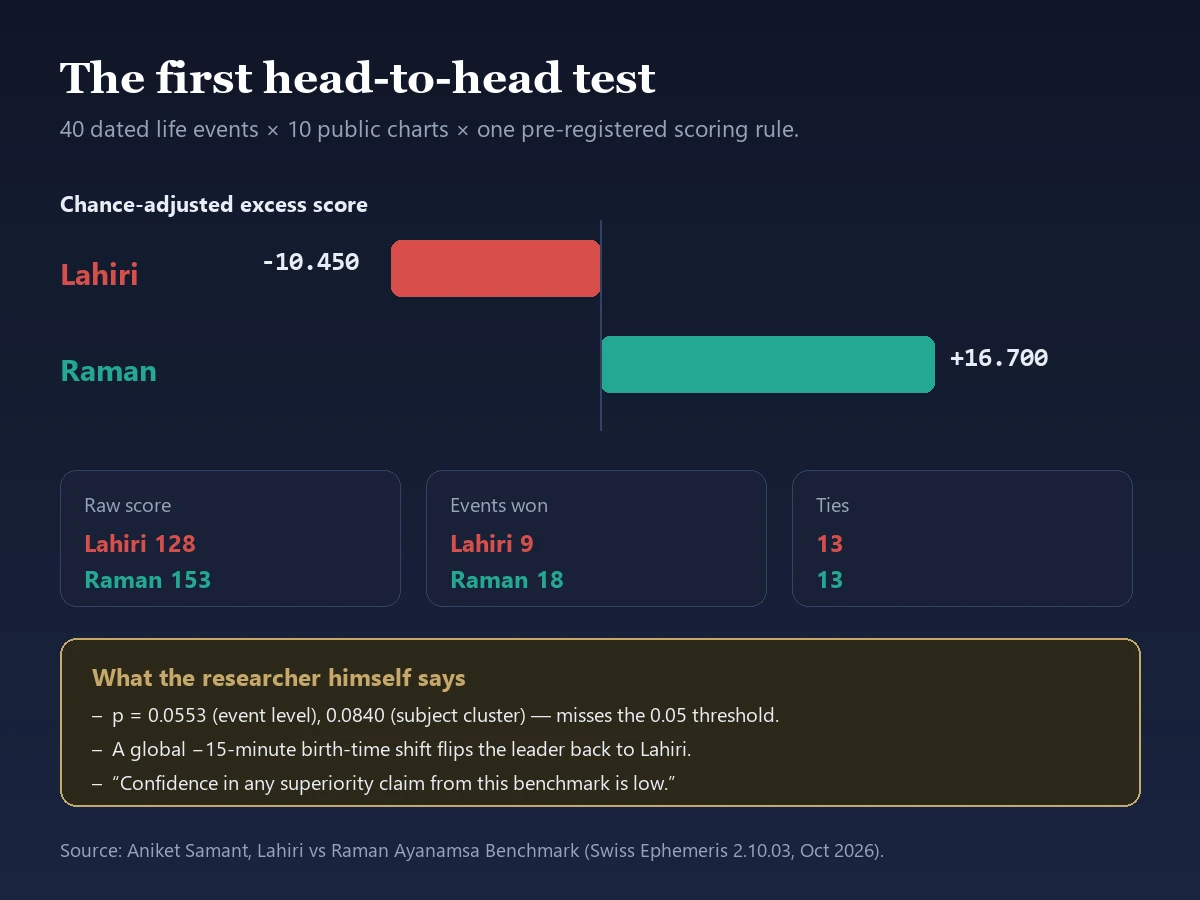
The result
| Metric | Lahiri | Raman |
|---|---|---|
| Raw score (out of 240) | 128 | 153 |
| Total expected by chance | 138.450 | 136.300 |
| Chance-adjusted excess | −10.450 | +16.700 |
| Mean excess per event | −0.261 | +0.417 |
| Median excess per event | −0.275 | +0.600 |
| Events won (of 40) | 9 | 18 |
| Events tied | 13 | 13 |
Lahiri scored below chance expectation. Raman scored above it. The gap is 27.15 excess points, and Raman won twice as many events as Lahiri did.
The pattern holds under every weight scheme tested (1-1-1, 1-2-3 and 1-2-4), and in both the corrected and the literal birth-data scenarios. Raman leads in all of them.
Broken down by event type, the interesting detail is where Raman gains. Marriage events: Lahiri +0.350, Raman +7.350. Death and maraka events: Lahiri +1.050, Raman +5.850. Childbirth: Lahiri +0.250, Raman +2.900. The categories where classical significator logic is most codified are the categories where the choice of ayanamsa separates the two most sharply.
Now the part most writers would leave out
Here is where we part company with the way this result has been described elsewhere, and where we ask you to trust us a little more rather than a little less.
This benchmark does not prove that Lahiri is astrologically false. Aniket Samant is admirably explicit about the limits of his own study, and we are not going to pretend otherwise on his behalf. In his own words:
“It cannot establish that either ayanamsa is scientifically true… Confidence in any superiority claim from this benchmark is low.”
Lahiri vs Raman Ayanamsa Benchmark, Interpretation and production recommendation
The specific limitations, stated plainly:
- The event-level p-value is 0.0553, and the more defensible subject-clustered value is 0.0840. Neither clears the conventional 0.05 bar. The result is suggestive, not conclusive.
- Four events share each natal chart, so the forty observations are not independent — the effective sample is closer to ten.
- A global −15 minute perturbation of birth times flips the leader back to Lahiri. The outcome is not robust to birth-time uncertainty.
- Three of the ten records turned out not to be Rodden AA as originally claimed, and a few event dates are contested or arguably mislabelled.
- There is an acknowledged circularity risk: modern Parashari rules and software conventions were themselves refined under particular ayanamsas, so testing them without an independent historical calibration set may favour whichever convention curated them.
- It also cannot show that astrology as a whole is validated. The study explicitly declines to claim that.
Those are real weaknesses, and we would rather you knew them now than discovered them later and dismissed everything above.
But set them against the alternative. The alternative is what we have had for seventy years: no test at all. Not a weak test, not a contested test — nothing. A number adopted for festival administration in 1955, inherited by software in the 1990s, and never once examined against outcomes. This study is a first pass by one researcher on ten charts. That is a small thing. It is also infinitely more than was done before it.
And note which direction the first real look pointed. It pointed the same way the history did.
How This Degrades the Craft
It is worth being precise about the causal claim, because it is easy to overstate. The argument of this article is not that every failed prediction in India is the ayanamsa's fault. It is narrower, and it is more serious.
A discipline cannot improve if its instrument errors are invisible and its failures are always explainable some other way.
Palm-leaf practitioners worked under brutal constraints, but with one enormous advantage: tight, unavoidable feedback. A reading either matched the person's life or it did not, and there was no elaborate theoretical apparatus available to explain away a miss. Whatever they were doing, the loop was closed. Knowledge could accumulate.
Modern practice has the opposite structure. Computation is free, so charts are cheap and plentiful. But the error signal is drowned. When a prediction fails, the practitioner can attribute it to birth-time error, insufficient rectification, an afflicted chart, insufficient remedial work, karmic debt, or the client's free will — and every one of those explanations is available within the tradition. The measuring instrument itself is never questioned, because it is not perceived as an instrument. It is perceived as the sky.
So the craft accumulates explanations instead of accuracy. Each generation adds a layer of interpretive sophistication on top of a foundation that was never checked, and the sophistication is doing the work that the correct constant should have done. This is what a degraded technical tradition looks like from the inside: it feels like depth.
Meanwhile the shift is not even uniform in its damage. It is worst exactly where Vedic astrology claims its greatest precision:
- Near sign boundaries, where dignity flips outright — exalted becomes ordinary, debilitated becomes neutral.
- In the nakshatra and pada, where the Vimshottari dasha balance is computed — the two-year discrepancy in the Jobs example.
- In the divisional charts, where 42–43% of placements move.
- In ashtakavarga, where bindu counts are tallied per sign, so a boundary crossing changes the score of two houses at once.
These are not the margins of the system. They are the parts practitioners lean on hardest.
What This Article Does Not Claim
To keep this honest and useful, here is what we are not saying — and we would ask you to hold us to it:
- We are not claiming the Raman ayanamsa has been proven correct. It has merely done better in the first small test, and the researcher himself rates confidence in that finding as low.
- We are not claiming that Lahiri practitioners are unskilled or dishonest. The opposite is true: their skill is precisely what has hidden the problem for seventy years.
- We are not claiming this benchmark validates astrology as a predictive science. It was not designed to, and it says so explicitly.
- We are not claiming the Calendar Reform Committee acted in bad faith. It acted entirely within its remit. The failure is not that the committee overreached — it is that astrology never checked the hand-me-down.
The claim is narrower, and it is enough: a calendar convention was inherited as a predictive constant, without ever being tested, and that inheritance has cost the tradition its ability to learn. That much is documented in the committee's own report and demonstrated in the benchmark's numbers.
What To Do About It
This is not a call to burn your books or abandon your teacher. It is a call to stop treating an administrative inheritance as a law of nature. Concretely:
- Make the ayanamsa visible. Every chart you produce should print which ayanamsa it used, alongside the ephemeris version, node type and dasha-year convention. A hidden setting becomes an unquestioned assumption. If a chart does not tell you its ayanamsa, you cannot evaluate anything about it.
- Stop hard-coding a winner. The benchmark's own software recommendation is the right one: ship both Lahiri and Raman as explicit, versioned profiles, let users switch without recomputing their birth data, and treat the default as a compatibility choice — never as a truth claim. VedAstro exposes the ayanamsa as a parameter for exactly this reason.
- Run your own clients both ways. Take charts you know well — your own, your family's, long-standing clients. Cast them under Lahiri and under Raman. Ignore the big picture and look for the fences: which grahas change sign, which lose or gain dignity, which nakshatra padas move, and how far the dasha boundaries shift. You will not need a study to see the disagreement. You will need one to know which side is right.
- Log before you look. The single most important discipline in the benchmark above is that significators were written down before the results were examined. If you want your own practice to produce real knowledge instead of confirmation, write your expectation for a dated event before it happens, then check it. This is the only way the loop ever closes again.
- Push for a proper study. The benchmark states what a defensible replication needs: 25–50 independent charts per stratum, prospectively frozen event definitions, verified birth timestamps, ordinary-person control cohorts, multiple ayanamsas including negative controls, subject-clustered inference (the person, not the event, as the unit of replication), and a held-out replication set. That is a real research programme. It is also entirely achievable now, at trivial cost. Nobody has done it.
The palm-leaf practitioners could not run that study. We can. That is the whole point.
Read the Full Benchmark
The complete 14-page report by Aniket Samant — full birth-data audit, per-epoch ayanamsa tables, the complete 40-event dasha schedule, significator scoring, the rasi-sandhi audit, divisional divergence, jitter and weighting sensitivity, and the reproducibility notes.
Contact: aniketpro101@gmail.com • PDF • 124 KB
The Bottom Line
India's official ayanamsa did not come from an astrological conclave weighing rival methods. It came from a calendar committee appointed to stop thirty panchangas from disagreeing about festival dates. Its members were physicists and mathematicians. It had no astrologer on it. It justified its ayanamsa on the grounds that the Moon should appear near the star that names the nakshatra — a labelling requirement for a public calendar. And it described its own chosen value, in print, as a measure of compromise adopted to avoid disturbing established custom.
That number then became the default in every piece of software, was taught to a generation as though it were discovered rather than decided, and was never once tested against real lives for the purpose it is now used for.
When somebody finally did test it against real lives, Lahiri scored below chance and Raman scored above it — by 27 excess points, winning twice as many events. That result is not proof. It is a first look, on ten charts, with a p-value that misses the conventional threshold and a birth-time sensitivity that flips the result. Anyone claiming more than that is overselling.
But here is what cannot be argued: something was used as the foundation of a predictive science for seventy years without ever being examined. The tradition that once read entire lives from a thumbprint lost the one habit that made that possible — the habit of checking whether the instrument is true.
Lahiri is not sacred. It is a compromise from 1955 that nobody audited. Test it, publish what you find, and let the evidence decide. That is the only route back to the standard those palm leaves set.
References & Sources
Primary sources — the Calendar Reform Committee
-
Calendar Reform Committee, Government of India (1955). Report of the Calendar Reform Committee. Council of Scientific and Industrial Research, New Delhi. Full scanned text at the Internet Archive.
archive.org — Report of the Calendar Reform CommitteeSource of the committee's mandate, its membership, the 23°15′ ayanamsa figure, and the “measure of compromise” statement. -
Members of the Calendar Reform Committee — the report's own membership list, including the note that “Shri N. C. Lahiri acted as the Secretary of the Committee.”
Transcription of the committee membership list -
Final Recommendations — “Religious Calendar”, item (7): the ayanamsa set at 23°15′ on 21 March 1956, with the stated reason that “the moon may be seen in the sky near the star or star-group of that name”; and the “measure of compromise” admission.
Transcription of the Final Recommendations -
Part A, Introductory — “Hindu religions: unified calendar”: the committee's mandate statement and its observation that “calendar making fell into the hands of astrologers”.
Transcription of the Introductory section
The empirical benchmark
-
Aniket Samant (October 2026). Lahiri vs Raman Ayanamsa Benchmark. Swiss Ephemeris 2.10.03 via
pyswisseph; 10 natal charts, 40 dated events; pre-registered 1-2-3 scoring rule with chance adjustment. Contact: aniketpro101@gmail.com.
Download the PDF (14 pages, 124 KB)All Table 1–7 figures, the scorecard, the rasi-sandhi cases and the divisional-divergence ratios quoted in this article come from this report. Its stated limitations are reproduced in the “Now the part most writers would leave out” section above.
Astronomical & astrological background
-
Swiss Ephemeris — the ephemeris used for all sidereal positions in the benchmark, including its documented sidereal modes and ayanamsa definitions.
astro.com/swisseph -
Buddhike Indrasena, Chandra Hari's arguments on Ayanamsa — a scholarly critique of the Citrapaksa (Chitrapaksha) ayanamsa and the reasoning behind the Calendar Reform Committee's adoption of it.
researchgate.net — Chandra Hari's arguments on Ayanamsa - B. V. Raman, Hindu Predictive Astrology; Graha and Bhava Balas; Ashtakavarga System of Prediction; Prasna Marga (translation). The Raman ayanamsa compared in this article is the one used across Dr. Raman's published ephemerides and worked examples.
-
S. N. Biswas, U. Mukhopadhyay & S. Ray, A Village Astronomer: Life and Works of R. G. Chandra, arXiv:1102.2383 — background on the Indian calendar-reform movement and the amateur-astronomy milieu from which the 1950s reforms emerged.
arxiv.org/abs/1102.2383 -
VedAstro — open-source Vedic astrology calculators in which the ayanamsa is an explicit, switchable parameter, so any chart can be recomputed under Lahiri and Raman without re-entering birth data.
VedAstro API documentation • Open source repository
Further reading
- Vijay Dubey, Ayanamsha in Vedic Astrology: Science, Controversy and the Zodiac Truth — From Lahiri to Chandra Hari. A book-length treatment of the ayanamsa controversy. Listed for further study; we have not relied on it for any factual claim in this article.
A note on sourcing. Every quotation attributed to the Calendar Reform Committee above is taken from the committee's published report and is linked to its transcription. Every number attributed to the benchmark is taken from the report available for download above. Where the benchmark's author states a limitation of his own work, we have reproduced it rather than omitted it. If you find an error in our reading of either source, please tell us — the point of this article is that these things should be checked.