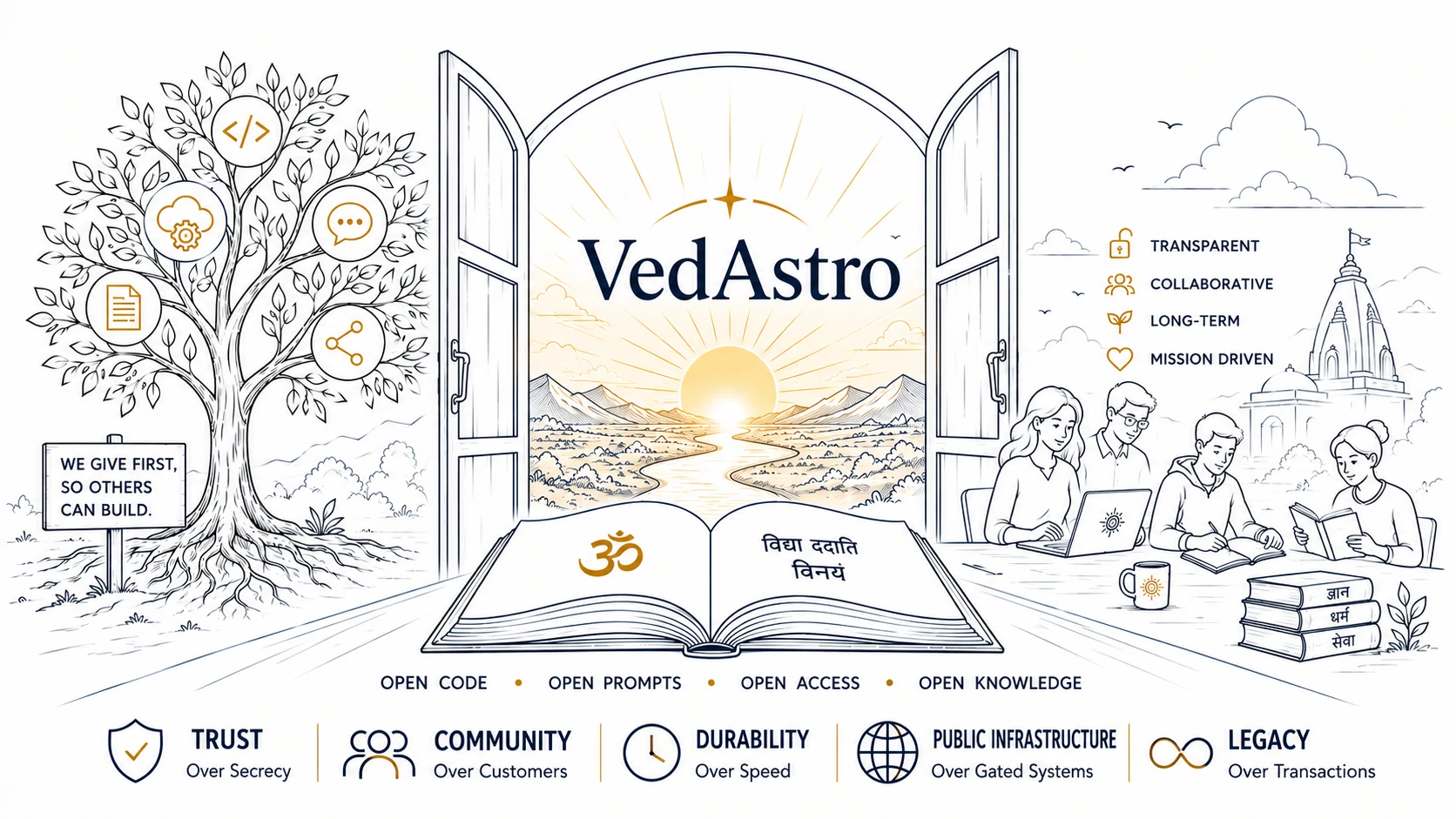
Why is VedAstro FREE and OPEN?
Because trust compounds faster in public than profit does in private!
VedAstro is built on a simple principle: create real value first, publish the work openly, and let the mission outlast applause, algorithms, and short-term transactions.
The core idea comes from Napoleon Hill: the strongest builder is the one who gives without demanding instant return.
VedAstro applies that idea to code, prompts, APIs, documentation, and public knowledge.
Give First
Value before validation
Stay Visible
No hidden prompt walls
Build Publicly
Code, docs, APIs, and tools
Play Long Game
Mission outlasts metrics
Core Principle
The page is rooted in one idea from Napoleon Hill: the person who gives without needing immediate return becomes difficult to stop, because their energy is not controlled by applause.
That is not passive charity. It is disciplined long-game building.
What we took from Napoleon Hill's words
Value beats desperation
The world rewards builders who create substance, not people who beg to be noticed.
Identity matters more than applause
Giving without a receipt trains a mission-first identity rather than a transaction-first habit.
Invisible work still compounds
Every honest act of service plants seeds of trust, precision, and reputation.
The mission is the anchor
A builder who is not controlled by short-term reaction can keep raising the standard.
Give Without Expecting Immediate Return
VedAstro keeps major knowledge surfaces open because hidden systems create dependence, while public systems create trust. We would rather publish the work and let people inspect it than force them to guess what the machine is doing.
Play the Long Game
Short-term extraction is easy. Long-term trust is harder. VedAstro chooses the slower path: publish openly, improve publicly, and let the body of work become the proof. That approach survives trends better than gated promises do.
Identity Over Transaction
Free and open is not a temporary growth tactic here. It is an identity decision. If the mission is to preserve, verify, and spread Vedic knowledge, then secrecy around core prompts and logic works against the mission itself.
Small Acts Compound Into Influence
Each visible prompt, public endpoint, documented method, and open-source commit is a small seed. Over time those seeds become reliability, community contribution, and a body of evidence that the platform is serious about what it claims.
Free and open is visible in the product, not just in the slogan.
The principle shows up in concrete choices: open-source library code, public MCP access, inspectable prompts, developer-facing APIs, and knowledge pages that explain how the system thinks instead of hiding behind marketing language.
Open Code
The core engine is open for inspection so trust can come from evidence, not brand claims.
Open Prompts
When the assistant behavior matters, the principle is to show the instruction logic rather than hide it behind mystique.
Open Access
Free public surfaces let students, developers, and researchers use the system before any commercial relationship exists.
See the principle in action
If this philosophy matters, inspect the code, try the API, or connect the MCP server. The claim should always be verifiable in the product itself.