Free Advanced Python Vedic Astrology Library & API
The VedAstro Python library gives you instant access to the world's most comprehensive Vedic astrology engine — planet positions, divisional charts, dasa periods, compatibility reports, and AI-powered features, all from a single pip install.
Whether you're building a horoscope app, a matchmaking platform, or a research tool, VedAstro's Python library removes every barrier between you and professional-grade Vedic astrology calculations. No complicated setup. No local binaries. No astrology expertise required to get started. Just install the library, set your API key, and start computing — the heavy lifting runs on VedAstro's cloud engine.
What You're Getting
684
Calculations — the largest collection in any astrology programming library
47
Ayanamsa systems — Lahiri, Raman, KP, Fagan-Bradley & 43 more
D1–D60
Divisional charts — full Parashari varga system coverage
AI-Powered
Birth time auto-fill and natural language horoscope search
Zero Deps
Everything runs in the cloud — your app stays lightweight
Open Source
MIT licensed, community maintained, fully auditable on GitHub
Simple by Design
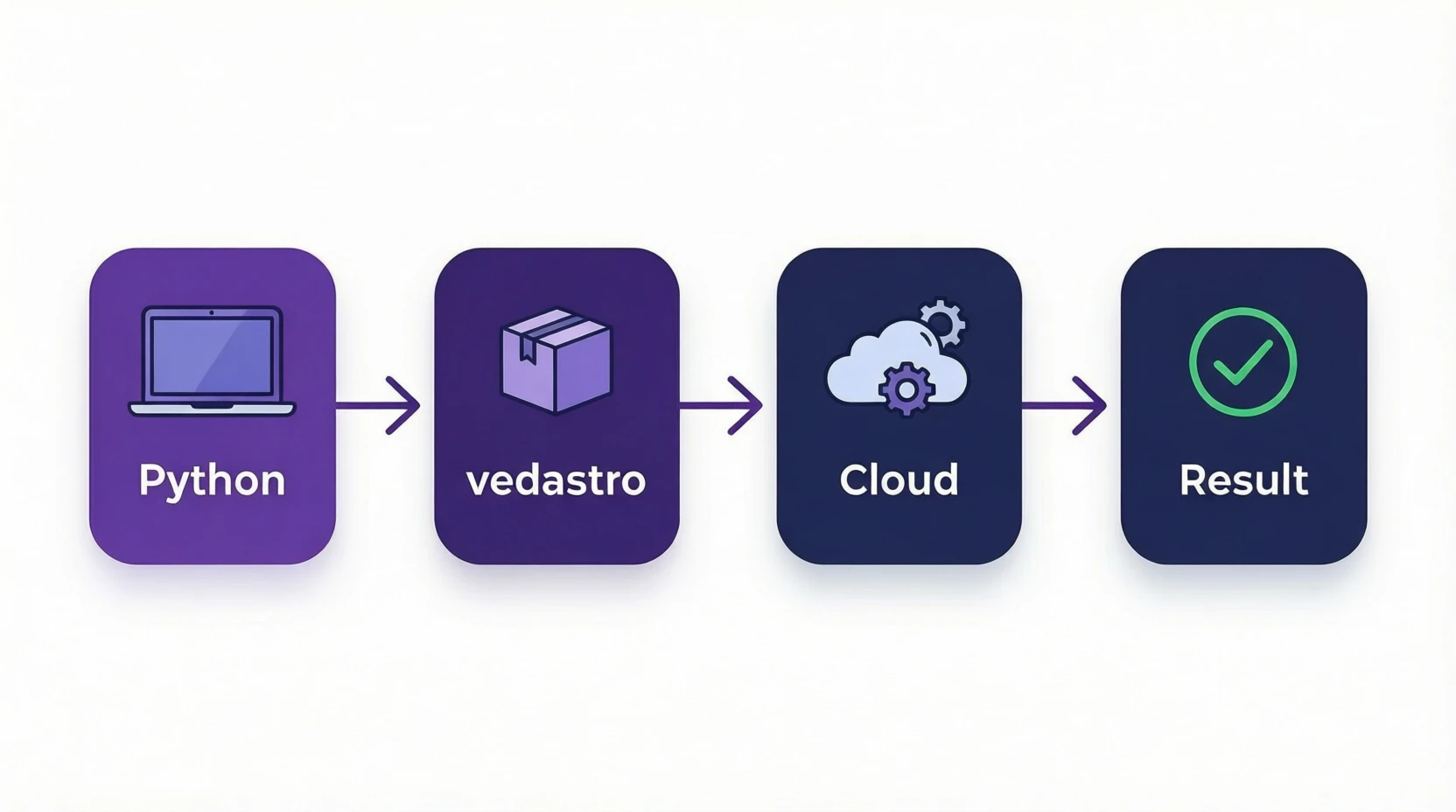
The VedAstro Python library is a thin, elegant wrapper around the VedAstro REST API. You write Python; the cloud does the calculation.
No heavy installation
The library itself is tiny — everything runs server-side
Always up to date
Calculation improvements roll out on the server automatically
Scales with you
From personal projects to production apps, same code works
Up and Running in 30 Seconds
Install the library from PyPI

pip install vedastroThat's it. No DLLs, no C extensions, no ephemeris files to download.
Ready to Unlock 684 Calculations?
Get unlimited access for just $1/month — no rate limits, all features included
Instant activation • Cancel anytime • 99.9% uptime guarantee
See It in Action
Get a complete planetary dataset for any birth chart in three lines:
from vedastro import *

Calculate.SetAPIKey('your-api-key')

geo = GeoLocation("Tokyo, Japan", 139.83, 35.65)
birth_time = Time(hour=23, minute=40, day=31, month=12, year=2010, offset="+08:00", geolocation=geo)

result = Calculate.AllPlanetData(PlanetName.Sun, birth_time)
Tools.Print(result)
Full Kuta-based compatibility analysis between two horoscopes:
from vedastro import *

Calculate.SetAPIKey('your-api-key')

romeo = Time("23:40 31/12/1996 +08:00", GeoLocation("Tokyo, Japan", 139.83, 35.65))
juliet = Time("14:30 15/06/1997 -05:00", GeoLocation("New York, USA", -74.006, 40.7128))

match = Calculate.MatchReport(romeo, juliet)
Tools.Print(match)
Pull dasa periods for any date range at any depth of sub-periods:
from vedastro import *
import json

Calculate.SetAPIKey('your-api-key')

geo = GeoLocation("Tokyo, Japan", 139.83, 35.65)
birth_time = Time("23:40 31/12/2010 +08:00", geo)

dasa = Calculate.DasaForLife(birth_time, "VimshottariJanma", depth=3)
print(json.dumps(dasa, indent=4))
Ask a plain-English question and get the most relevant passages from classical Vedic books — no exact keywords needed:
from vedastro import *

Calculate.SetAPIKey('your-api-key')

# see which classical texts are searchable
print(Calculate.GetAvailableSourceTexts())

# natural-language semantic search across all texts
passages = Calculate.SearchSourceText("effects of Saturn in the 7th house", topK=5)

for p in passages:
    print(p["sourceName"], p["pageNumber"], p["text"])
Remove rate limits and get instant access to all 684 calculations
684 Calculations Across Every Major Category
| Category | What's Included |
|---|---|
| Positions, longitudes, strengths, aspects, conjunctions, retrograde status | |
| House signs, lords, bhava chart, all house data | |
| D1 through D60 — Navamsha, Drekkana, and all varga charts | |
| Sign-based calculations, planet-in-sign queries | |
| Vimshottari dasa periods with explicit starting rules and configurable depth | |
| Auspicious time finding, event predictions over any date range | |
| Kuta scoring, full compatibility reports, BaZi integration, AI chat analysis | |
| Birth time auto-fill from partial data, natural language horoscope search |
Full method reference: vedastro.org/API.html
47 Ayanamsa Systems — Vedic, Western, and KP
Switch ayanamsa systems with a single line
Lahiri
Modern Vedic standard
Raman
VedAstro default
Krishnamurti
KP System
Fagan-Bradley
Western sidereal
Calculate.SetAyanamsa(Ayanamsa.Lahiri)
Calculate.SetAyanamsa(Ayanamsa.Fagan_Bradley)
Calculate.SetAyanamsa(Ayanamsa.Krishnamurti)
Start Free. Scale When You're Ready.
Free
Rate-limited
'FreeAPIUser'No signup required — ideal for exploration and development
Subscriber
Unlimited access
High-speed access to all 684 calculations for production apps
Calculate.SetAPIKey('your-key-here')Ready-to-Run Examples
The GitHub repository includes a full set of demo scripts to get you started immediately
from vedastro import *  # install via pip

# PART 0 : Set API key
Calculate.SetAPIKey('FreeAPIUser')  # !! unlimited speed  API key from "vedastro.org/API.html"

# PART 1 : PREPARE NEEDED DATA
#-----------------------------------

# set birth location
geolocation = GeoLocation("Tokyo, Japan", 139.83, 35.65)

# group all birth time data together (day/month/year)
birth_time = Time("23:40 31/12/2010 +08:00", geolocation)


#PART 2 : CALCULATE ALL DATA
#-----------------------------------

#PLANETS
allPlanetDataList = Calculate.AllPlanetData(PlanetName.Sun, birth_time)
Tools.Print(allPlanetDataList)

#HOUSES
allHouseDataList = Calculate.AllHouseData(HouseName.House1, birth_time)
Tools.Print(allHouseDataList)

#ZODIAC SIGNS
allZodiacDataList = Calculate.AllZodiacSignData(ZodiacName.Gemini, birth_time)
Tools.Print(allZodiacDataList)from vedastro import * # install via pip
# PART 0 : Set API key
Calculate.SetAPIKey('FreeAPIUser') # !! unlimited speed API key from "vedastro.org/API.html"
# PART 1 : PREPARE NEEDED DATA
#-----------------------------------
# set birth location
geolocation = GeoLocation("Tokyo, Japan", 139.83, 35.65)
# group all birth time data together (day/month/year)
birth_time = Time("23:40 31/12/2010 +08:00", geolocation)
#PART 2 : CALCULATE ALL DATA
#-----------------------------------
#PLANETS
allPlanetDataList = Calculate.AllPlanetData(PlanetName.Sun, birth_time)
jsonStringA = Tools.AnyToJSON("", allPlanetDataList)
print(jsonStringA)
#HOUSES
allHouseDataList = Calculate.AllHouseData(HouseName.House1, birth_time)
jsonStringB = Tools.AnyToJSON("", allHouseDataList)
print(jsonStringB)
#ZODIAC SIGNS
allZodiacDataList = Calculate.AllZodiacSignData(ZodiacName.Gemini, birth_time)
jsonStringC = Tools.AnyToJSON("", allZodiacDataList)
print(jsonStringC)from vedastro import * # install via pip
import datetime
import pandas as pd # Install via pip if not already installed
import json
# PART 0 : Set API key
Calculate.SetAPIKey('FreeAPIUser') # !! unlimited speed API key from "vedastro.org/API.html"
# PART 1 : PREPARE NEEDED DATA
# -----------------------------------
# Set birth location
geolocation = GeoLocation("Tokyo, Japan", 139.83, 35.65)
# Initial birth time string
birth_time_str = "23:40 31/12/2010 +08:00"
# Parse the initial birth time string into a datetime object
birth_datetime = datetime.datetime.strptime(birth_time_str, "%H:%M %d/%m/%Y %z")
# PART 2 : GENERATE TIME INSTANCES AND CALCULATE DATA
# -----------------------------------
# List to store all results
results = []
# Define the planet for which data is to be calculated
planet = PlanetName.Sun # You can change this to other planets as needed
# Loop to create 100 time instances, incrementing by 1 hour each
for i in range(10):
try:
# Increment the time by 'i' hours
current_datetime = birth_datetime + datetime.timedelta(hours=i)
# Format the new datetime back to the string format expected by Vedastro's Time class
current_time_str = current_datetime.strftime("%H:%M %d/%m/%Y %z")
# Create a Time object with the new time
current_time = Time(current_time_str, geolocation)
# Calculate all planet data for the specified planet at the current time
planet_data = Calculate.AllPlanetData(planet, current_time)
# Flatten the planet_data if it's a nested dictionary
# This step depends on the actual structure of planet_data
# For demonstration, let's assume it's a flat dictionary
flat_data = {
"time": current_time_str,
"planet": planet.value # Assuming PlanetName is an Enum
}
# Update flat_data with planet_data
if isinstance(planet_data, dict):
for key, value in planet_data.items():
# Handle nested dictionaries if necessary
if isinstance(value, dict):
for sub_key, sub_value in value.items():
flat_data[f"{key}_{sub_key}"] = sub_value
else:
flat_data[key] = value
else:
# If planet_data is not a dict, store it as a string
flat_data["planet_data"] = str(planet_data)
# Append the flattened data to the results list
results.append(flat_data)
except Exception as e:
print(f"Error at iteration {i}: {e}")
# Optionally, you can decide to continue or break the loop based on the error
continue
# PART 3 : SAVE THE RESULTS TO A CSV FILE
# -----------------------------------
# Convert the results list to a pandas DataFrame
df = pd.DataFrame(results)
# Optional: Reorder columns if necessary
# For example, place 'time' and 'planet' first
cols = ['time', 'planet'] + [col for col in df.columns if col not in ['time', 'planet']]
df = df[cols]
# Save the DataFrame to a CSV file
csv_filename = 'planet_data_results.csv'
df.to_csv(csv_filename, index=False)
print(f"Data successfully saved to {csv_filename}")from vedastro import * # install via pip
import re
# PART 0 : Set API key
Calculate.SetAPIKey('FreeAPIUser') # !! unlimited speed API key from "vedastro.org/API.html"
# PART 1 : Define CALCULATE Planet DATA Function
#---------------------------------------
def getplanetinfo(planet, time):
planet_data = Calculate.AllPlanetData(planet, time)
degree = str(planet_data[83])
# Extracting degrees, minutes, and seconds from a string
degree, minute, second = map(int, re.findall(r'\d+', degree))
# Convert to decimal
decimal_degrees = degree + (minute / 60) + (second / 3600)
is_retrograde = str(planet_data[28])
if is_retrograde == 'True':
is_retrograde = True
else:
is_retrograde = False
json_data = {"name":str(planet),
"is_retrograde":is_retrograde,
"position":str(planet_data[0]),
"degree":decimal_degrees,
"longitude":float(str(planet_data[61]))
}
return json_data
#PART 2 : PREPARE NEEDED DATA
#-----------------------------------
# set birth location
geolocation = GeoLocation("Tokyo, Japan", 139.83, 35.65)
# group all birth time data together (day/month/year)
time = Time("23:40 31/12/2010 +08:00", geolocation)
#PART 3 : Make all Planet Json Format Info using Method
#------------------------------------------------------
# PLANETS
json_data = []
json_data.append(getplanetinfo(PlanetName.Sun, time))
json_data.append(getplanetinfo(PlanetName.Moon, time))
json_data.append(getplanetinfo(PlanetName.Mercury, time))
json_data.append(getplanetinfo(PlanetName.Venus, time))
json_data.append(getplanetinfo(PlanetName.Mars, time))
json_data.append(getplanetinfo(PlanetName.Jupiter, time))
json_data.append(getplanetinfo(PlanetName.Saturn, time))
json_data.append(getplanetinfo(PlanetName.Rahu, time))
json_data.append(getplanetinfo(PlanetName.Ketu, time))
result = {'status': 'ok',
'data': {'planet_position':json_data}
}
# Print
print(result)from vedastro import * # install via pip
# THIS DEMO CALCULATES DATA NEEDED TO MAKE BHAVA CHART
# PART 0 : Set API key
Calculate.SetAPIKey('FreeAPIUser') # !! unlimited speed API key from "vedastro.org/API.html"
# PART 1 : PREPARE NEEDED DATA
#-----------------------------------
# set birth location
geolocation = GeoLocation("Tokyo, Japan", 139.83, 35.65)
# group all birth time data together (day/month/year)
birth_time = Time("23:40 31/12/2010 +08:00", geolocation)
#PART 2 : CALCULATE DATA FOR CHART
#-----------------------------------
# Get the sign for House 1
house1ZodiacSign = Calculate.HouseSignName(HouseName.House1, birth_time)
Tools.Print(house1ZodiacSign)
# Get Planets in House 1 (Bhava Chart)
planetsInHouse1 = Calculate.PlanetsInHouseBasedOnSign(HouseName.House1, birth_time)
Tools.Print(planetsInHouse1)
# Get Planets in House 1 (Rasi Chart)
planetsInHouse1 = Calculate.PlanetsInHouseBasedOnSign(HouseName.House1, birth_time)
Tools.Print(planetsInHouse1)
# Get the sign for House 2
# ......from vedastro import * # install via pip
# PART 0 : Set API key
Calculate.SetAPIKey('FreeAPIUser') # !! unlimited speed API key from "vedastro.org/API.html"
# Set custom ayanamsa (the API default is Lahiri when none is sent)
Calculate.SetAyanamsa(Ayanamsa.Lahiri)
# PART 1 : PREPARE NEEDED DATA
#-----------------------------------
# set birth location
geo = GeoLocation("Tokyo, Japan", 139.83, 35.65)
# group all birth time data together (day/month/year)
birth_time = Time("23:40 31/12/2010 +08:00", geo)
# get planet data using custom ayanamsa
result = Calculate.AllPlanetData(PlanetName.Sun, birth_time)
Tools.Print(result)from vedastro import * # install via pip
# PART 0 : Set API key
Calculate.SetAPIKey('FreeAPIUser') # !! unlimited speed API key from "vedastro.org/API.html"
# PART 1 : PREPARE NEEDED DATA
#-----------------------------------
# set location
geolocation = GeoLocation("Tokyo, Japan", 139.83, 35.65)
# set time hh:mm dd/mm/yyyy zzz
birthTime = Time("23:40 31/12/2010 +08:00", geolocation)
# run calculator to get result
calcResult = Calculate.HoroscopePredictions(birthTime)
# display results
Tools.Print(calcResult)from vedastro import * # install via pip
import json
# PART 0 : Set API key
Calculate.SetAPIKey('FreeAPIUser') # !! unlimited speed API key from "vedastro.org/API.html"
#PART 1 : PREPARE NEEDED DATA
#-----------------------------------
# set birth location
geolocation = GeoLocation("Tokyo, Japan", 139.83, 35.65)
romeo_birth_time = Time("23:40 31/12/1996 +08:00", geolocation)
juliet_birth_time = Time("23:40 31/12/1997 +08:00", geolocation)
#PART 2 : CALCULATE
#-----------------------------------
matchReport = Calculate.MatchReport(romeo_birth_time, juliet_birth_time)
print(json.dumps(matchReport, indent=4))from vedastro import * # install via pip
import json
# PART 0 : Set API key
Calculate.SetAPIKey('FreeAPIUser') # !!unlimited speed API key from "vedastro.org/API.html"
# PART 1 : PREPARE NEEDED DATA
#-----------------------------------
# set birth location
geolocation = GeoLocation("Tokyo, Japan", 139.83, 35.65)
# group all birth time data together (day/month/year)
birth_time = Time("23:40 31/12/2010 +07:00", geolocation)
# set start and end time for the range
start_time = Time("00:00 01/01/2020 +08:00", geolocation)
end_time = Time("23:59 31/12/2025 +08:00", geolocation)
# PART 2 : CALCULATE DASA
#-----------------------------------
# Choose the starting system explicitly; levels controls nesting depth.
levels = 3 # represents Dasa, Bhukti, Antaram, Pratyanthar, etc...
dasaAtRange = Calculate.DasaAtRange(birth_time, start_time, end_time, "VimshottariJanma", levels=levels)
print(json.dumps(dasaAtRange, indent=4))"""
DEMO: RAG — Semantic Search of Classical Vedic Texts
USE CASE: Ask a plain-English question and get back the most relevant passages
from classical Vedic astrology books (BPHS, Phaladeepika, Hindu
Predictive Astrology, etc.) — the same RAG feature that powers the
"Vedic Books" search on vedastro.org.
DIFFICULTY: Intermediate
WHAT YOU'LL LEARN:
- How to list which classical texts are searchable (GetAvailableSourceTexts)
- How to run a natural-language semantic search (SearchSourceText)
- How to read each result: source book, page number, similarity score, text
- How to narrow a search to a single book and tune topK / contextSize
HOW IT WORKS:
Your query is embedded and matched against a vector index built from the full
text of the classical books. You get back the passages whose meaning is closest
to your question — no exact keywords required. This is the same retrieval step
used internally by VedAstro's AI/RAG enrichment.
PREREQUISITES:
- pip install vedastro
RUN:
python demo_rag_vedic_books.py
EXPECTED OUTPUT (abridged):
Available source texts:
- Brihat-Parashara-Hora-Shastra
- Hindu-Predictive-Astrology
- Phaladeepika
...
Query: "effects of Saturn in the 7th house"
[1] Hindu-Predictive-Astrology p.142 (relevance 71.3%)
Saturn in the 7th house makes the native ...
...
"""
# Import everything from VedAstro
from vedastro import *
def relevance_pct(passage):
"""Convert the raw similarity score (lower = closer) to a 0-100% relevance.
Mirrors the formula used by the website's RAG UI: (1 - score) * 100.
Defaults to a score of 1 (0% relevance) when the field is missing.
"""
score = passage.get("score", 1)
pct = (1 - score) * 100
# clamp to 0-100 so odd scores never print a negative / >100 value
return max(0.0, min(100.0, pct))
def print_passages(passages):
"""Pretty-print a list of retrieved passages."""
if not passages:
print(" (no passages found — try different wording)")
return
# closest match first (lowest score = highest relevance)
passages = sorted(passages, key=lambda p: p.get("score", 1))
for i, p in enumerate(passages, start=1):
source = p.get("sourceName") or "Unknown source"
page = p.get("pageNumber") or "?"
text = (p.get("text") or "").strip()
print(f" [{i}] {source} p.{page} (relevance {relevance_pct(p):.1f}%)")
print(f" {text}\n")
def main():
# Step 1: Set API Key
# Free tier: 'FreeAPIUser' (5 requests/min). Premium key: vedastro.org/API.html
Calculate.SetAPIKey('FreeAPIUser')
# Step 2: Discover which classical texts are available to search
print("Available source texts:")
for name in Calculate.GetAvailableSourceTexts():
print(f" - {name}")
print()
# Step 3: Basic semantic search across ALL texts
# No exact keywords needed — the query is matched by meaning.
query = "effects of Saturn in the 7th house"
print(f'Query: "{query}"')
results = Calculate.SearchSourceText(query) # topK defaults to 5
print_passages(results)
# Step 4: Scoped search — restrict to one book and tune the knobs
# sourceName : limit retrieval to a single classical text
# topK : how many passages to return
# contextSize : characters of surrounding context per passage (default 600)
query2 = "results of Jupiter aspecting the Moon"
print(f'Query (Hindu Predictive Astrology only): "{query2}"')
results2 = Calculate.SearchSourceText(
query2,
topK=3,
sourceName="Hindu-Predictive-Astrology",
contextSize=800,
)
print_passages(results2)
if __name__ == "__main__":
main()
# NEXT STEPS:
# - Swap in your own question — anything about planets, houses, yogas, dasas.
# - Drop the sourceName argument to search every book at once.
# - Feed the retrieved passages into an LLM prompt to build a cited astrology
# chatbot (retrieval-augmented generation).from vedastro import * # install via pip
# PART 0 : Set API key
Calculate.SetAPIKey('FreeAPIUser') # !! unlimited speed API key from "vedastro.org/API.html"
# PART 1 : PREPARE NEEDED DATA
#-----------------------------------
# set location
geolocation = GeoLocation("Tokyo, Japan", 139.83, 35.65)
# set time hh:mm dd/mm/yyyy zzz
time = Time("23:40 31/12/2010 +08:00", geolocation)
# set planet
planetName = PlanetName.Sun
# run calculator to get result
calcResult = Calculate.HousePlanetOccupiesBasedOnSign(planetName, time)
# display results
Tools.Print(calcResult)
Open Source at Its Core
The VedAstro Python library is fully open source under the MIT License. You can read the code, verify every API call, and contribute improvements back to the community. The library is maintained alongside the main VedAstro engine — when new calculations are added to the API, the Python wrapper updates to match.
Note: vedastro/calculate.py is auto-generated from the main VedAstro repository to stay in sync with the live API surface. All other library files are open to contributions.
Ready to Build?
Install the library, try the free tier, and see how fast you can go from zero to a working Vedic astrology application. When your project is ready for the real world, your API key is one click away.
pip install vedastroMade and funded by users — Support VedAstro